
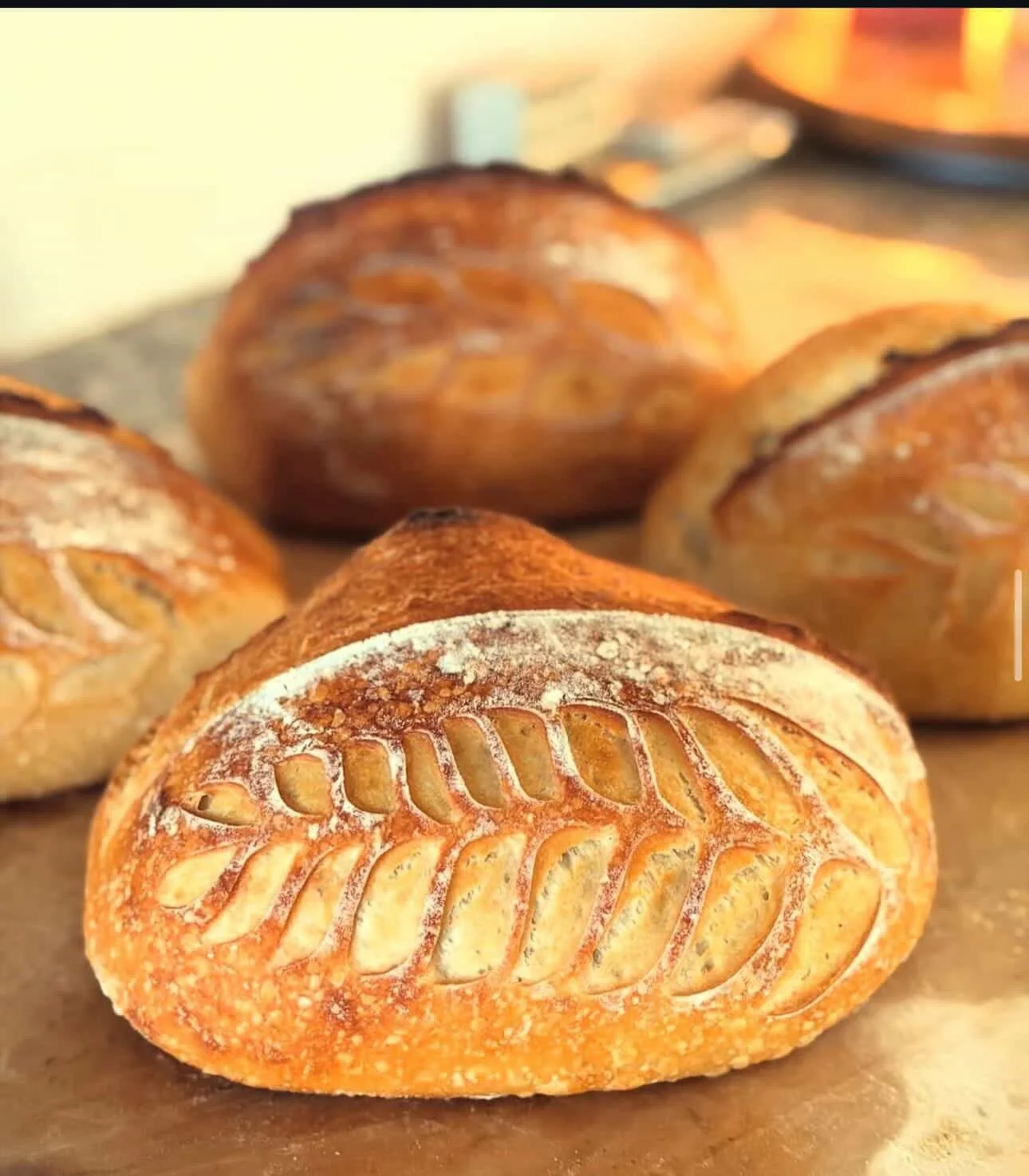
Taking Inventory
What Editing a Book Reminded Me About Editing a Life
By the time Finding Your Sourdough reaches the end of the editing process, my publisher and I will have gone through the manuscript more than seven times.
Seven complete passes.
More than three hundred pages.
Again.
And again.
And again.
At first, editing meant looking for the obvious things.
Grammar.
Punctuation.
Chronology.
A sentence that didn't quite work.
Then we went deeper.
Words I used too often.
Phrases that had quietly become habits.
Thoughts I had explained more than once.
Sentences that no longer needed the words surrounding them.
What should stay?
What should go?
What is essential?
What has already done its work?
Somewhere in the middle of all of this, I realized I had done this before.
Not with a manuscript.
With my life.
The Rooms
More than six years ago, I found myself sitting in the rooms of Alcoholics Anonymous.
Broken.
Exhausted.
Unrecognizable.
I didn't know the language yet.
I didn't know how to tell my story.
So in those early days, I mostly listened.
I sat quietly toward the back of the room and took it all in.
People spoke a language I was only beginning to understand.
They talked about surrender.
Acceptance.
Inventory.
Amends.
One day at a time.
They talked about showing up.
And slowly, I began learning.
I remember those first months working with my sponsor.
We went through the Big Book.
I learned about taking inventory.
Not an inventory of everyone else's behavior.
Mine.
That distinction mattered.
I began learning how to look honestly at my life.
What belonged to me?
What needed acknowledgment?
Where had I caused harm?
What patterns kept repeating?
What was I carrying that I needed to release?
What needed repair?
And what could no longer come with me if I wanted to live differently?
It wasn't comfortable work.
But it was honest work.
And honesty, I would learn, has a way of clearing space.
Seven Passes
All these years later, I am sitting with another kind of inventory.
My manuscript.
My publisher and I have gone through it over and over.
And this final pass has been particularly interesting.
I began noticing my habits.
Perhaps.
Maybe.
Looking back now.
There is something...
And apparently, everyone in my book smiles.
A lot.
But underneath the humor was something familiar.
Patterns.
Things I couldn't see until I was willing to look closely enough.
So I began taking inventory.
Does this sentence belong?
Does it serve the story?
Am I saying this because it needs to be said, or because I have become accustomed to saying it?
Am I explaining something the reader already understands?
Is this the truth?
And most importantly...
Am I willing to let something go simply because it no longer needs to be there?
That question felt familiar too.
What Stays
Editing has taught me that removing something doesn't mean it was wrong.
Some sentences belonged to an earlier version of the story.
Some thoughts needed more explanation when I first wrote them than they do now.
Some words helped me find my way to what I was really trying to say.
They weren't mistakes.
They were part of the process.
They simply didn't need to come with me into the finished book.
I think healing can work that way too.
There are things we carry because we needed them once.
Ways of protecting ourselves.
Ways of thinking.
Stories we told ourselves because they helped us survive a particular season.
Questions we asked repeatedly because we weren't ready for the answers.
They weren't necessarily wrong.
They simply may not belong in the next chapter.
Taking inventory asks us to notice the difference.
And Then, Of Course, There Is Sourdough
Somehow, I always end up back here.
Flour.
Water.
Starter.
Salt.
Sourdough has taught me that more isn't always better.
More water doesn't automatically make better bread.
More fermentation doesn't make better dough.
More handling doesn't improve a loaf simply because I keep touching it.
There comes a point when I have done what I can do.
Mix.
Fold.
Watch.
Learn.
Shape.
And then...
leave it alone.
That last part has taken me a while to learn.
There is a temptation, particularly when we care deeply about something, to keep working it.
One more adjustment.
One more fold.
One more edit.
One more pass.
Surely I can make it just a little better.
But eventually, continued handling stops improving the thing we love.
At some point, we have to trust the work.
The Inventory of a Life
I think that is what these final weeks with my manuscript have been reminding me.
Recovery taught me how to take inventory of my life.
Writing taught me how to take inventory of my story.
Sourdough taught me how to recognize when I have done enough.
All three require honesty.
All three require humility.
And all three eventually require surrender.
There are things worth keeping.
There are things worth changing.
There are things worth making right.
And there are things that have already taught us what they came to teach us.
Those can be released.
Not because they didn't matter.
Because they did.
They helped bring us here.
The Final Pass
Soon, I will send the manuscript back to my publisher.
And at some point, someone will tell me:
That's it.
No more edits.
No more rewriting.
No more moving sentences around.
No more wondering whether I used perhaps three times too many.
The book will have to leave my hands.
I think there is a lesson in that too.
We can spend our entire lives editing ourselves.
Revisiting.
Reconsidering.
Replaying.
Trying to perfect what has already happened.
But healing isn't perfection.
Neither is recovery.
Neither is writing.
Neither is bread.
They are practices of attention.
Of honesty.
Of learning.
Of showing up.
Every. Single. Day.
And then knowing when it is time to stop working yesterday's dough.
Take the inventory.
Make the correction.
Keep what is true.
Release what has finished its work.
And move forward.
I think that is what editing has been teaching me all along.
Not how to create a perfect book.
How to recognize when the story I have lived, examined, rewritten, and finally learned to accept...
is ready to be released.
Warmly,
Kathy
Art of The Crumb
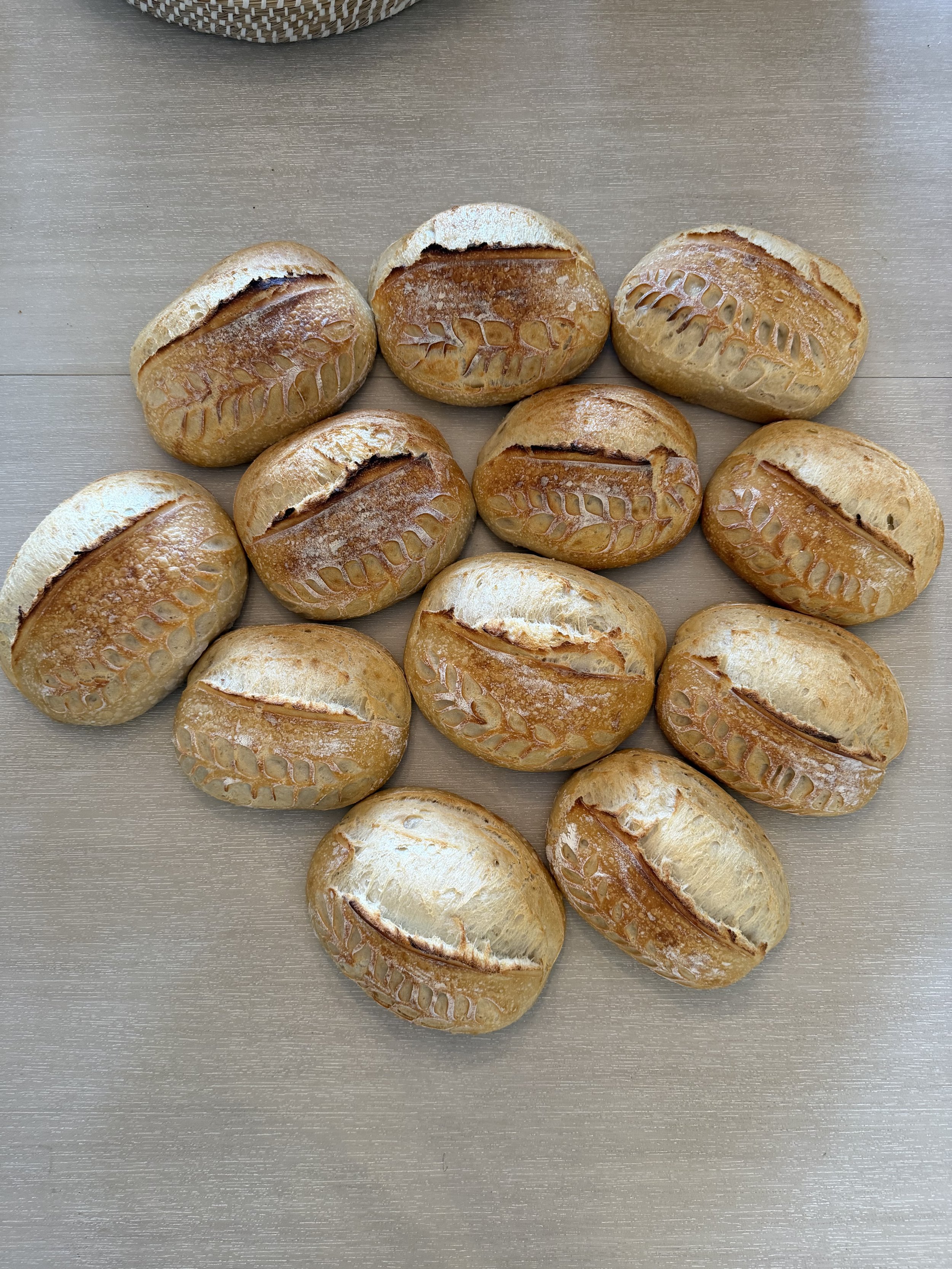
Remember Lot's Wife
What Sourdough Has Taught Me About Leaving Yesterday Behind
This morning, during the quiet routine that has become the foundation of my days, I found myself in the Book of Luke.
Coffee.
Scripture.
Prayer.
My journal nearby.
And then I came to three words spoken by Jesus in Luke 17:32.
“Remember Lot's wife.”
I read the words again.
And then I did what I do.
I asked a question.
What does that mean?
That question sent me into one of my investigative mornings. I went back to Genesis. I read about Lot and his family leaving Sodom. I returned to Luke. I read the surrounding verses. I followed references.
And eventually, as seems to happen so often these days, Scripture brought me back to something happening in my own life.
And somehow...
back to sourdough.
The Temptation to Look Back
I have been thinking a great deal lately about forgiveness.
Not forgiving others.
My own.
There are things in my past I deeply regret.
Choices I would make differently today.
Words I wish I hadn't spoken.
Things I wish I had done better.
I have confessed them.
I have asked God for forgiveness.
I believe I have been forgiven.
And yet...
every once in a while, something from the past finds its way back into my thoughts.
And I pick it up again.
Examine it.
Turn it over.
Replay it.
Sometimes I even find myself asking God to forgive me again for something I have already placed before Him.
That was what caught my attention this morning.
Why am I continuing to carry something I have already confessed?
Why am I asking God repeatedly for a mercy I believe He has already given?
Why do I keep turning around?
Remember Lot's Wife
Jesus' words in Luke weren't specifically a teaching about revisiting forgiven sins.
I want to be careful about that.
But those three words caused me to examine my own life.
Remember Lot's wife.
She was leaving.
But she looked back.
And this morning I found myself wondering about all the ways I still look backward.
Not because I want my old life back.
I don't.
Not because I haven't changed.
I have.
But perhaps because regret can convince us that continuing to punish ourselves is somehow evidence that we are truly sorry.
I'm beginning to understand that it isn't.
There is a difference between repentance and remaining imprisoned by regret.
One asks us to acknowledge what happened, confess it, learn from it, and change.
The other keeps asking us to return to the scene.
Again.
And again.
And again.
I don't believe God asks me to live there.
Mercy
First John tells us that when we confess our sins, God is faithful and just to forgive us and cleanse us.
And Lamentations reminds us that His mercies are new every morning.
New every morning.
I sat with those words today.
Mercy isn't something I earn by feeling badly long enough.
It isn't something I finally deserve after carrying enough shame.
And it doesn't expire because I woke up remembering something I wish I could change.
Mercy is received.
It could be that's the part I am still learning.
I know how to confess.
I know how to ask for forgiveness.
Maybe I am still learning how to receive it.
To believe that when I have placed something before God honestly, repented, and done what I can to make things right, I don't honor Him by continually dragging it back into today.
I can learn from yesterday without continuing to live there.
And Then, Of Course, There Was Bread
I thought about my dough.
Because apparently I can no longer contemplate anything important without eventually finding sourdough somewhere in the middle of it.
A loaf doesn't always turn out the way I hoped.
I've overproofed dough.
Underproofed it.
Missed fermentation.
Made mistakes with hydration.
Scored badly.
Burned crusts.
Produced loaves I wouldn't sell.
But once that bake is finished, it's finished.
I learn.
I pay attention.
I make adjustments.
And then...
I begin again.
Fresh flour.
Fresh water.
A living starter.
Another opportunity.
I don't take yesterday's failed loaf and put it back into the oven hoping somehow I can bake it differently.
That loaf has already taught me what it came to teach me.
My responsibility is to carry the lesson forward.
Not the loaf.
Maybe grace asks the same of me.
What Am I Carrying Into Today?
There is accountability in faith.
There is confession.
There is repentance.
There is making amends where we can.
There is change.
But there is also mercy.
I have started to recognize that receiving mercy means believing God when He says the past does not have to be carried into every new morning.
That doesn't erase what happened.
It doesn't excuse it.
It doesn't rewrite the story.
It means I allow what happened to teach me without allowing it to continue defining me.
That distinction feels important.
Because I cannot change yesterday.
But I can decide what I carry from it into today.
Wisdom?
Yes.
Humility?
Absolutely.
Responsibility?
Always.
Gratitude for forgiveness?
Every single day.
But shame?
I don't think I need to keep packing that bag.
New Every Morning
I think that is why those words from Lamentations feel so beautiful to me.
His mercies are new every morning.
Not because yesterday didn't happen.
Because today has.
Another morning.
Another prayer.
Another opportunity to live differently.
Another chance to show up.
Every. Single. Day.
I wonder if that’s what happened again this morning.
I opened my Bible and found three words spoken by Jesus.
“Remember Lot's wife.”
Three words that made me curious enough to ask a question.
That question led me back through Scripture, into my own life, and eventually, as it so often does, back to sourdough.
I am beginning to recognize this rhythm.
Scripture gives me the question.
My life gives me the experience.
Sourdough gives me the language.
And faith helps me hold all three together.
I am beginning to understand that is why flour and water continue to teach me things I never expected to learn in a kitchen.
Sourdough has taught me that yesterday's fermentation informs today's bake.
But it doesn't become today's bake.
I carry the knowledge forward.
Then I begin again.
That's what I am being asked to do with my own life.
Confess what needs confessing.
Learn what needs learning.
Make right what I can.
Receive the mercy.
And walk forward.
No need to keep turning around to prove I remember where I've been.
I remember.
God knows.
The lesson remains.
But so does His mercy.
And mercy has no expiration date.
This morning, I wrote three sentences in my journal that I think I want to carry with me:
Confess it.
Release it.
Walk in mercy.
Perhaps tomorrow morning I will need to remember them again.
That's okay.
Mercy will be waiting there too.
Warmly,
Kathy
Art of The Crumb
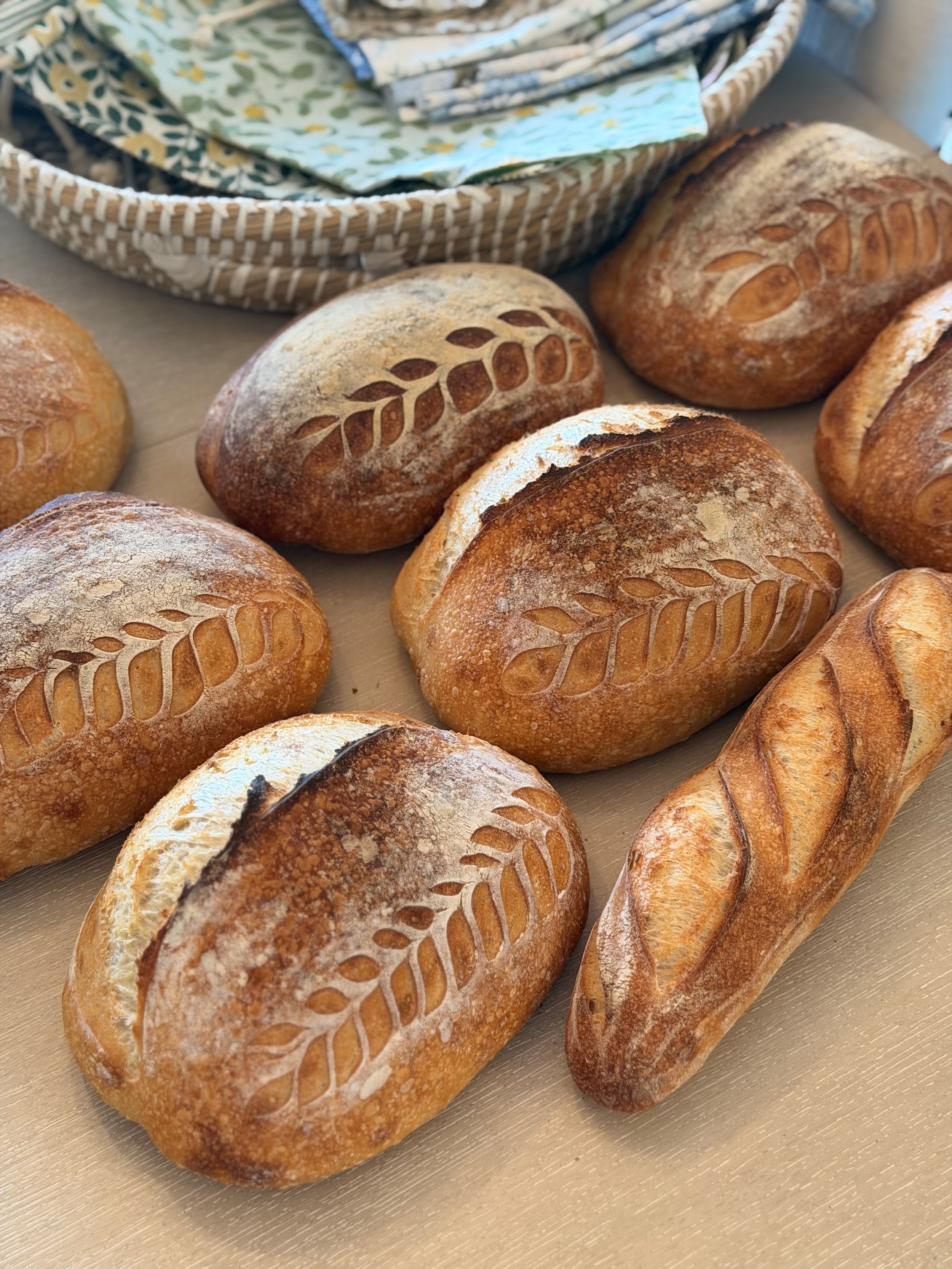
Fear of Being Alone
What Sourdough Has Taught Me About Accepting Solitude
The school bus started making its way through my neighborhood again this week.
I noticed it one morning while I was standing in my kitchen.
There was a time when the beginning of a school year dictated nearly everything.
School calendars.
Back-to-school shopping.
Sports schedules.
Practices.
Games.
Vacations carefully planned around school breaks.
Meals.
Appointments.
Graduations.
There was always somewhere someone needed to be.
I hear empty nesters talk often about the silence that arrives when that season ends.
The house changes.
The sounds of family no longer echo through the rooms.
There are no backpacks dropped by the door.
No practices to get to.
No school calendar sitting on the desk determining where everyone will be for the next nine months.
No dinner to plan around different schedules.
And eventually, there comes a realization.
The house is quiet.
I have been thinking about that lately.
Perhaps the school bus had something to do with it.
The Quiet
I have never really been afraid of being alone.
Maybe that's because, for most of my life, I wasn't.
I was someone's daughter.
Then someone's wife.
Then a mother raising four children.
There was always movement around me.
Always another person in the house.
Always another responsibility.
Always noise.
Today, my life looks very different.
I am sixty-five years old.
And for the first time in my life, I am truly, physically alone.
There is something interesting about finally being able to say that without attaching sadness to it.
Because I don't feel alone.
I live alone.
Those are not the same thing.
It has taken me some time to understand the difference.
Solitude
There was a time when I might have thought solitude meant absence.
Now I think it means space.
Space to listen.
Space to pray.
Space to think.
Space to notice.
Space to become comfortable with the sound of my own life.
My mornings are quiet.
I wake before the rest of the world seems to be moving.
I pray.
I read Scripture.
Sometimes I listen to the Word.
I journal.
I drink my coffee.
And somewhere nearby, there is usually a jar of sourdough starter quietly doing what sourdough starter does.
Living.
Changing.
Becoming.
There is something deeply comforting about that rhythm.
The Company of Bread
Sourdough is not loud work.
There are long stretches when nothing appears to be happening.
You feed the starter.
Then you wait.
You mix the dough.
Then you wait.
You fold it.
And wait again.
Fermentation asks for patience.
It also asks for presence.
You cannot rush it simply because you would prefer something to happen.
You learn to stay.
Perhaps that is one of the greatest things sourdough has taught me about solitude.
How to stay.
Not how to fill every quiet space.
Not how to distract myself from silence.
How to inhabit it.
There is a difference.
I don't need noise simply because the house is quiet.
I don't need another person in the room to make the room feel full.
I can stand at my kitchen counter with flour on my hands and dough beneath them and feel completely present in my own life.
That has been an unexpected gift.
Never Really Alone
My faith has deepened enormously during this season.
Perhaps solitude created room for that too.
There are fewer voices competing for my attention now.
And in the quiet, I have learned to listen differently.
My prayers have changed.
My relationship with God has changed.
Not because He suddenly appeared when the house became quiet.
God has been part of my life for as long as I can remember.
I simply hear Him differently now.
Maybe that's what solitude has given me.
Not God's presence.
An awareness of it.
That distinction matters to me.
Because when I say I am physically alone, I am not saying my life is empty.
Quite the opposite.
My life feels remarkably full.
There are customers who have become friends.
Friends who have become family.
People who gather around my market table.
Conversations that happen because someone came looking for a loaf of bread.
There is writing.
There is prayer.
There is service.
There is work I love.
There is God.
And yes...
There is bread.
Lots and lots of bread.
A Different Kind of Full
I think we sometimes measure the fullness of our lives by how many people are standing in the room.
I don't anymore.
A full life can also be a quiet one.
Perhaps especially so.
There is something beautiful about reaching a place where silence no longer needs to be filled.
Where an evening at home doesn't feel like something is missing.
Where solitude isn't something to escape.
It becomes something to receive.
I don't know whether I would have understood that twenty years ago.
I certainly wasn't living a life that allowed much room for it.
But this season has asked something different of me.
To stay.
To listen.
To trust.
To become comfortable in my own company.
To recognize God's presence without needing Him to announce Himself.
And once again, sourdough has become the unlikely teacher.
Feed.
Wait.
Watch.
Trust.
Stay.
Every. Single. Day.
Maybe that's what accepting solitude looks like for me.
Not learning how to be alone.
Learning that I never really was.
The house is quieter now.
The school bus comes and goes without anyone from this house climbing aboard.
There are no school calendars on my desk.
No practices to get to.
No back-to-school shopping waiting for me.
That season is complete.
And there is something beautiful about being able to honor it without wishing myself back into it.
Because another season arrived.
Quieter.
Slower in some ways.
Fuller in others.
And I am learning not to fear the quiet.
I am learning to live inside it.
To listen inside it.
To pray inside it.
To bake inside it.
And perhaps most importantly...
To recognize that solitude isn't the absence of a life.
It can be the place where we finally become fully present for the one we have.
Warmly,
Kathy
Art of The Crumb
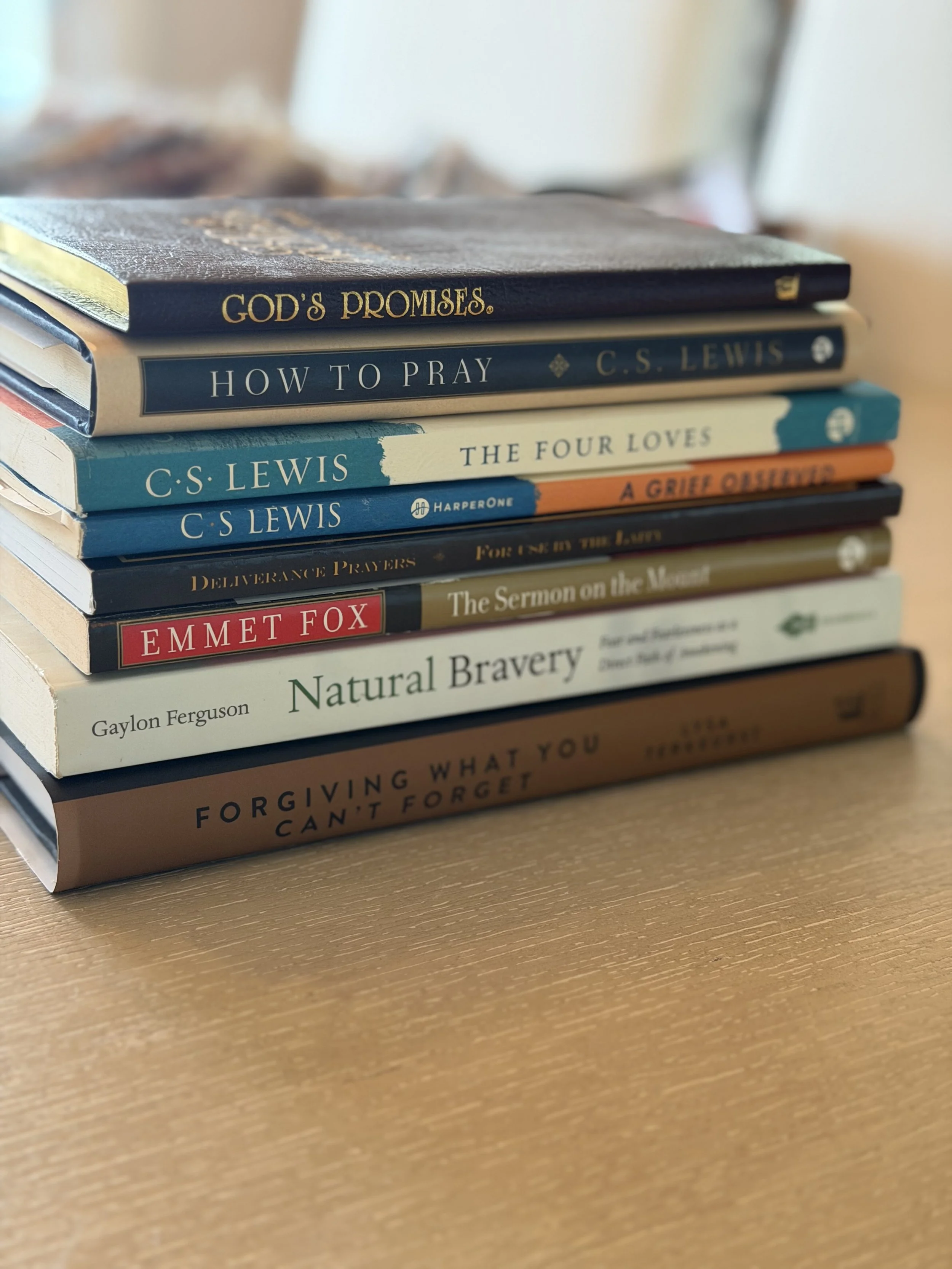
Same Book. Same Words. Different Woman.
The first story from The Bookshelf
Over the past several months, I have been asked more than once what I have been reading during this season of loss, grief, healing, faith, and beginning again.
It is a fair question.
Books have always been part of my life, and over the past few years there have been several that have found their way onto my desk, beside my Bible, into my morning reading, and sometimes back into my hands after decades of sitting quietly on a shelf.
So I had an idea.
I would create a page on my website called The Bookshelf.
Simple enough.
I began gathering the books.
C. S. Lewis.
Emmet Fox.
Lysa TerKeurst.
Gaylon Ferguson.
Books about prayer.
Grief.
Forgiveness.
Courage.
Faith.
I thought I would photograph the covers, write a few sentences about each one, arrange them neatly on a page, and share them with anyone who might be interested.
But as I began pulling the books from my shelves, something happened.
I remembered their stories.
Not the stories inside the books.
The stories of how they came to me.
And suddenly, a list didn't feel like enough.
Because each of these books belongs to a particular season of my life.
Some found me when I was grieving.
Some during the early days of sobriety.
Some challenged my understanding of forgiveness.
Others deepened my relationship with prayer.
And a few have been quietly traveling with me for much longer than I realized.
So The Bookshelf is going to become something different.
From time to time, I am going to take one of these books down from the shelf and tell you its story.
Not a review.
Not necessarily a recommendation.
Simply where I was when the book found me, why it mattered, and what remained after I closed it.
And it seems only fitting that I begin with a book that has somehow been traveling with me for most of my adult life.
The Sermon on the Mount by Emmet Fox.
The First Time the Word Moved Me
I first read The Sermon on the Mount as required reading in one of my religious studies courses at Santa Clara University, the Jesuit university I attended in California.
At the time, it was simply another book on a college reading list.
Or so I thought.
I was taking a Bible as Literature class, and I remember the first time we read the Sermon on the Mount from the Bible.
I cried.
Not because I was sad.
Not because something terrible had happened.
I was simply overcome with emotion.
I had known God throughout my life. Faith wasn't foreign to me. Scripture wasn't something I was encountering for the first time.
But this felt different.
The words seemed to move beyond something I was studying and reach somewhere much deeper within me.
And I didn't understand why.
So I did what I have apparently been doing for most of my life when I don't understand something.
I asked.
I reached out to my professor and asked him why reading those words had moved me to tears.
He gave me a word.
Compunction.
He explained it to me as a deep stirring of the heart when we encounter spiritual truth.
I don't remember every word of that conversation.
But I remember that word.
And I remember the tears.
It was the first time in my life that I can remember not simply reading the Word...
but feeling it.
I loved Emmet Fox's book then.
And somehow, I kept it.
The Book That Waited
Years passed.
A lot of them.
Life unfolded in ways that a young college student could never possibly have imagined.
Marriage.
Motherhood.
Moves across the country.
Loss.
Grief.
Change.
And somewhere along the way, my copy of The Sermon on the Mount found its way into a box in my garage.
I didn't throw it away.
I didn't intentionally preserve it either.
It was simply there.
Waiting.
During the early days of my sobriety, someone mentioned Emmet Fox during an AA meeting.
I remember thinking,
I know that book.
And even after all those years, I knew I still had it.
So I went looking.
Somewhere among the boxes containing pieces of another life, I found my original copy.
The same book I had held in my hands as a college student.
I dusted it off.
And I began reading it again.
There was something deeply moving about that moment, although I don't think I fully understood it at the time.
The young woman who had first opened those pages could never have known the life ahead of her.
She couldn't have known the joy.
She couldn't have known the heartbreak.
She couldn't have known the mistakes she would make.
She couldn't have known the losses she would endure.
And she certainly couldn't have known that decades later, newly sober and beginning again, she would go searching through boxes in a garage for the very same book.
But there it was.
Waiting for her.
The Words Hadn't Changed
That book moved from the garage into my office.
It has remained there ever since.
And now, in this season of my life, I find myself reaching for it again.
What strikes me most is that the words haven't changed.
I have.
Perhaps that is one of the extraordinary things about returning to a book years later.
We think we're rereading the same thing.
We're not.
Because the person doing the reading is no longer the same person who first opened the cover.
I read those words now through the lens of sixty-five years of living.
Through sobriety.
Through grief.
Through healing.
Through loss.
Through forgiveness.
Through prayer.
Through a relationship with God that has become deeper, quieter, and more intimate than the young woman sitting in that college classroom could have understood.
And yet...
I think of her sometimes.
That young woman who unexpectedly cried when she encountered the Word and then went to her professor because she wanted to understand why.
Maybe she understood more than I give her credit for.
Maybe she didn't need to understand at all.
Maybe something had simply been planted.
A seed.
And perhaps some seeds take decades before we recognize what has been growing.
Still on the Shelf
There is something comforting to me about knowing that this book has survived so many versions of my life.
It didn't remain prominently displayed on a beautiful bookshelf.
For years, I wasn't even reading it.
It sat in a box.
In a garage.
Quietly waiting.
Until one day, in an AA meeting, someone said its name.
And I remembered.
I find that beautiful.
Because perhaps that's how so much of faith has worked in my own life.
God was never absent.
There were simply seasons when I wasn't paying as much attention.
Then something would happen.
A word.
A person.
A prayer.
A book mentioned unexpectedly in a room.
And I would remember.
Oh yes.
I know this.
I've been here before.
Maybe that is why The Sermon on the Mount feels like the right place to begin The Bookshelf.
It reminds me that not everything we gather along the way is meant only for the season in which we first receive it.
Some things travel with us.
Some wait for us.
And some return when we're finally ready to hear them differently.
This book did all three.
Same book.
Same words.
Different woman.
And somehow, after all these years...
it is still teaching me.
Warmly,
Kathy
Art of The Crumb
My Testimony
God Was There All Along
Yesterday, a pastor asked me for my testimony.
My testimony.
I paused.
Perhaps it was because the question came from a man of faith, someone who has known me through another season of my life, that the words carried a little more weight.
No one had ever asked me that before.
At first, I wasn't even entirely certain what he meant.
Then I sat with it.
I have written so much over this past year about faith, sobriety, healing, bread, prayer, grace, and beginning again that, in many ways, I suppose I have been writing my testimony all along.
Just in pieces.
A loaf here.
A prayer there.
A farmers market morning.
A broken oven.
A conversation with a stranger.
A stone gathered along the way.
Evidence of grace.
But when a pastor looks at the life you are living and asks you directly for your testimony, there is something about the question that makes you stop.
It made me ask myself...
What is my testimony?
I knew immediately what it wasn't.
There was no grand moment when I collapsed at the feet of God and suddenly discovered Him.
I didn't find God.
God has been part of my life for as long as I can remember.
Faith was woven into my childhood. Prayer was familiar. God was never an abstract idea I encountered after my life became difficult.
He was already there.
What has changed is me.
And perhaps more importantly, my relationship with Him.
It has deepened slowly.
Quietly.
Over time.
That is why I think of my faith as fluid.
Not uncertain.
Fluid.
Moving.
Deepening.
Changing shape as I have changed.
There have been seasons when I held tightly to God and seasons when I wandered farther from Him.
There were years when my prayers were mostly requests.
Please fix this.
Please change that.
Please give me the answer I want.
I think many of us begin there.
Then life happened.
Loss happened.
Grief happened.
My life changed in ways I never anticipated.
And eventually, sobriety happened.
Something began changing in my prayer life.
My prayers became less about asking God to change my circumstances and more about asking Him to change me.
Give me wisdom.
Give me discernment.
Keep me humble.
Show me where You want me.
Help me recognize what is mine to carry and what isn't.
Help me remain faithful.
And every morning, before anything else has the opportunity to enter my thoughts, I begin with gratitude.
Thank You, God, for another day of sobriety.
That prayer has become the foundation beneath everything else.
Not because sobriety is the entirety of my story.
Because sobriety gave me the clarity to begin seeing my story differently.
I began noticing.
That may be one of the greatest changes of all.
I started paying attention to the quiet ways God had been present all along.
Not necessarily in enormous miracles.
In ordinary moments.
People who appeared when I needed them.
Doors that opened.
Doors that remained firmly closed.
Prayers that were answered.
And prayers that weren't.
There was a time when an unanswered prayer felt like God's absence.
Today, I understand it differently.
Sometimes what has been withheld from me has carried as much grace as what has been given.
And then...
There was sourdough.
Even writing that makes me smile.
Because if someone had told me several years ago that flour and water would become part of my testimony, I probably would have laughed.
I didn't begin making sourdough because I was searching for God.
I began because I wanted to learn something new.
But something happened in the repetition.
Feed.
Wait.
Watch.
Learn.
Try again.
There was no rushing it.
No forcing it.
No pretending.
The dough told the truth every single time.
Slowly, the practice became grounding.
The grounding became healing.
The healing became purpose.
And what began as a jar of flour and water eventually became Art of The Crumb.
Then something else happened that I never anticipated.
People began gathering around the bread.
At first, they were customers.
Then they became familiar faces.
Then conversations began.
Stories were shared across my market table.
People came back.
Relationships formed.
Bread was donated.
People were fed.
And somewhere along the way, I began to understand that perhaps the bread wasn't the whole story.
Yesterday, that same pastor, someone who has known me through a very different season of my life, told me that he believes God gave me this bakery as a ministry.
I would never have called it that myself.
Even now, I hesitate.
Not because I don't believe God is present in this work.
Because the word feels much larger than anything I would ever claim for myself.
But he named something he sees.
And I chose to receive it.
Not as a title.
As a gift.
A God Wink.
A reminder that sometimes other people can see something unfolding in our lives before we have language for it ourselves.
And the timing mattered.
Because only hours earlier, I had climbed into my car after a difficult farmers market and said,
"I don't know if this is worth it."
I was exhausted.
The heat and humidity had taken everything out of me.
The market had been slow.
The energy felt different.
For a moment, I questioned the whole thing.
Then I came home.
And there was his message.
He didn't know what I had said in the car.
He didn't know what kind of morning I had experienced.
He simply told me what he saw.
I don't need to make more of that moment than I know to be true.
But I can receive it for what it meant to me.
Encouragement.
Confirmation.
Grace arriving on a day when I needed a little extra.
Another stone.
Perhaps that is my testimony.
Not one enormous moment.
Thousands of small ones.
A lifetime of God being present and a woman gradually learning how to notice.
I used to think faith was about having certainty.
Today, I think mine has become much more about trust.
Trusting when I understand.
Trusting when I don't.
Trusting the answered prayer.
Trusting the silence.
Trusting the open door.
Trusting the closed one.
Trusting this season without demanding to know what the next one will hold.
My relationship with God is stronger today than it has ever been.
Not because life has become easier.
Not because every prayer has been answered.
Not because I have figured everything out.
Quite the opposite.
I have become increasingly comfortable saying,
I don't know.
And increasingly peaceful adding,
But I trust You.
Maybe that's what all of this has been about.
The bread.
The bakery.
The writing.
The sobriety.
The people.
The stones.
The seasons.
The grace.
I thought I was learning how to make bread.
I didn't realize God was using bread to remake me.
And perhaps the most beautiful part of my testimony is that it isn't finished.
I don't know where Art of The Crumb is going.
I don't know what will happen with the book I've written.
I don't know what the next season will ask of me.
For once in my life, I don't need to.
I only need to remain faithful to the one I'm standing in.
So if someone asks me today for my testimony, perhaps this is my answer:
I didn't find God.
I began to recognize how faithfully He had been there all along.
And every day, I am still learning to notice.
Warmly,
Kathy
Art of The Crumb
The Four Seasons
What Sourdough Has Taught Me About Trusting the Next Season
This morning, during prayer, my thoughts wandered somewhere unexpected.
The seasons.
I couldn't quite explain why.
Perhaps it was because August has a way of whispering that summer won't last forever.
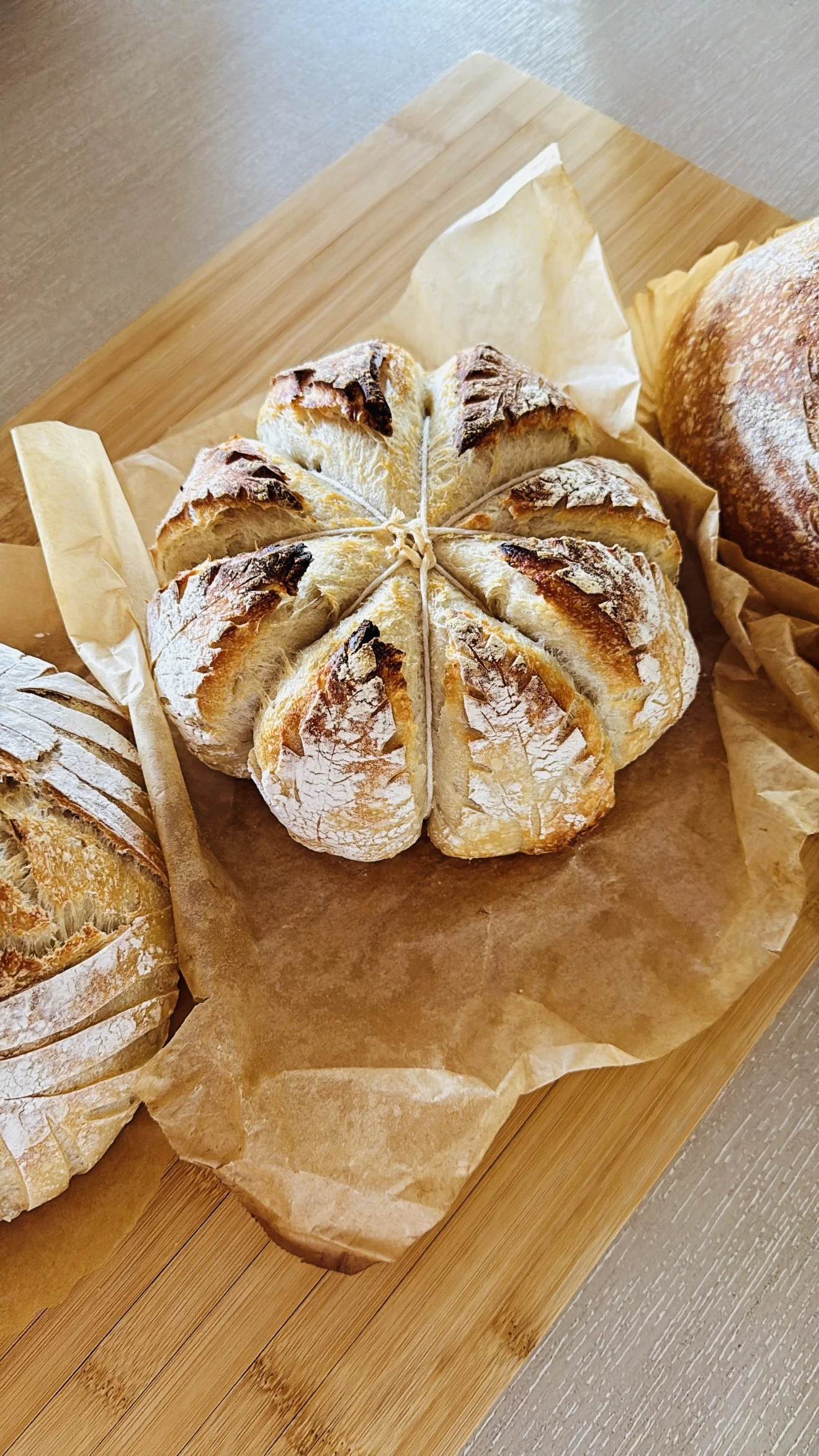
Perhaps it was because I caught myself thinking about cooler mornings, changing leaves, pumpkin-shaped loaves, and the quiet anticipation that always seems to arrive before autumn itself.
I've always loved the changing of the seasons.
There is something deeply comforting about them.
Not because I hurry through one to reach the next.
Quite the opposite.
Each season seems to know exactly when its work is finished.
Spring quietly gives way to summer.
Summer slowly loosens its grip as autumn arrives.
Autumn never clings to its leaves.
Winter never apologizes for its stillness.
There is a rhythm to creation that never seems anxious.
Nothing rushes.
Nothing forces itself.
Nothing fears what comes next.
As I sat with those thoughts this morning, I found myself wondering...
Why does all of this remind me of sourdough?
I smiled.
Because, of course it does.
Sourdough has been teaching me about the seasons from the very beginning.
Not the seasons outside my kitchen window.
The seasons inside my life.
Every loaf begins with a feeding.
Then waiting.
Then quiet fermentation.
Expansion.
Rest.
Shaping.
Another rest.
Finally...
The heat of the oven.
Every stage prepares the dough for the next.
None of them can be skipped.
The dough never argues with the process.
It simply becomes what it was created to become.
Creation works the same way.
So do we.
As I thought about my own life, I realized how many seasons have quietly shaped me.
There was the season of being my father's little girl, following him from swim meet to swim meet every summer.
The season of becoming a wife.
Then a mother.
The season of losing myself.
The season of addiction.
The season of grief.
The season of beginning again.
The season of discovering sourdough.
The season of opening a bakery.
The season of writing a book.
None of those seasons lasted forever.
None of them were wasted.
Each one carried something I would need for the one that followed.
Perhaps that is why I find such comfort in autumn.
Autumn has never struck me as a season of endings.
It has always felt like a season of trust.
The trees don't mourn every leaf that falls.
They simply let go.
Not because they are dying.
Because they know another season is coming.
There is such wisdom in that.
I wonder how much of our anxiety comes from resisting the season we are standing in.
We want spring while we're still in winter.
We long for harvest while we're still planting.
We want certainty while God is still teaching us trust.
Sourdough has never allowed me to rush.
The dough is ready when it is ready.
No amount of impatience changes that.
The seasons don't hurry either.
Neither does grace.
Lately, I've been thinking about how much of my life has been spent asking,
"What's next?"
Perhaps there is a better question.
"What is this season asking of me?"
Those are very different prayers.
One looks ahead.
The other pays attention.
I think God has been teaching me the second.
This season has asked me to bake.
To write.
To rest.
To pay attention.
To gather evidence of grace.
To remain teachable.
To celebrate other people's successes without comparing them to my own.
To trust that the work He has given me today is enough for today.
And somehow...
Sourdough has become the classroom where I keep learning those lessons.
I used to think I was simply learning how to bake bread.
Now I wonder if bread has quietly been teaching me how to live.
Maybe that's why the changing of the seasons feels so deeply familiar.
They remind me that life was never meant to be lived all at once.
Only one season at a time.
Only one loaf at a time.
Only one faithful day at a time.
And perhaps that is where peace has been waiting all along.
Not in arriving.
But in learning to love the season I have been given.
Warmly,
Kathy
Art of The Crumb
The Trap of Comparison
Learning to stay in my own lane.
Comparison has been part of my life for as long as I can remember.
I suppose that's true for most of us.
As children, we compare grades.
As teenagers, we compare friendships, sports, clothes, and accomplishments.
As adults, we compare careers, homes, vacations, families, and sometimes even our happiness.
It seems to be woven into the human experience.
The interesting thing is...
For much of my life, comparison felt healthy.
I grew up in competitive sports.
Swimming was my first love.
I was six years old when I began, and my dad was my coach.
Every summer we packed up towels, goggles, and coolers and traveled from one town to the next for swim meets. Some of my happiest childhood memories were made sitting beside a pool waiting for my next event.
Competition had purpose.
The clock didn't lie.
You either swam faster than you did last week...
Or you didn't.
As I grew older, swimming gave way to track, badminton, and eventually tennis in high school. I continued playing through college on a club team, simply because I loved the game.
Competition became familiar.
Comfortable, even.
It challenged me.
It taught me discipline.
It taught me resilience.
There was something healthy about measuring my progress against a standard that asked me to become better than I had been yesterday.
School was much the same.
I wasn't the student collecting every academic award.
I was average.
But I worked hard.
My dad never asked me to be perfect.
He asked me to do my best.
Sometimes even a little better than I thought I could.
He held the bar high.
When I reached it...
He quietly raised it again.
I understand now that he wasn't teaching me to compete with other people.
He was teaching me to compete with the person I had been yesterday.
Somewhere along the way, though...
The comparison changed.
It quietly slipped out of the swimming pool and into everyday life.
The nicer house.
The newer car.
The neighborhood.
The schools.
As a young mother, I found myself wondering if I was making all the right decisions.
Were my children attending the best schools?
Was I giving them every possible opportunity?
Was I doing enough?
Those questions rarely brought peace.
They usually brought pressure.
Then life did what life often does.
It humbled me.
Today, at sixty-five years old, I find myself beginning again.
This season looks very different.
The comparison trap still exists.
It has simply changed its address.
Now it lives on social media.
It waits inside beautiful photographs of perfectly scored loaves.
It quietly whispers while I watch talented bakers from around the world.
I saw it at Proof Bread.
I see it at farmers markets.
I see it every time another baker creates something beautiful.
The temptation is always the same.
Am I enough?
It is such a subtle question.
It doesn't sound prideful.
It sounds honest.
But I have learned it is rarely helpful.
Because once I begin measuring my worth against someone else's gifts, I have already stepped out of my own lane.
That is where comparison quietly steals joy.
Not because someone else is succeeding.
Because I have stopped noticing my own blessings.
So these days, when I catch myself slipping toward that familiar trap, I pause.
I have learned to interrupt my own thoughts.
Instead of asking whether I measure up...
I choose something different.
"Good for them."
"Those loaves are beautiful."
"They are incredibly talented."
"I'm so happy for them."
Something remarkable happens when I sincerely celebrate another person's success.
Comparison begins to lose its grip.
Gratitude quietly takes its place.
Then, as I have come to do so often, I pray.
Not for more customers.
Not for better bread.
Not for greater recognition.
I simply ask God to keep my heart in alignment.
To remind me that He has never asked me to become someone else.
He has only asked me to faithfully become myself.
That prayer changes everything.
Because the truth is...
There will always be someone baking more loaves.
Scoring more beautifully.
Selling more bread.
Writing better.
Growing faster.
There will also always be someone just beginning.
Comparison doesn't end when we reach a certain milestone.
It simply moves the finish line.
Gratitude, however...
Gratitude allows us to stop running someone else's race.
I think that's one of the greatest gifts sobriety has given me.
A clear lens.
The ability to recognize when my thoughts have wandered somewhere they were never meant to go.
When they do...
I gently bring them home.
Back to gratitude.
Back to prayer.
Back to the work that has been placed in front of me.
Because I have come to believe that comparison doesn't simply distract us.
It takes us out of alignment.
And when I step out of alignment, I stop hearing the quiet voice that has faithfully guided me all along.
So these days...
I stay in my lane.
I bake my bread.
I write my stories.
I celebrate the success of others.
And then I quietly return to the life God has asked me to live.
It turns out...
That has always been more than enough.
Warmly,
Kathy
Art of The Crumb
The Question I Didn't Know How to Answer
Sometimes the best things I've made began with the words, "I don't know."
This morning, as I sat with my coffee, Scripture, and journal, my thoughts wandered to a question I was asked at market many months ago.
It wasn't a question about sourdough.
It wasn't about hydration.
Or fermentation.
Or even baking.
A customer was standing at my table purchasing a loaf of bread when she looked up and asked,
"How do I store the bread?"
I smiled.
Then answered as honestly as I could.
"I don't know...but I'll find out."
I've come to appreciate those words.
There was a time in my life when I thought I should have all the answers.
Now, I think there is something deeply freeing about simply saying,
"I don't know."
Not because the conversation ends there.
Because curiosity begins there.
So I went home and did what has become a familiar rhythm for me.
I started learning.
I researched the best way to store fresh sourdough bread.
I read article after article.
Watched video after video.
Somewhere along the way, YouTube introduced me to something I had never heard of before.
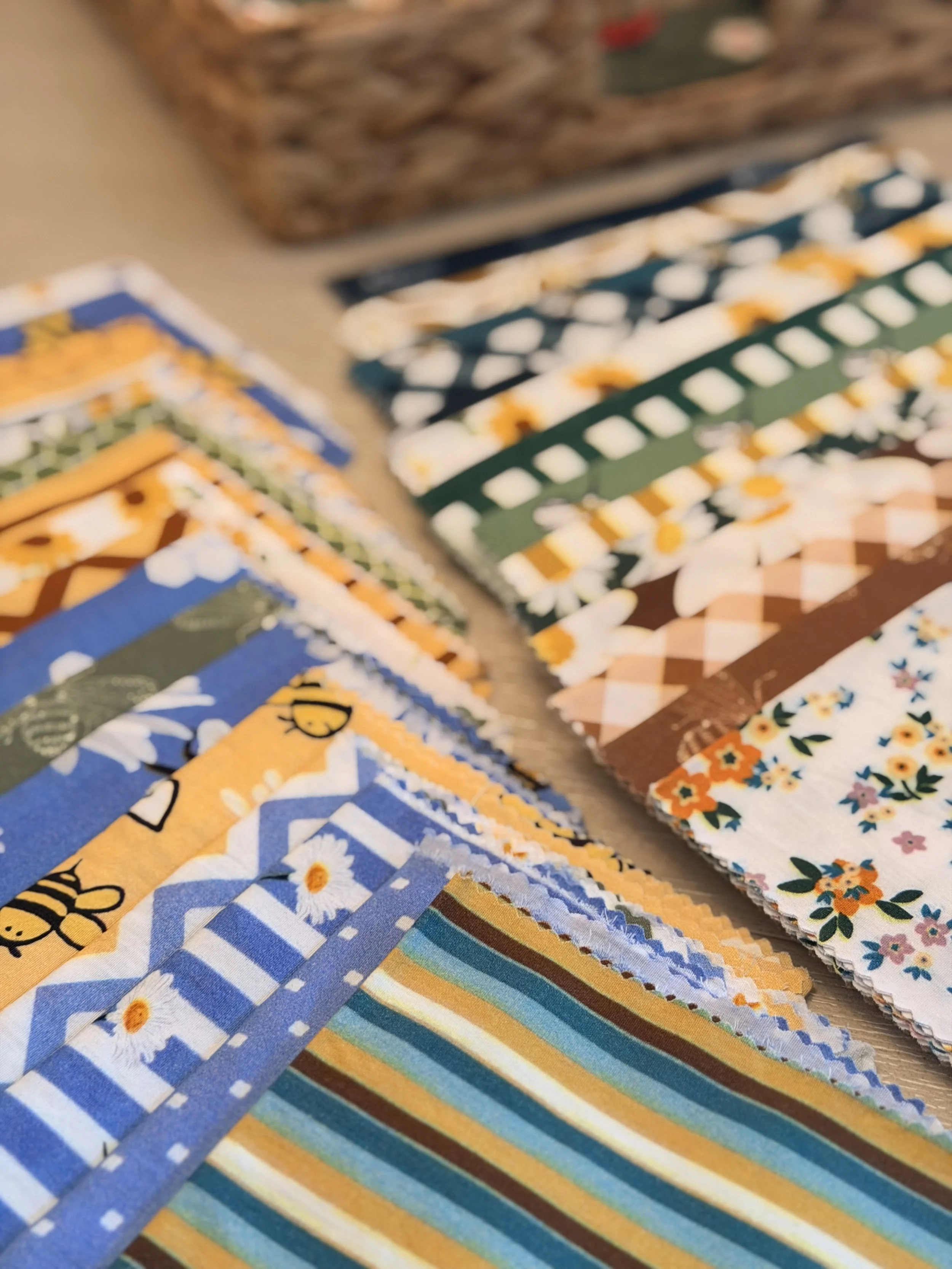
Beeswax bread bags.
That one question quietly led me down another rabbit hole.
Soon I found myself watching hours of videos, learning how to make them.
I drove to the craft store and bought fabric.
I cut pieces that weren't quite right.
I melted beeswax.
Pressed.
Folded.
Tried again.
Like sourdough, they didn't become beautiful the first time.
Or the second.
But little by little, I learned.
Today, those same bags have become one of my favorite things on my market table.
Not because I planned it.
Because a customer asked a question I couldn't answer.
One of the sweetest surprises has been hearing people come back the following week and say,
"Oh my gosh...you were right."
"I kept one of your loaves in the bag for a week, and it never grew stale or moldy."
Every single time someone tells me that, I smile.
Not because I made the bag.
Because I was able to help someone enjoy their bread just a little longer.
Then something else began happening.
People would pick one up, look at it for a moment, and ask,
"You make these?"
I still love that question.
I usually grab one, turn it inside out, and show them exactly how it's made.
There isn't much mystery.
Just cotton fabric, beeswax, and a little patience.
I think people enjoy seeing the inside as much as the outside.
Perhaps because handmade things carry a story.
Then there are the moments I never expected.
Someone walks past my booth.
They aren't looking at the bread.
They're looking at the bags.
They stop.
Turn around.
Walk back.
Then ask, almost excitedly,
"Are these what I think they are?"
"Are these beeswax bread bags?"
"I've been looking everywhere for these!"
Imagine that.
Someone comes to market looking for a beeswax bread bag...
And leaves with a loaf of sourdough.
There is one little detail I especially love.
I purchase my beeswax pellets from an apiarist in Kentucky.
While learning about beeswax, I discovered something fascinating.
If bees spend their days gathering nectar from fields of lavender, the wax can sometimes carry the gentle fragrance of lavender.
As beautiful as that sounds, I intentionally choose unscented beeswax.
These bags are meant to hold fresh bread.
When someone opens one, I want the first thing they smell to be sourdough.
Not perfume.
The beeswax does something remarkable.
It creates a breathable barrier around the bread.
It helps regulate moisture instead of trapping it, allowing the loaf to keep the crisp crust and tender crumb that make fresh sourdough so special.
Simple.
Natural.
Effective.
As I thought about all of this, it occurred to me that those bags have become one of the greatest surprises of my bakery.
Not the bags themselves.
The way they came to be.
They were never part of the plan.
They were born from one customer's question.
I think about that a lot.
How many beautiful things in our lives begin because we are willing to admit we don't know something?
How many unexpected gifts are waiting just beyond our curiosity?
If that customer had never asked me how to store bread...
I never would have learned how to make beeswax bread bags.
Sometimes the things we become known for are the very things we never intended to create.
They begin with a question.
A willingness to learn.
And the quiet decision to keep saying,
"I don't know...but I'll find out."
Warmly,
Kathy
Art of The Crumb
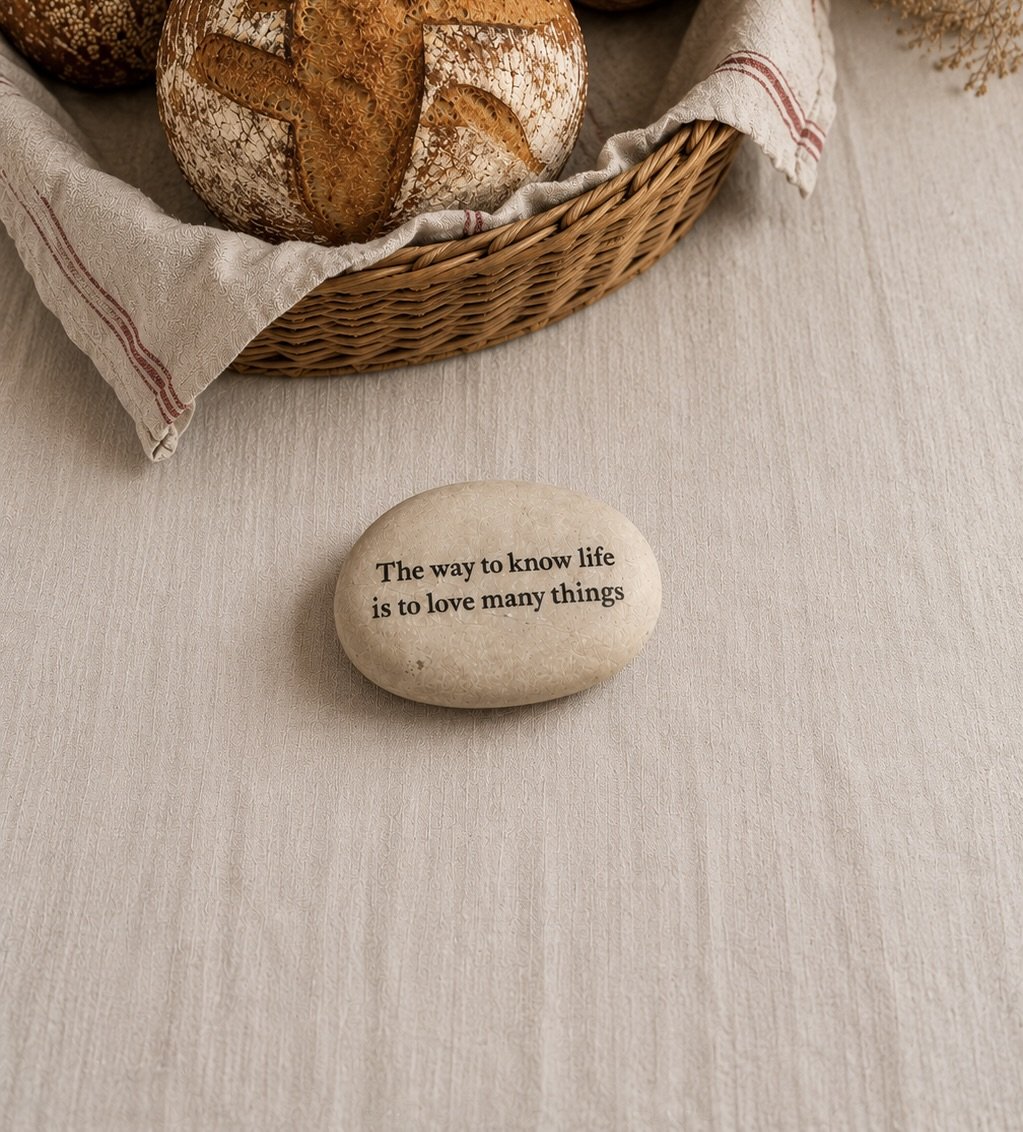
I Don't Write From the Wound
I Write Through It.
When I was finishing my manuscript, I found myself reflecting on all of the stories I had chosen not to tell.
Not because they weren't true.
Some of them shaped my life in profound ways.
Not because they didn't hurt.
Some of them still do.
I chose not to tell them because, over and over again, I returned to one simple question.
Will this serve the reader?
If the answer was yes, the story stayed.
If it existed only to explain myself, defend myself, or convince someone else that my pain was justified...
I let it go.
That wasn't easy.
There is a part of all of us that wants to be understood.
A part that wants someone to hear the whole story and finally say,
"Now I understand."
I don't think that desire is wrong.
I think it's deeply human.
But somewhere along the way, I realized something.
I don't write from the wound.
I write through it.
There is a difference.
Writing from the wound often asks the reader to carry our pain.
Writing through the wound offers them hope that healing is possible.
That realization changed not only my writing.
It changed my life.
For years, I gathered evidence of disappointment.
The prayers that weren't answered the way I hoped.
The relationships that changed.
The dreams that quietly came to an end.
The words that wounded me.
The losses I never expected.
Those stones were real.
I don't pretend they weren't.
Healing has never asked me to deny what happened.
Healing has asked me something much more difficult.
What will I choose to gather now?
I can continue building memorials to disappointment.
Or...
I can begin gathering evidence of grace.
That isn't denial.
It isn't pretending painful things never happened.
It isn't choosing selective memory.
It is choosing where I will build my life.
Every morning, I still have that choice.
I can rehearse the conversations that hurt me.
Or I can remember the kindness that found me.
I can count what has been lost.
Or I can give thanks for what remains.
I can gather stones of resentment.
Or I can gather stones of remembrance.
I choose grace.
Not because bitterness wouldn't be understandable.
Because grace has given me life.
The older I become, the more convinced I am that we all become collectors.
Some of us collect evidence that the world cannot be trusted.
Some collect evidence that people will always disappoint us.
Some collect evidence that life has been unfair.
I understand that impulse.
I have lived it.
But today...
I choose to gather evidence of grace.
The stranger who became a friend.
The customer who returned.
The loaf that taught me patience.
The prayer that was answered.
The prayer that was lovingly withheld.
The ordinary morning that quietly reminded me God was still present.
Those are the stones I want to leave behind.
Not because they tell the whole story.
Because they tell the truest one.
I no longer believe my life is defined by the deepest wound I have experienced.
I believe it is being shaped by the grace I have chosen to receive.
That doesn't erase the wound.
It transforms what grows around it.
Perhaps that is what healing has always been.
Not forgetting.
Not denying.
Not pretending.
But choosing, one ordinary day at a time, to build a life where grace has the final word.
Warmly,
Kathy VandenBerghe
Art of The Crumb
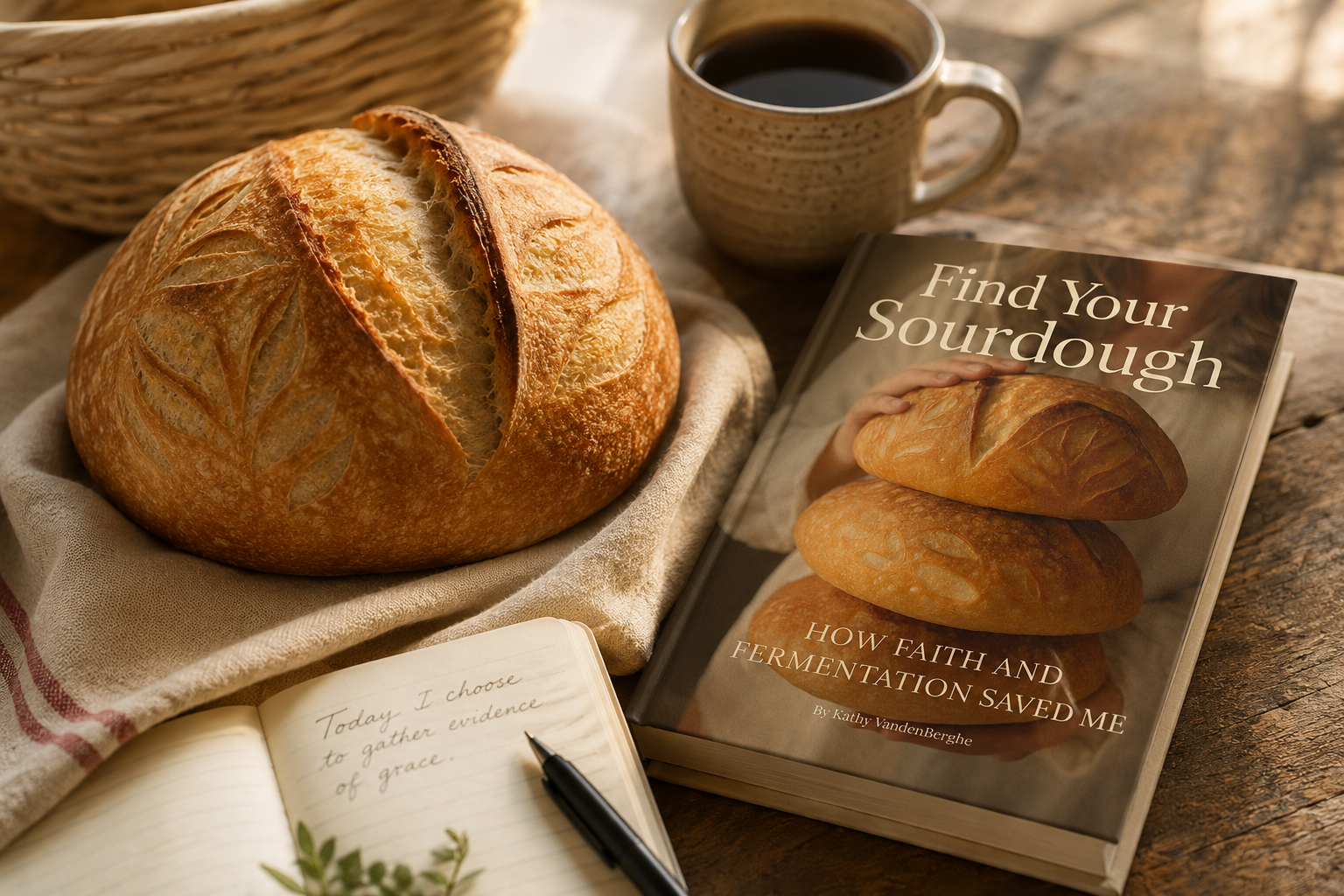
When the Book Became Enough
Trusting the Story God Asked Me to Tell
The manuscript is now in the hands of my publisher.
Those words still feel surreal to write.
For months, my world has been measured in chapters, paragraphs, and quiet mornings spent reading the same pages over and over again. I have lived inside this story. I have questioned sentences, moved paragraphs, deleted words I loved, and rewritten passages that, only days before, I thought were finished.
At some point, though, I realized something.
There comes a moment when editing stops serving the story and begins serving our fear.
A writer could always begin again.
There is always another sentence to polish. Another chapter to rethink. Another memory to include. Another way to say the same thing. If we aren't careful, we can spend the rest of our lives trying to write the perfect book instead of releasing the honest one.
I think that's a trap.
Eventually, every writer has to make peace with the words that remain on the page and trust that they are enough.
Not perfect.
Enough.
As I made my final pass through the manuscript, one question quietly stayed with me.
Will readers be put off by how often I mention God?
It's an honest question.
The answer is probably yes.
Some readers will.
And strangely enough, I found peace with that.
Not because I want to exclude anyone.
Quite the opposite.
Because this book is a memoir.
A memoir is not an argument.
It is not a sermon.
It is not an attempt to persuade someone to see the world exactly as I do.
A memoir is one person telling the truth about their own life as honestly as they know how.
To remove God from these pages simply because someone might disagree with my faith would not have made this a more accessible book.
It would have made it a less truthful one.
My faith is not something I added to the story.
It is the lens through which I lived it.
The prayers were real.
The unanswered prayers were real.
The moments of gratitude were real.
The quiet ways I came to recognize God's presence in ordinary life were real.
If I had edited those things away, I wouldn't have been editing a manuscript.
I would have been editing my life.
That realization settled something inside me.
This book has never been about convincing anyone to believe what I believe.
It has always been an invitation.
An invitation to slow down.
To pay attention.
To notice the quiet moments we often overlook.
To consider that healing rarely arrives all at once.
To recognize that some of the most meaningful transformations happen so gradually we only see them when we look back.
You may read these pages and call that grace.
Someone else may call it healing.
Another person may simply recognize the beauty hidden inside ordinary life.
I have learned that invitations leave room for people to arrive from different places.
That feels right to me.
Will there be critics?
Of course.
Every book has them.
Every story does.
Not every reader will connect with my writing, my perspective, or my faith.
And that's okay.
This book was never meant to be everything to everyone.
It was meant to be an honest offering.
One of the greatest gifts this writing journey has given me is the understanding that my responsibility is not to control how my story is received.
My responsibility is to tell it truthfully.
The rest belongs to the reader.
And perhaps, even more importantly, it belongs to God.
As I closed the manuscript for the last time before sending it to my publisher, I found myself returning to the same simple prayer that has carried me from the very beginning.
"Lord, help me remain faithful."
Not successful.
Not universally understood.
Not universally applauded.
Faithful.
Faithful to the story I was given.
Faithful to the lessons that changed me.
Faithful to the quiet unfolding of grace that I have tried, as honestly as I know how, to place into words.
Now the manuscript no longer belongs only to me.
Soon it will belong to readers.
Some will see themselves in these pages.
Some won't.
Some may close the book after a few chapters.
Others may carry pieces of it with them long after they have turned the final page.
I have come to realize that none of those outcomes are mine to manage.
My work was to write the story.
Now comes a different kind of faith.
The faith to let it go.
Warmly,
Kathy VandenBerghe
Art of The Crumb
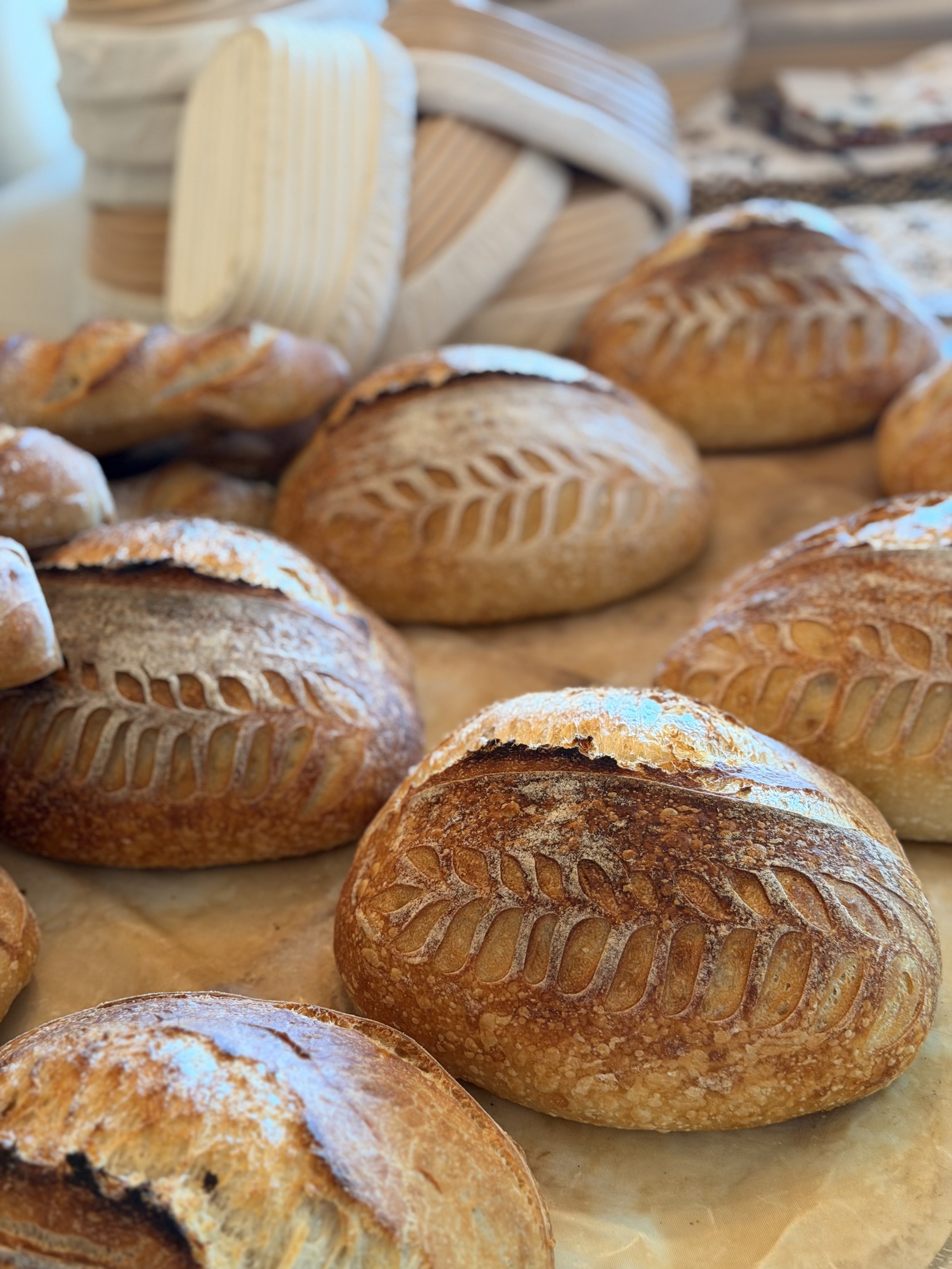
Bread Is the Path. Connection Is Where It Leads
I didn't set out to live a slower life.
If anything, I was trying to become more efficient.
Bake more bread.
Work smarter.
Find better systems.
Stay ahead of the next market.
Like so many of us, I was looking for ways to accomplish more in less time.
I'm grateful for many of those things.
My mixer allows me to bake more bread than my arthritic hands could ever manage. My freezer helps me prepare cookie dough ahead of time so I can be more present during the busiest part of my week. Those are gifts, and I wouldn't want to pretend otherwise.
Convenience has its place.
It allows me to do work I genuinely love.
But somewhere along the way, bread began teaching me something I wasn't expecting.
It began teaching me to become unhurried.
Not because life became less busy.
It didn't.
Not because my schedule suddenly opened up.
It hasn't.
But because sourdough refuses to hurry.
You can't rush fermentation.
You can influence it.
Guide it.
Care for it.
But you cannot force it to become something before it's ready.
The dough doesn't respond to pressure.
It responds to patience.
Over time, I began wondering if the same might be true of us.
Trust takes time.
Friendship takes time.
Healing takes time.
Grief takes time.
Faith takes time.
None of those things can be hurried without changing what they become.
Perhaps the invitation isn't to make life slower.
Perhaps it's to become less hurried within it.
I've noticed that beginning to happen every Saturday at Farmers Market.
People arrive carrying shopping bags and lists, but once they step up to the table, something shifts.
They ask about flour.
They ask about fermentation.
They tell me about the toast they made that morning or the loaf they shared with their family.
Sometimes they return the following week just to tell me how they served the bread.
Sometimes they introduce themselves by saying,
"We're the seed people."
Those conversations don't happen because bread is extraordinary.
They happen because someone paused long enough to begin one.
I've come to believe that attention is one of the purest forms of love.
When we give another person our full attention, we're quietly saying,
"Right now, nothing is more important than this moment we're sharing."
Perhaps that's why Farmers Market feels different.
Not because it's better than a grocery store.
It isn't.
They simply offer different experiences.
At the grocery store, we buy food.
At market, we often meet the people behind it.
The vegetables have a farmer.
The flowers have a grower.
The honey has a beekeeper.
The bread has a baker.
The story stays attached to the food.
And somehow, that changes everything.
A loaf of bread nourishes the body.
A conversation across the table nourishes something else entirely.
The older I get, the more convinced I become that we're not longing for slower calendars.
We're longing for deeper presence.
We've become remarkably efficient.
We answer texts while standing in line.
We listen to podcasts while driving.
We eat lunch while answering emails.
I'm not criticizing any of it.
I'm simply noticing that efficiency and presence are not the same thing.
One saves time.
The other gives it meaning.
Bread has quietly been teaching me that.
Not because bread itself is magical.
But because bread insists on a rhythm that refuses to be rushed.
And when I began honoring the rhythm of bread, I slowly began honoring the rhythm of my own life.
I notice the evening light finding the loaves before I reach for my camera.
I notice the pause before someone says,
"Oh my goodness...that's the best bread I've ever tasted."
I notice conversations that would have been missed had either of us been in a hurry.
I've come to believe that the most meaningful parts of life rarely announce themselves.
They simply ask us to slow down long enough to notice.
Perhaps that's the invitation in all of this.
Not to reject convenience.
Not to fear a busy life.
But to remember that some of life's greatest gifts still refuse to be rushed.
A meaningful conversation.
A loaf of sourdough.
A friendship.
Trust.
Healing.
A prayer.
The evening light finding a kitchen table.
I've discovered that becoming unhurried has very little to do with time.
It has everything to do with attention.
Convenience may save time.
Presence gives it meaning.
And perhaps that's what bread has been teaching me all along.
Not simply how to bake.
But how to live.
Warmly,
Kathy
Art of The Crumb
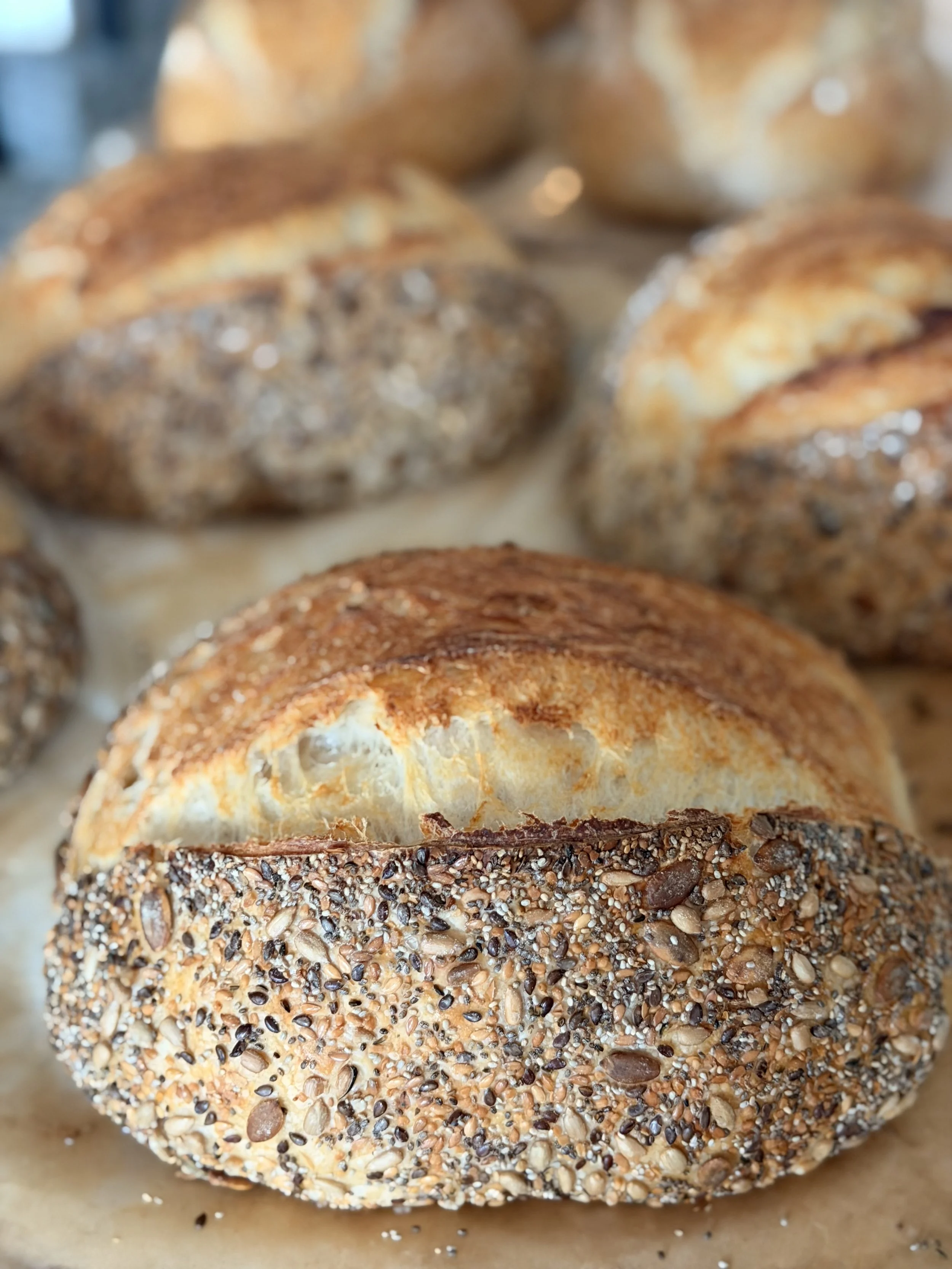
Bread and Relationships
There is something unfolding at Farmers Market that I didn't expect.
It has very little to do with bread.
Every Saturday I slice a loaf into small samples and offer a taste to anyone who would like one.
Some people hesitate.
Others reach immediately.
I've learned not to watch the bread.
I watch their faces.
The bread reaches their mouth.
There is always a pause.
Just for a moment.
They let it settle.
They experience the texture.
The crunch of the crust.
The chew of the crumb.
Then, almost every single time, the same thing happens.
Their eyes widen.
They begin nodding their head.
They turn to the person standing beside them and say,
"Oh my goodness...that's the best bread I've ever tasted."
Or,
"What is it?"
"How do you do that?"
Sometimes they say something that makes me smile every single time.
"I wasn't planning on buying bread today..."
They'll walk away.
Browse another booth.
Then two minutes later, they're back.
"Okay...I have to have a loaf."
What continues to capture my attention isn't that they love the bread.
It's the pause before they say anything at all.
I've learned that the most honest response isn't spoken.
It happens in the quiet moment before the words arrive.
That little pause has become one of my favorite parts of market.
Not because it says something about my bread.
Because it reminds me that there are still things in this world capable of surprising us.
Yesterday, another customer returned for English muffins.
She smiled as she walked up to my booth.
"I have to tell you," she said.
"I toasted one, spread cream cheese on it, then added sliced avocado."
She closed her eyes for a second and laughed.
She described it as though she had experienced something completely unexpected.
Then she bought two more packages.
Not because she needed English muffins.
Because she wanted to experience that moment again.
Later that morning another woman walked up and said,
"We're the seed people."
I smiled immediately because I knew exactly who she was talking about.
A couple of weeks earlier, her husband had come through the rain looking for one of my seeded loaves.
"I'm so sorry," I told her.
"I don't have seeded bread today."
She laughed.
"No, no...we came for English muffins."
Then she told me something I'll never forget.
She said her husband almost didn't come that rainy morning because he didn't think I would be there.
She looked at him and said,
"Oh no. That woman is a person of integrity. If she said two weeks ago she'd have your seeded bread, she'll be there...with your bread."
Then she laughed.
"He's ridiculous about your bread."
Of all the conversations from yesterday, those were the words that lingered.
Not because someone complimented my baking.
But because someone noticed my character.
That meant more to me than she'll probably ever know.
People don't simply come to my booth for bread.
They come for conversation.
For connection.
For familiar faces.
For stories.
And then something beautiful happens.
They leave carrying a loaf.
But they also leave carrying a story.
The wonderful part is...
They come back carrying one for me.
They tell me how they served the bread.
How they shared it with family.
How they toasted an English muffin.
How they finally decided they couldn't leave market without a loaf after all.
They invite me into their kitchens long after market has ended.
I feed them.
Then, without even realizing it...
They feed me.
For a long time, I believed feeding people was my love language.
Now I understand that bread is simply the invitation.
The real gift has never been what comes out of my oven.
It's what grows because of it.
The relationships.
The trust.
The stories.
The laughter.
The tears.
Those are the real harvest.
Bread is simply the way we find each other.
Perhaps that's why I've stopped measuring market only by how many loaves I sell.
Instead, I find myself remembering conversations.
The pause before someone smiles after the first bite.
The woman who came back for more English muffins because of cream cheese and avocado.
"The seed people."
The customer who had been following the journey of my Heritage Khorasan loaf before she ever tasted it.
Those are the moments I carry home.
Those are my stones of remembrance.
Because at the end of the day, I don't think I'm simply building a bakery.
By God's grace...
I think we're building a community.
And I can't imagine anything more meaningful than that.
Warmly,
Kathy
Art of The Crumb
Another Rainy Market
Some mornings ask a quiet question before the day has even begun.
Will you show up?
This morning was one of those mornings.
It would have been so easy to cancel.
Message the market manager and simply say, "I won't be attending market today."
Kenny has always made it clear to the vendors that attendance isn't mandatory. If the weather feels unsafe or you simply don't want to take the chance, staying home is always an option.
This morning certainly felt like one of those mornings.
The forecast couldn't make up its mind. One moment there was a 30% chance of rain. The next it was 75%, with intermittent thunderstorms.
I packed my car in the rain.
I drove to market in the rain.
I arrived...in the rain.
I sat in my car for a few minutes, looking through the windshield, feeling the weight of the decision.
Part of me wanted to send the text.
"I won't be there today."
But I didn't.
Not because I was thinking about nearly one hundred loaves of bread.
Not because I had over two hundred English muffins packed and ready to go.
Not even because I had baked my very first Heritage Khorasan loaves.
Although those loaves had already become something far more meaningful to me than bread.
Just last weekend, I was introduced to Khorasan during the Proof Bread Intensive in Arizona. It is an ancient grain that has remained remarkably unchanged over thousands of years, carrying with it a rich, buttery flavor and a story that reaches back generations. I came home eager to learn from it, but somewhere along the way, it began teaching me instead.
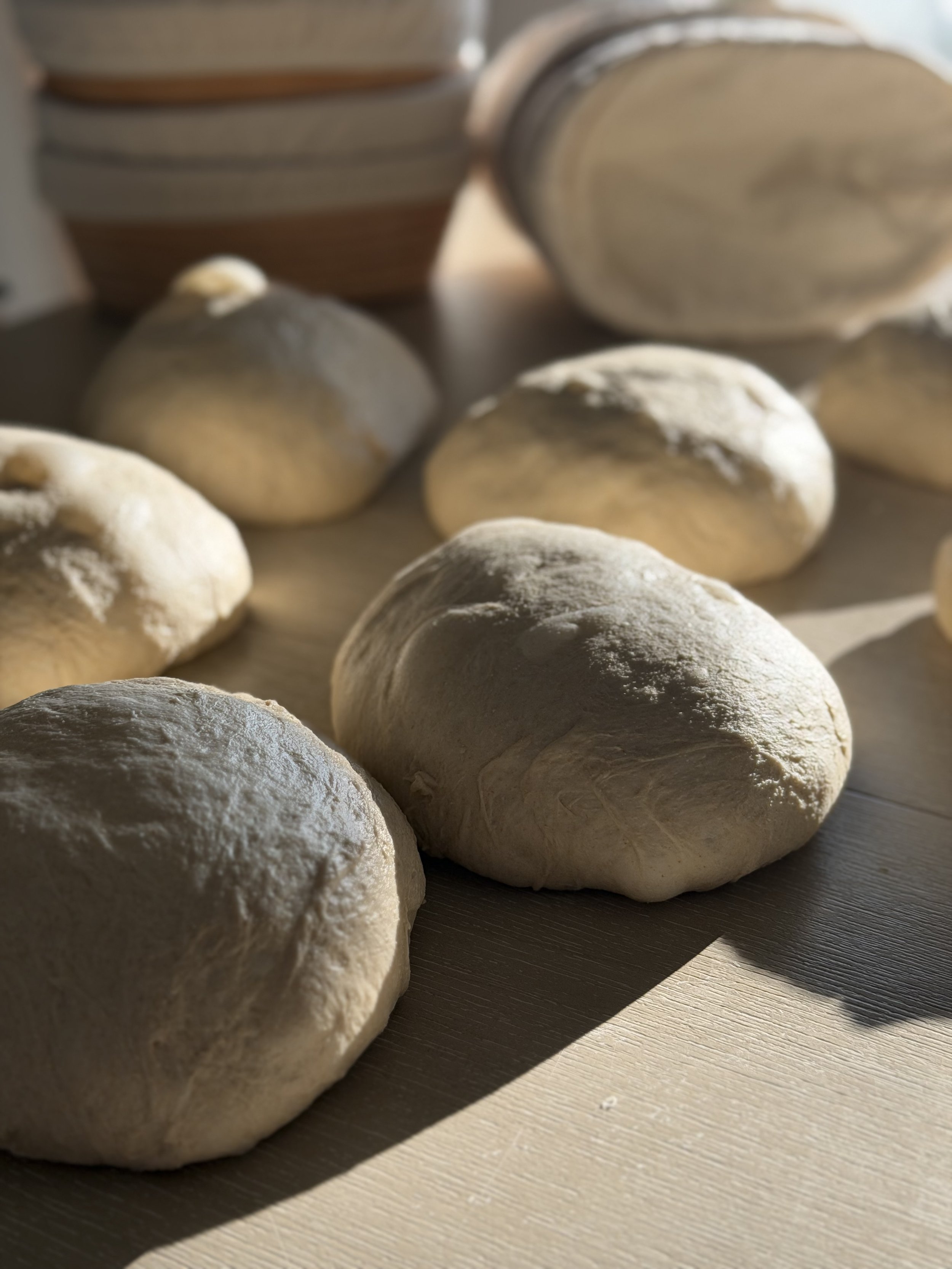
As the dough fermented, the aroma filled my kitchen unlike anything I had ever experienced. After shaping the loaves, the evening light quietly found them. It made me pause. I found myself simply standing there, taking it all in before reaching for my camera.
That photograph has already become one of my Stones of Remembrance.
Not because of the bread itself.
But because it reminded me that beauty often appears quietly...if we're willing to pause long enough to notice it.
By the time I arrived at market this morning, those loaves felt like much more than a new offering.
They felt like part of my story.
Not long after I opened my booth, a woman walked up wearing her rain gear.
She pointed directly at the Khorasan loaf.
"Is this it?" she asked with a smile.
"Is this the new loaf?"
I don't know how to explain what I felt in that moment.
She had been following along.
Following the journey.
Reading the stories.
Waiting for this loaf.
We stood there talking for nearly twenty minutes.
Not just about bread.
About ancient grains.
About flour.
About how our food has changed over the years.
About the beauty of returning to something that has remained remarkably close to its original form.
Before she left, she thanked me for bringing the loaf to market.
She bought one.
But that's not what I'll remember.
I'll remember the way I felt when she pointed to that loaf and asked,
"Is this it?"
Because in that moment I realized something.
She wasn't simply buying bread.
She had become part of the journey.
She had watched this loaf come into being before she ever held it in her hands.
As I packed up this afternoon, I found myself thinking about how close I came to staying home.
Had I done that...
I would have missed that conversation.
I would have missed meeting her.
I would have missed the quiet reminder that showing up often has less to do with the weather than it does with being open to whatever the day might bring.
I've been learning lately to ask a different question when plans don't unfold the way I expect.
What if this delay is Grace?
Today, I found myself asking a similar question.
What if showing up is Grace?
Not because every market ends with a beautiful story.
But because sometimes the simple decision to show up allows us to receive one.
Warmly,
Kathy
Art of The Crumb
Returning
I've been home for a few days now, and something has quietly settled within me.
As the familiar rhythm of my mornings returned—coffee, prayer, gratitude, Scripture, and my journal—I found myself noticing something I hadn't expected.
Not around me.
Within me.
I feel stronger.
I feel balanced.
I feel grounded.
It has taken me a few days to find words for what I carried home from Arizona.
At first, I thought I had gone there to learn about bread.
I thought I had gone there to learn about scaling a bakery.
About systems.
About production.
About sustainability.
I did learn those things.
But they weren't the reason I was there.
It reminded me of one of the final conversations I had with my father.
We were sitting quietly together in my garden just a few days before he passed away.
Neither of us was saying much.
We simply sat side by side, watching a pair of hawks circling high above us.
Without ever taking his eyes off the sky, he quietly said,
"I want Kathy VandenBerghe back."
I smiled.
"Daddy...I'm right here."
Only then did he slowly slide his sunglasses down to the end of his nose.
It was his signature move whenever he had something important to say to someone he loved.
He looked at me with all the tenderness a father carries for his daughter.
"You know what I mean."
Then he quietly said,
"You've lost yourself along the way."
I knew exactly what he meant.
For years, I remembered that conversation as a correction.
Today, I understand it differently.
He wasn't trying to correct me.
He was trying to call me home.
When I boarded the plane to Arizona, I thought I was leaving home.
Looking back now, I realize I was traveling toward it.
Not because Arizona became home.
Tennessee is home now.
My kitchen is home.
My market is home.
The people I love are home.
But somewhere along the way, I had quietly wandered away from myself.
Arizona didn't bring me home to a place.
It brought me home to the woman God had been patiently calling back all along.
Returning wasn't about geography.
It was about identity.
For the first time in a very long time...
My inner life...
My work...
My faith...
My writing...
My purpose...
All occupy the same room.
There isn't any tension between them.
They belong together.
That's what grounding feels like.
For years, I believed strength was something you fought for.
Something you earned by surviving difficult seasons.
Now I understand it differently.
Strength wasn't something I found.
It quietly emerged when my life finally came into alignment with the woman God had been shaping me to become.
When I came home, I noticed something else.
I wasn't talking about expansion.
Or mixers.
Or wholesale accounts.
Or production numbers.
Instead, I found myself talking about compassion.
Identity.
Stones.
Loaves.
Grace.
Observation.
That isn't someone who came home carrying information.
That's someone who came home carrying integration.
There was a time when I believed love meant making myself smaller.
Not intentionally.
Not overnight.
I slowly learned to soften convictions that once came naturally.
To question my own voice.
To make room for everyone else's needs while quietly setting my own aside.
Somewhere along the way, I confused self-abandonment with selflessness.
They are not the same thing.
I've come to understand that returning isn't about becoming someone new.
It's about remembering the person God created before life convinced us we needed to become someone else.
Returning has not made me less compassionate.
It has made me more honest.
Not only with others.
With myself.
I've learned that compassion begins where certainty ends.
It allows me to hold truth without letting go of kindness.
To acknowledge pain without surrendering grace.
To remain faithful to my convictions while leaving room for humility.
There is a quiet confidence that comes from no longer needing to prove who you are.
You simply become willing to live as the person you've always been.
Since returning home, I've noticed something else.
The Stones of Remembrance seem to find me everywhere.
Perhaps they always did.
Maybe Grace has always been quietly leaving clues.
Maybe I simply needed to become the woman I am today to finally recognize them.
Healing didn't create Grace.
It simply taught me how to receive where Grace had been all along.
Sometimes I wonder what my father would say if he were sitting across from me this morning.
I can almost picture him.
Those familiar sunglasses.
That quiet smile.
This time...
I don't think he'd say,
"I want Kathy VandenBerghe back."
I think he'd simply smile...
Look at me...
And say,
"Welcome back, Wiggy."
I have never missed him more.
And I have never felt him closer.
Warmly,
Kathy
Art of The Crumb
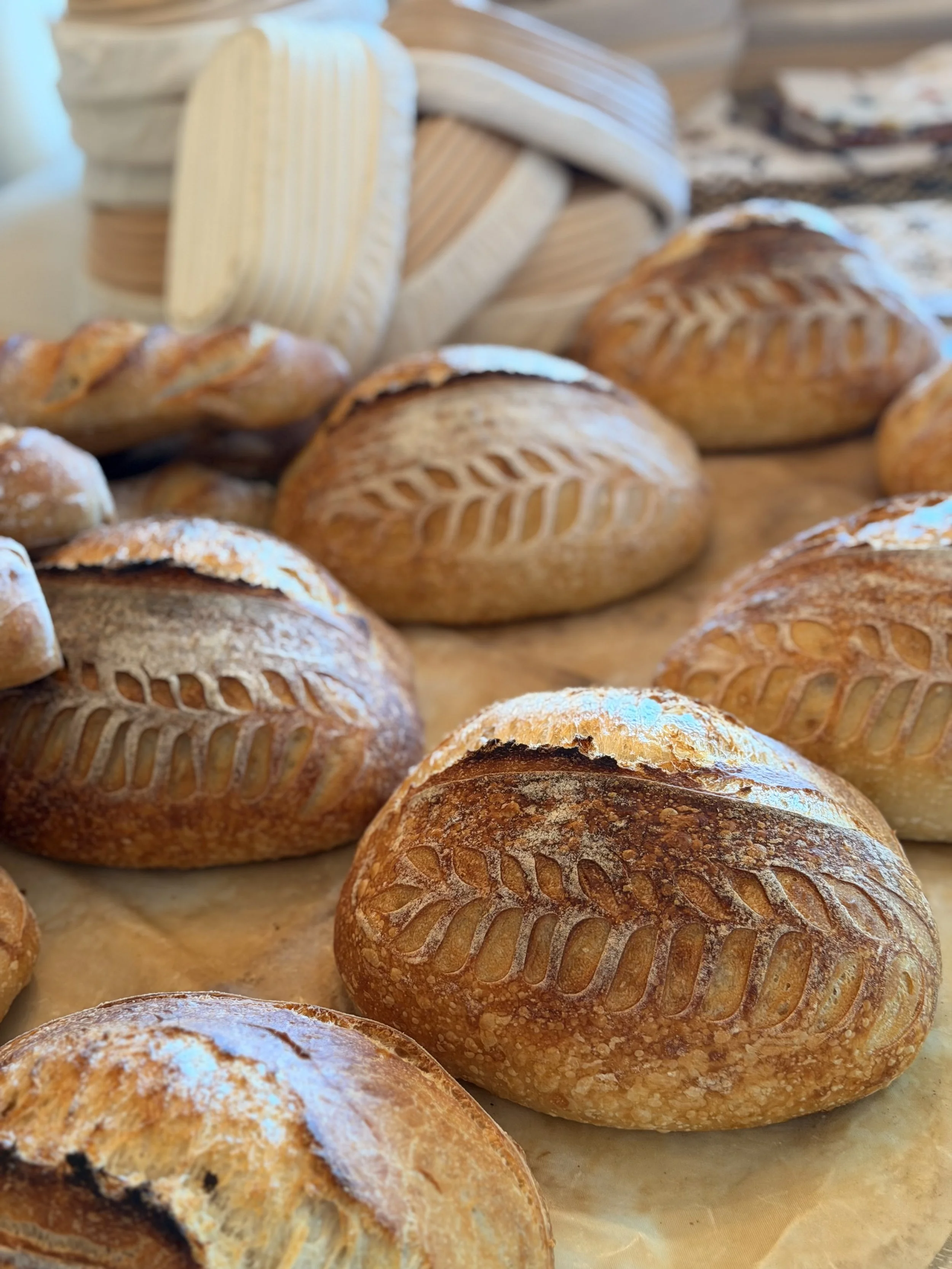
The Chapters We Cannot Read
There is something I've been thinking about for quite some time.
As I've grown older, I've become less interested in being right and more interested in being kind.
Less interested in proving my story and more interested in understanding that every story has chapters I may never read.
I've discovered that humility sometimes begins with three of the hardest words we'll ever say.
"I don't know."
For much of my life, I believed understanding came from having answers.
Now I wonder if understanding begins somewhere entirely different.
Perhaps it begins with acknowledging how little we actually know.
We see moments.
God sees lifetimes.
We see conversations.
God sees hearts.
We see one chapter.
God holds the entire story.
That realization has changed the way I move through the world.
It has changed the way I meet strangers.
The way I listen to friends.
The way I think about people whose lives have taken turns I don't understand.
And perhaps most importantly...
It has changed the way I think about Grace.
I've learned that compassion begins where certainty ends.
When I'm certain I know someone's motives...
Compassion has very little room to breathe.
When I'm certain I understand another person's choices...
Curiosity quietly leaves the room.
But the moment I allow myself to say,
"I don't know what they've carried."
"I don't know what they've been told."
"I don't know what fears they're living with."
"I don't know what chapters I've never read."
Something remarkable happens.
Compassion enters.
Not because every choice suddenly makes sense.
Not because hurt disappears.
But because I've stopped pretending I know everything there is to know.
There is a quiet freedom in that.
It allows me to hold truth without letting go of kindness.
To acknowledge pain without surrendering compassion.
To disagree without forgetting someone's humanity.
One of the greatest gifts sourdough has given me has very little to do with bread.
It has taught me patience.
Not only with dough.
With people.
Fermentation cannot be rushed.
Neither can healing.
Neither can understanding.
There are stories that take years to unfold.
Perhaps our job isn't to rush toward conclusions.
Perhaps our job is simply to remain faithful while the next chapter is still being written.
I've stopped asking life to explain everything to me.
Instead, I've begun asking a different question.
How do I tell the truth in a way that serves the reader?
Not to convince.
Not to persuade.
Not to prove my point.
But to leave behind something that helps another human being feel a little less alone.
Maybe that's what kindness has always been.
Not having all the answers.
Simply leaving room for another person's story to continue unfolding.
Because every life is still being written.
Including mine.
Warmly,
Kathy
Art of The Crumb
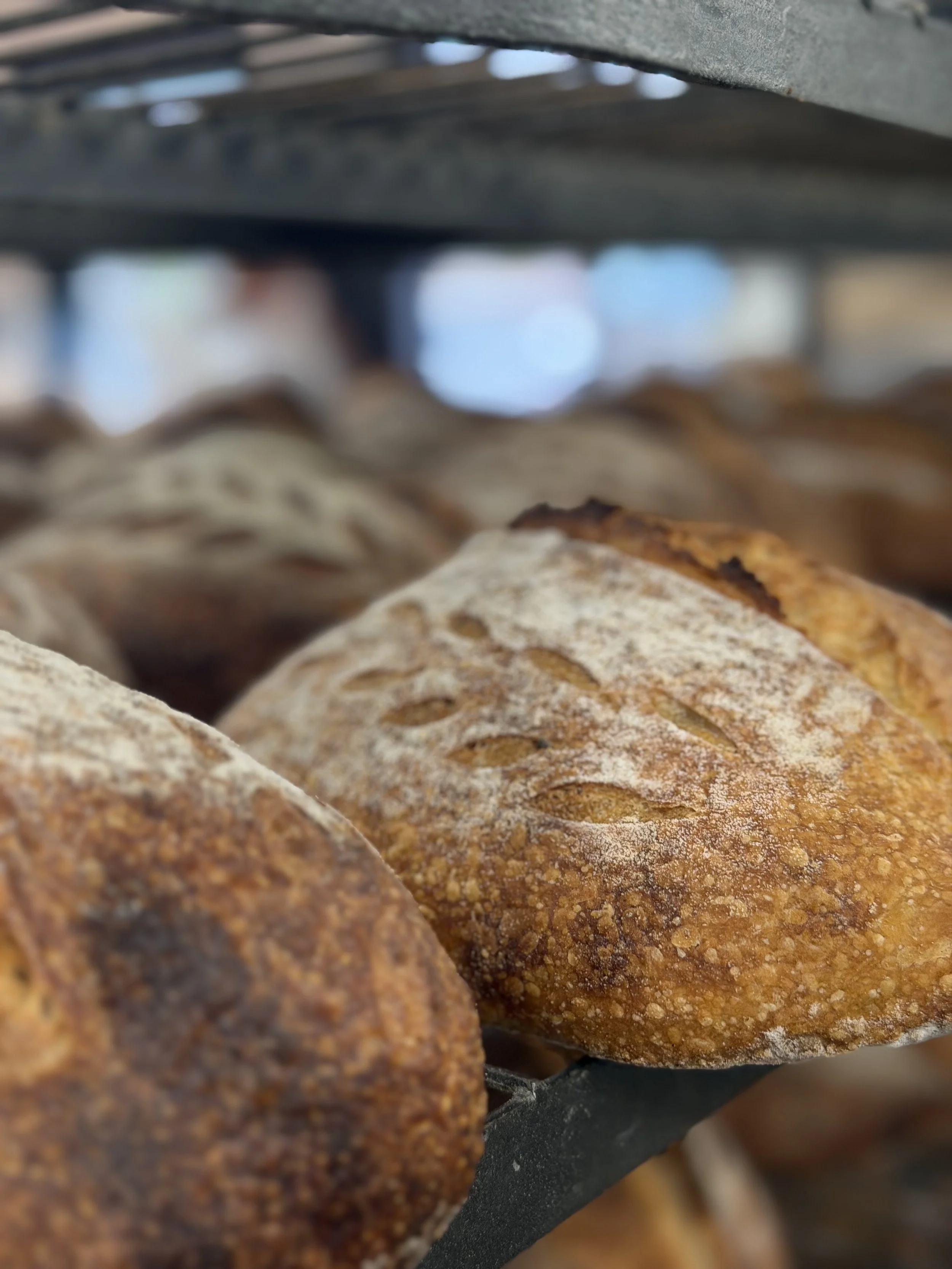
Gathering Stones
"Take twelve stones from the middle of the Jordan... These stones are to be a memorial to the people forever. In the future, when your children ask, 'What do these stones mean?' tell them..."
— Joshua 4:3, 6–7
There are moments in life that quietly become memorials.
Not because they change everything in an instant, but because years later we look back and realize they marked the beginning of something we couldn't yet see.
The Israelites gathered stones from the middle of the Jordan River after God led them safely across. Those stones weren't trophies. They weren't monuments to human achievement. They were reminders of God's faithfulness.
I've come to believe we all gather stones.
Not from riverbeds.
From moments.
From conversations.
From unexpected kindness.
From quiet confirmations that gently whisper, "Keep going."
I came home from Arizona carrying several of them.
I Thought I Was Going to Learn About Bread
When I boarded the plane for Arizona, I thought I knew why I was going.
I thought I was going to learn about bread.
About growth.
About production.
About systems.
About sustainability.
Those things certainly happened.
I filled pages of notes.
I learned techniques that will shape the future of Art of The Crumb.
But that's not why I went.
Now I know.
I went to Arizona for confirmation.
I went for quiet validation.
I went to gather stones of Grace.
The Strength of Vulnerability
On the very first day, Jon and Amanda invited us into something unexpected.
Vulnerability.
Not as a weakness.
As a strength.
They encouraged us to ask questions.
To admit what we didn't know.
To step beyond the safety of certainty and into the humility of learning.
It changed the atmosphere immediately.
No one needed to pretend.
No one needed to prove themselves.
We simply became a room full of bakers learning together.
There is remarkable freedom in that.
I realized that the strongest people in the room were not the ones who knew the most.
They were the ones who remained teachable.
Stewards
Throughout the weekend, another word quietly settled into my heart.
Stewardship.
I found myself surrounded by people who weren't simply excellent bakers.
They were stewards of their craft.
They handled flour with respect.
People with kindness.
Knowledge with generosity.
Nothing felt possessive.
Everything felt entrusted.
That distinction has stayed with me.
I don't simply want to build a bakery.
I want to become a faithful steward of whatever God chooses to place in my hands.
An Observer
Before leaving Tennessee, I made a promise to myself.
I would go as a quiet observer.
I wouldn't arrive with opinions.
I wouldn't rush to conclusions.
I would simply pay attention.
I carried that intention with me every day.
Then, near the end of the first day, Amanda quietly walked over and pulled me aside.
She smiled and asked,
"You are an observer, aren't you?"
I smiled.
Because she had just given words to something I had only recently begun to understand myself.
She didn't tell me who I was.
She simply recognized it.
Sometimes another person sees something in us long before we fully embrace it ourselves.
That quiet conversation became one of my stones.
Grace Leaves Clues
One evening, as I reflected on everything unfolding around me, I realized something.
Grace leaves clues.
The question is whether we're paying enough attention to gather them.
Every day in Arizona seemed to offer another one.
The rain that greeted the desert.
The feeling that settled over me the moment I stepped inside the bakery.
The conversations.
The laughter.
The quiet encouragement.
The sense that somehow I had found my people.
None of those moments demanded attention.
But together...
They became a memorial.
One Final Stone
My final stone wasn't gathered inside the bakery.
It happened at the airport.
As I waited to board my flight home, a woman struck up a conversation with me.
She asked why I had been in Phoenix.
I told her.
Not just about Proof Bread.
I told her my story.
About grief.
Loss.
Recovery.
Sourdough.
Healing.
The unexpected journey that led me here.
As I spoke, tears filled her eyes.
She looked at me and said,
"I felt compelled to come talk to you, and I didn't even know why. I know why now."
She shared that she, too, had experienced profound loss over the past three years—her partner, her mother, and her job.
Then she said something I'll never forget.
"I needed to hear your story."
We exchanged phone numbers.
As I drifted off to sleep last night, my phone softly pinged.
It was a text from her.
She told me something inside her had shifted.
A weight had been lifted.
Then she wrote the words that brought tears to my own eyes.
"I think I've found my sourdough."
Teaching.
At that moment, I realized something.
Find Your Sourdough was never really about bread.
It has always been an invitation.
Not for people to bake.
But for them to discover the ordinary place where Grace is quietly transforming their lives.
Gathering Stones
As I look back over my time in Arizona, I don't find myself remembering formulas or production schedules first.
I remember people.
I remember kindness.
I remember humility.
I remember vulnerability.
I remember stewardship.
I remember being seen.
I remember gathering stones.
Years ago, Joshua instructed the people of Israel to gather stones so future generations would remember God's faithfulness.
Today, I understand why.
We are quick to remember disappointment.
We have to become intentional about remembering Grace.
Arizona didn't simply teach me how to become a better baker.
It reminded me who I am.
An observer.
A steward.
A writer.
Someone learning, day by day, to pay attention to the unfolding of Grace.
And perhaps that is the greatest stone of all.
Warmly,
Kathy
Art of The Crumb
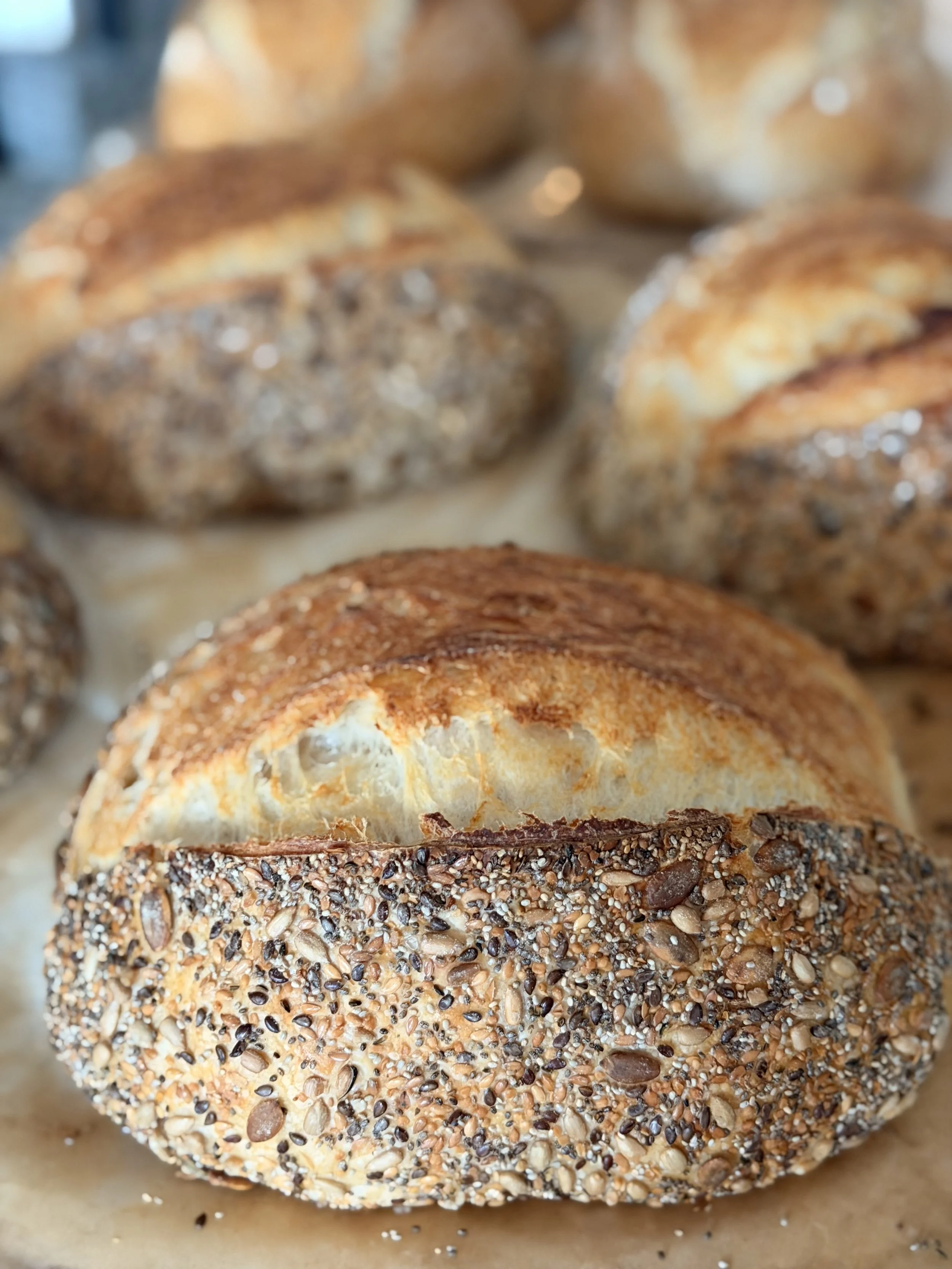
The Hands That Led Me Here
A Quiet Morning
This morning, before the sun had fully made its way over the trees, I found myself doing what has become the foundation of every day.
Coffee in hand.
Scripture open.
Journal beside me.
A simple prayer rising from my heart.
"Thank You, God, for another day of sobriety. Thank You for Your love, Your guidance, and for every blessing You have placed in my life. Thank You for the prayers You have answered...and even for the ones You have lovingly withheld."
That last part has become one of the greatest lessons of my life.
Because sometimes the prayers that are not answered are quietly making room for something I never knew to ask for.
Looking Back
Last night, I received the complete itinerary for the Proof Bread Intensive in Arizona.
As I read through each page, I wasn't thinking about bread.
I wasn't thinking about fermentation or shaping or production systems.
I found myself thinking about the road that led me here.
It would be easy to say I was accepted into an intensive.
But that isn't the story.
The story began long before the acceptance email arrived.
It began with heartbreak.
With healing.
With surrender.
With learning to trust God one ordinary day at a time.
It began with a jar of flour and water sitting quietly on my kitchen counter, teaching me lessons I didn't even know I needed to learn.
One Faithful Step
There have been so many moments over the past several years when I've quietly said to those closest to me,
"God has His hand in all of this."
Not because every day has been easy.
Far from it.
But because doors kept opening that I could never have opened myself.
People appeared exactly when I needed encouragement.
Lessons arrived before I even knew I would need them.
Opportunities unfolded one after another, each one asking only one thing of me.
Take the next faithful step.
Not ten steps.
Just one.
The next mix.
The next loaf.
The next market.
The next customer.
The next prayer.
Preparation Doesn't Always Look Like Preparation
When I was learning sourdough, I thought I was learning how to bake bread.
Now I realize I was learning patience.
Consistency.
Humility.
The willingness to fail, study, adjust, and begin again.
When I was accepted into the Clarksville Downtown Market, I thought God was giving me customers.
Instead, He introduced me to a community.
When New York Butcher Shoppe asked for more bread, I thought it was about business.
Instead, it became another invitation to trust Him with what comes next.
Looking back, I can see that each season was quietly preparing me for the next one.
Not all at once.
One loaf at a time.
An Invitation I Never Could Have Planned
As I read through the Intensive schedule, I noticed something unexpected.
The weekend doesn't begin with formulas.
It begins with people.
A farmers market.
Conversations.
Questions.
Working shoulder to shoulder.
Learning from one another.
That speaks to something much deeper than baking.
It speaks to the kind of bakery I hope to continue building.
One where bread is never the whole story.
One where people leave feeling nourished in more ways than one.
The Gift
I don't see this Intensive as a reward.
I see it as a gift.
Not because I've earned it.
But because I believe God delights in placing people exactly where they need to be when they're ready to receive what comes next.
This opportunity feels less like an arrival and more like another invitation.
An invitation to remain teachable.
To listen.
To observe.
To ask better questions.
To continue becoming.
The Thread I Could Not See
There is a verse in Proverbs that says,
"Trust in the Lord with all your heart and lean not on your own understanding."
There were so many seasons when I couldn't understand what God was doing.
Some prayers seemed to disappear into silence.
Some losses felt impossible to redeem.
Some roads made no sense at all.
Yet somehow, every one of those roads led me here.
Not because life unfolded according to my plans.
But because it unfolded according to His.
Before I Go
Tomorrow, I'll board a plane with a notebook, an open heart, and flour-ready clothes.
I'll spend four days learning from people whose work I deeply admire.
I'll ask questions.
I'll listen carefully.
I'll pay attention.
But more than anything, I'll remain grateful.
Grateful for every ordinary morning that led to this extraordinary opportunity.
Grateful for every lesson hidden inside a loaf of bread.
Grateful for a God who has been writing a story far more beautiful than anything I could have imagined for myself.
If there's one thing this journey has taught me, it's this:
Sometimes we only recognize God's fingerprints when we stop long enough to look behind us.
And when we do, we discover He has been leading us all along.
Warmly,
Kathy
Art of The Crumb
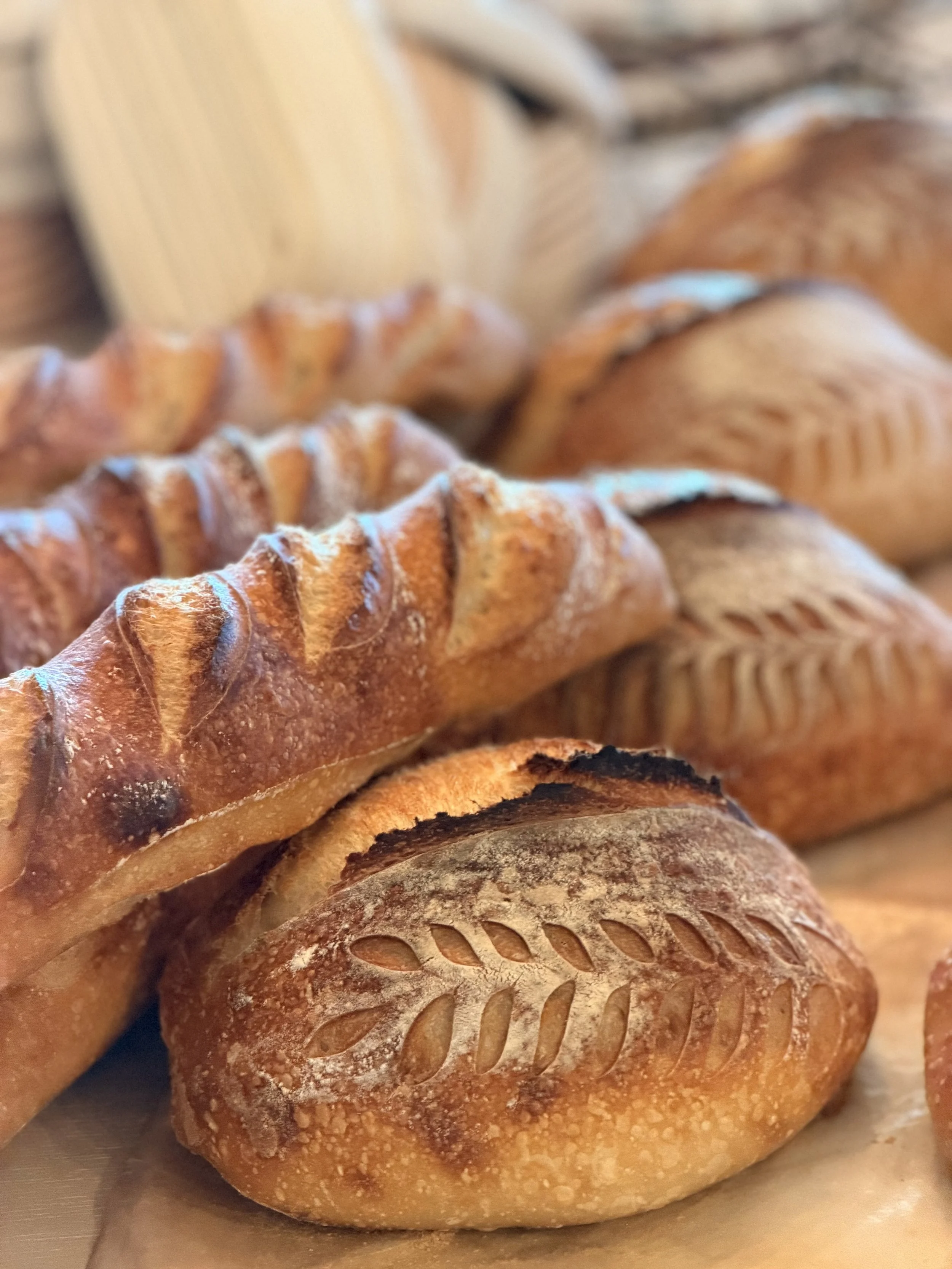
Keep Coming Back
It Works If You Work It
There is a phrase I learned years ago that has stayed with me ever since.
Keep coming back.
At first, I thought those words were simply an invitation to return.
To another meeting.
To another day.
To another chance.
Over time, I realized they were describing something much deeper.
They were describing a way of living.
Because the truth is, very little in life is transformed by one grand moment.
Most things are changed by quiet consistency.
By showing up again.
And again.
And again.
Flour, Water, and Faith
When sourdough entered my life, I didn't realize it was teaching me the very same lesson.
A starter doesn't ask for perfection.
It asks for consistency.
You feed it.
You wait.
You trust.
You come back tomorrow.
There are days when it looks sleepy.
Days when it seems to burst with life.
Days when you wonder if you're doing everything wrong.
And still...
You keep coming back.
It turns out healing works much the same way.
The Life That Is Built Slowly
People sometimes ask me how I built Art of The Crumb.
The answer isn't very exciting.
I kept coming back.
I kept learning.
I kept failing.
I kept asking questions.
I kept baking.
I kept praying.
I kept showing up.
There wasn't one moment that changed everything.
There were thousands of ordinary moments that slowly changed me.
The Pause Between Here and What's Next
As I write this, I'm preparing to leave for Arizona to attend the Proof Bread Intensive.
My mind is full of questions.
How do I scale?
What comes next?
How do I grow without losing the heart of this little bakery?
I don't have those answers yet.
And for once...
I'm okay with that.
Because if sourdough has taught me anything, it's this:
The next step doesn't have to be forced.
It simply has to be faithful.
Tomorrow, I'll keep coming back.
To learning.
To listening.
To curiosity.
To whatever God has waiting for me there.
An Invitation
Maybe that's what we all need from time to time.
Not a new plan.
Not a dramatic breakthrough.
Just the willingness to come back.
To the work.
To the people we love.
To our faith.
To the practices that steady us.
To hope.
Because transformation isn't usually found in the extraordinary.
It's found in the ordinary things we choose to do over and over again.
Feed the starter.
Say the prayer.
Write the page.
Bake the bread.
Love the people in front of you.
And tomorrow...
Keep coming back.
Warmly,
Kathy
Art of The Crumb
Why I Write
A Quiet Declaration
There was a time when I believed I was building a bakery.
Then I thought I was writing a book.
Somewhere along the way, I realized I was doing neither.
I was learning to pay attention.
To the quiet ways God moves through ordinary moments.
To the sacred hidden within the everyday.
To the conversations that linger long after the bread is gone.
To the lessons found in failure, the beauty revealed through patience, and the hope that quietly rises when we choose to keep showing up.
My life has taught me that Grace rarely arrives with fanfare.
More often, it unfolds.
Slowly.
Patiently.
Faithfully.
Like a loaf of sourdough rising before dawn.
Like healing that comes one small step at a time.
Like a prayer answered in a way I never expected.
For many years, I gathered evidence of disappointment.
Today, I choose to gather evidence of Grace.
I choose to notice.
To pause.
To remember.
To collect the quiet stones that mark God's faithfulness along the path, trusting that what seems ordinary today may one day become the very story that encourages someone else.
Whether I am baking bread, writing words, serving my community, or simply sharing a cup of coffee across a kitchen table, my hope is always the same:
That people leave feeling nourished.
Not only in body, but in spirit.
That they leave feeling seen.
Encouraged.
Welcomed.
Reminded that kindness still matters.
Reminded that healing is possible.
Reminded that God is often closest in the ordinary moments we are most tempted to overlook.
Art of The Crumb was born from flour and water.
But its true foundation has always been Grace.
The bread is simply one expression of that Grace.
The writing is another.
Together, they tell the story of a life still becoming.
I believe every life is filled with stones of remembrance—quiet moments that reveal God's presence if we are willing to notice them.
My calling is simply this:
To write about the unfolding of Grace.
To gather its evidence.
To share its stories.
And to invite others to discover that Grace has been quietly unfolding in their lives all along.
Warmly,
Kathy VandenBerghe
Stones of Remembrance
An Unexpected Email
A few days ago, I received an email from a customer.
I expected it to be about bread. Maybe they wanted to place an order. Maybe they had a question about storage or wanted to tell me they had enjoyed their loaf.
Instead, I found myself reading words I wasn't expecting.
"You have a way of filling a room with a sense of peace."
I read that sentence several times.
Not because it was flattering.
Because it became one of those moments I never want to forget.
In the Old Testament, after the Israelites crossed the Jordan River, God instructed them to gather stones from the riverbed and build a memorial. They would become stones of remembrance—a tangible reminder of God's faithfulness so that future generations would ask, "What do these stones mean?"
I think we all gather stones throughout our lives.
Not stones we can hold in our hands, but moments that remind us who we are becoming. A handwritten note. An unexpected conversation. A kindness we never saw coming. Words spoken at just the right time.
This email became one of those stones for me.
What People Really Remember
As bakers, we spend so much of our time chasing the tangible things.
The perfect ear.
A beautiful crumb.
Better oven spring.
The right hydration.
Freshly milled flour.
The list never ends.
And while all of those things matter—they should matter—we can begin to believe they are the most important part of what we offer.
But what if they aren't?
What if people remember something entirely different?
What if they remember how they felt?
A Table Is Never Just a Table
Every Saturday I stand behind my table at the Clarksville Downtown Market.
People come for bread.
At least that's what they think.
But somewhere between slicing samples, answering questions, and wrapping warm loaves, something else happens.
People tell me about their week.
They introduce me to their children.
They share stories about parents they've lost.
They celebrate birthdays, anniversaries, retirements, and new beginnings.
Sometimes they tell me things I imagine they haven't told many people.
I've often wondered why.
Maybe it's because bread has always been an invitation.
It slows us down.
It asks us to gather.
It reminds us that nourishment has never been only about food.
The Long Road to Peace
If someone had met me years ago, I don't know that "peace" is the word they would have used.
Life has a way of shaping us.
There have been seasons of grief.
Seasons of fear.
Seasons of rebuilding.
Seasons where I was simply trying to find my footing.
There were days when I believed I had lost far more than I would ever recover.
But healing has a quiet way of changing us.
Not all at once.
Not dramatically.
Little by little.
Much like sourdough itself.
Flour.
Water.
Time.
Consistency.
Faith.
One day you realize you are no longer the person you were.
Bread as a Vehicle
I've often said that Art of The Crumb was never just about bread.
It was about finding my way back to myself.
It was about learning to trust God again.
It was about discovering that service has a remarkable way of healing the one who serves.
The bread became the vehicle.
The real work was happening inside me.
Perhaps that's why the email touched me so deeply.
The customer never mentioned my bread.
They mentioned peace.
And somehow, that felt like the greatest compliment I could have received.
What I Hope People Take Home
Of course I hope every loaf has a beautiful crust.
I hope the crumb is exactly as it should be.
I hope families gather around tables and tear into fresh bread together.
But if someone leaves my table carrying something more than a loaf...
If they leave feeling seen.
If they leave feeling encouraged.
If they leave believing, even for a moment, that kindness still exists in this world...
Then I think I've done something worthwhile.
The Real Measure
Success is an interesting thing.
There was a time when I thought success would be measured by how many loaves I sold.
Or whether I would someday have a storefront.
Or how much my bakery might grow.
Those things may come.
Or they may not.
But I'm beginning to think the real measure of a life is much quieter than that.
It's found in the things we never set out to earn.
A conversation.
A returning customer.
A handwritten note.
An unexpected email.
A sentence that reminds us who we're becoming.
"You have a way of filling a room with a sense of peace."
I don't know that there is a greater gift than knowing someone walked away with that instead of simply remembering the bread.
Maybe that's what Art of The Crumb has been teaching me all along.
Bread feeds the body.
But love, kindness, and peace...
Those are the things people carry home.
Warmly,
Kathy
Art of The Crumb