
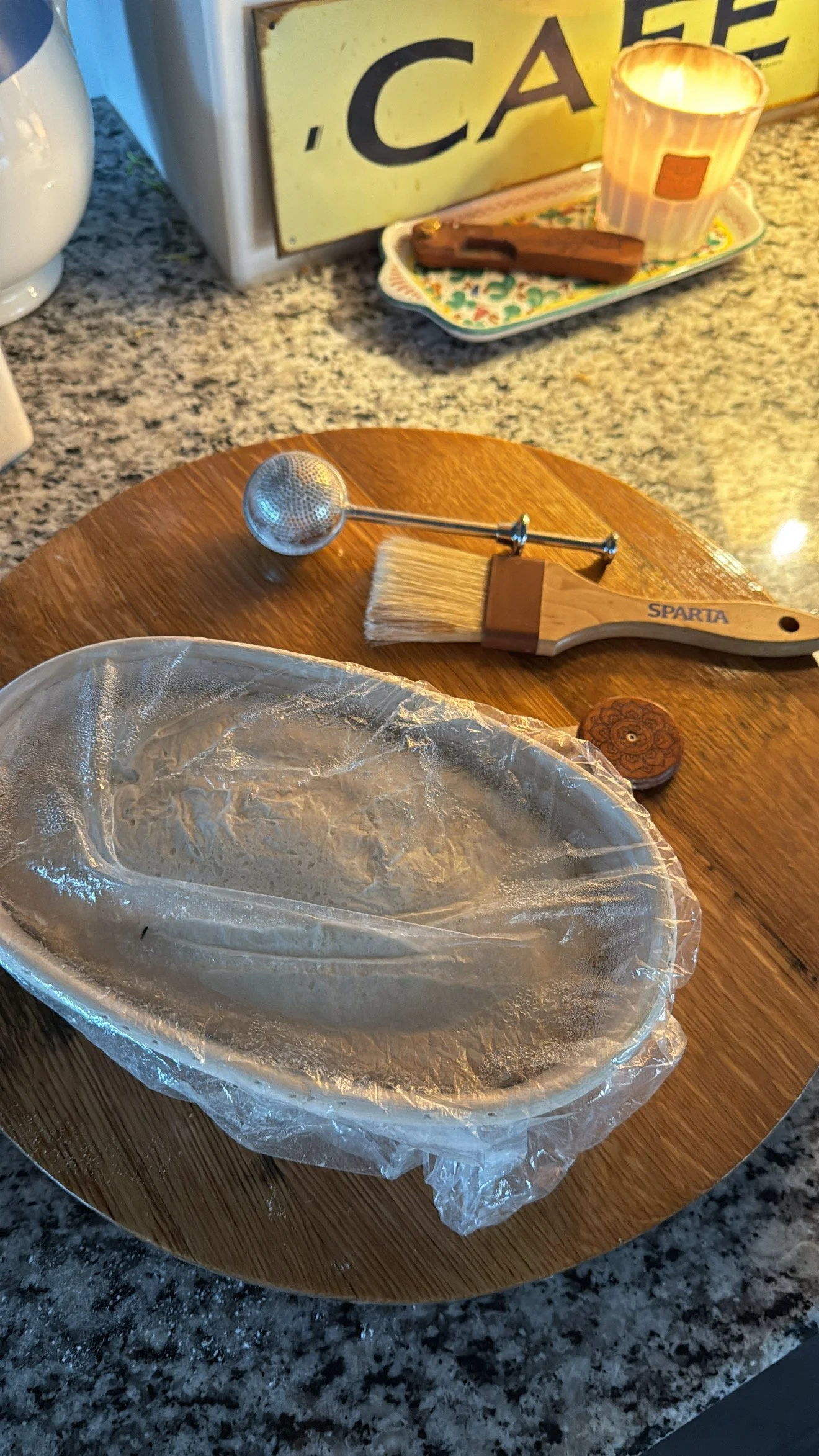
Sourdough as Grounding
Where the Noise Begins to Quiet
There is a word I’ve been thinking about lately.
Grounding.
Some people talk about it as walking barefoot on the earth. Stepping away from the noise. Letting your body reconnect with something real and steady.
I’ve never spent much time thinking about the science of it.
But I do know this.
I have found that same feeling in my kitchen.
Coming Back to Myself
There is something that happens when I begin working with sourdough.
The world outside doesn’t stop. The noise is still there. The unanswered questions, the waiting, the uncertainty. All of it still exists.
But when my hands touch the dough, something shifts.
I come back to myself.
Flour.
Water.
Salt.
Starter.
Simple things.
And yet, in those simple things, there is a rhythm that asks me to slow down.
Stretch.
Fold.
Wait.
There is no rushing it. No forcing it. No controlling it.
Only tending.
Out of My Head, Back Into My Body
I spend a lot of time in my thoughts.
Thinking ahead.
Replaying the past.
Trying to make sense of things that don’t always make sense.
But sourdough doesn’t live in my head.
It lives in my hands.
In the feeling of the dough as it changes.
In the way it tightens, then relaxes.
In the quiet repetition of movement that brings me into the present moment.
And without even trying, my breathing slows.
My shoulders soften.
The noise quiets.
The Gift of Repetition
There is something sacred in repetition.
The same movements.
The same steps.
The same quiet attention.
Over and over again.
It becomes a kind of prayer.
Not always spoken.
But felt.
Each fold is a return.
Each pause is an invitation.
Each rise is a reminder that transformation is happening, even when I cannot see it yet.
Letting the Process Hold Me
There are things in life I cannot fix.
There are questions without answers.
Situations I cannot control.
Outcomes I cannot predict.
But in the kitchen, I am reminded of something important.
I don’t have to control everything.
I only have to show up.
To feed what needs to be fed.
To tend what is in front of me.
To trust the process that has been set in motion.
And somehow, that becomes enough.
Grounded in the Present
I don’t know if sourdough detoxes anything from my body.
But I do know this.
It brings me out of my head and back into my body.
It brings me out of fear and back into the present.
It grounds me.
Not in the sense of escaping life, but in the sense of returning to it.
Fully.
Honestly.
With my hands in something real.
An Invitation
If you’ve ever felt overwhelmed by the noise of the world, or the noise inside your own mind, I would gently offer this:
Find something that brings you back.
Something simple.
Something tactile.
Something that asks you to slow down and pay attention.
For me, it is sourdough.
It is the quiet rhythm of stretch and fold.
The patience of fermentation.
The reminder that not everything needs to happen all at once.
Sometimes, the most powerful thing we can do is come back to where we are.
And begin again.
Warmly,
Kathy
Art of The Crumb
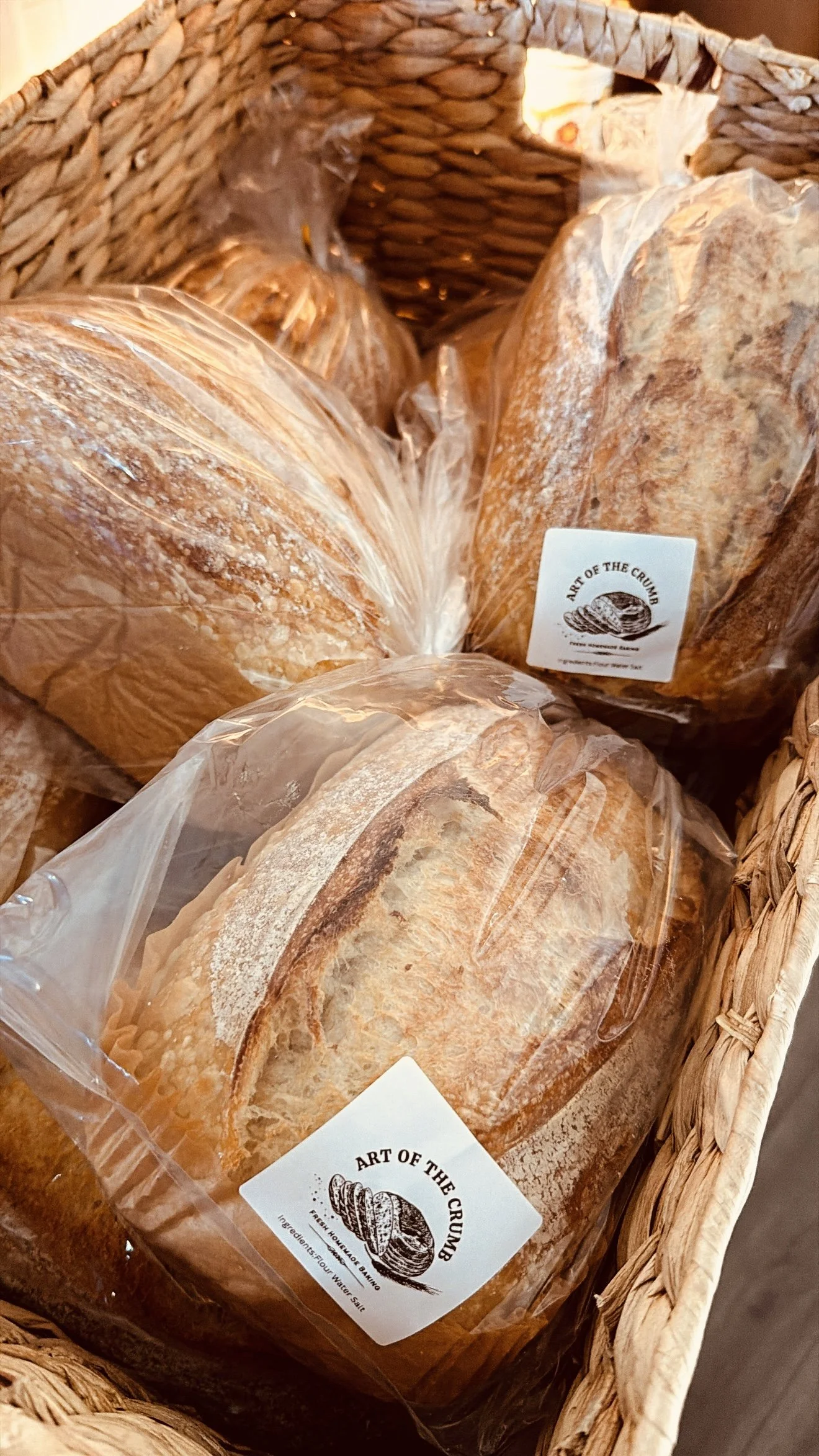
Choosing Faith Over Fear in the Kitchen
Back to the Classroom at 65
I never imagined I would find myself back in the classroom at 65.
And yet, here I am.
Not sitting at a desk with notebooks and pencils, but standing in my kitchen with flour on my hands, a starter on the counter, and pages of notes scattered around me like a student preparing for an exam.
This week has felt like studying.
Studying the process.
Studying the timing.
Studying the rhythm of something much bigger than a single loaf.
As I prepare for my first farmers market, I find myself learning in a new way. Not from textbooks, but from other bakers who have walked this path before me. People who have shared their knowledge generously, offering guidance on everything from feeding a starter to managing a full bake schedule.
And I’ve realized something.
This is not just about learning how to bake more bread.
It is about learning how to trust a process at a new scale.
Learning the Rhythm
There is a rhythm to baking for a market that feels very different from baking for my kitchen or my neighbors.
I am learning to think in days instead of hours.
Feed the starter heavily one to two days before mixing, so it is strong and ready.
Mix the dough and allow it to rise slowly.
Shape the loaves and place them into baskets.
Then comes the part that feels almost counterintuitive at first.
Wait.
Let the dough rest in the refrigerator for twelve to twenty-four hours. A cold, quiet pause that develops flavor and gives structure, while also giving the baker space to breathe.
Then, on baking day, the loaves go straight from the cold into the heat of the oven.
No rushing.
No overthinking.
Just trust in what has already been prepared.
It feels familiar.
Very much like life.
From One Loaf to Many
Until now, most of my baking has been one loaf at a time. A slower, more intimate rhythm.
Now I am learning to think in batches.
Mixing multiple loaves in one container.
Shaping with intention so each loaf is consistent.
Using a dough scraper not just as a tool, but as a way of creating steadiness and uniformity.
There is something humbling about this part.
It is no longer just about creating one beautiful loaf. It is about showing up with consistency, with care, and with enough to serve a community.
And yet, the heart of it remains the same.
Flour.
Water.
Salt.
Time.
The Practical Meets the Personal
There are so many practical details I am learning.
How long to let bread cool before packaging so the crust stays crisp.
How to bag each loaf so it can breathe.
How to create labels that help someone take that loaf home and know exactly how to enjoy it.
How many loaves to bake.
And this one made me pause.
Every experienced baker seems to say the same thing.
Do not bake too many your first day.
It is better to sell out than to carry bread home.
There is wisdom in that.
Not just for baking, but for life.
We are not meant to overextend ourselves in the beginning. We are meant to grow into what we are building, one step at a time.
Trusting What Is Being Built
As I sit here, preparing for May 9th, I can feel both excitement and uncertainty.
There are still questions.
There are still things I do not know.
But I am learning to be at peace with that.
Because every step of this journey has shown me something.
When I stay present, when I do the work in front of me, when I trust the process instead of trying to control every outcome, things unfold the way they are meant to.
This week, my kitchen has become my classroom.
The lessons are not just about dough and ovens and timing.
They are about patience.
About restraint.
About trust.
About understanding that growth does not happen all at once.
It happens slowly.
Quietly.
Just like sourdough.
And just like faith.
So here I am, back in the classroom at 65.
Learning.
Listening.
Preparing.
And trusting that when the time comes, I will be ready to open my table and share what I have been given.
Warmly,
Kathy
Art of The Crumb
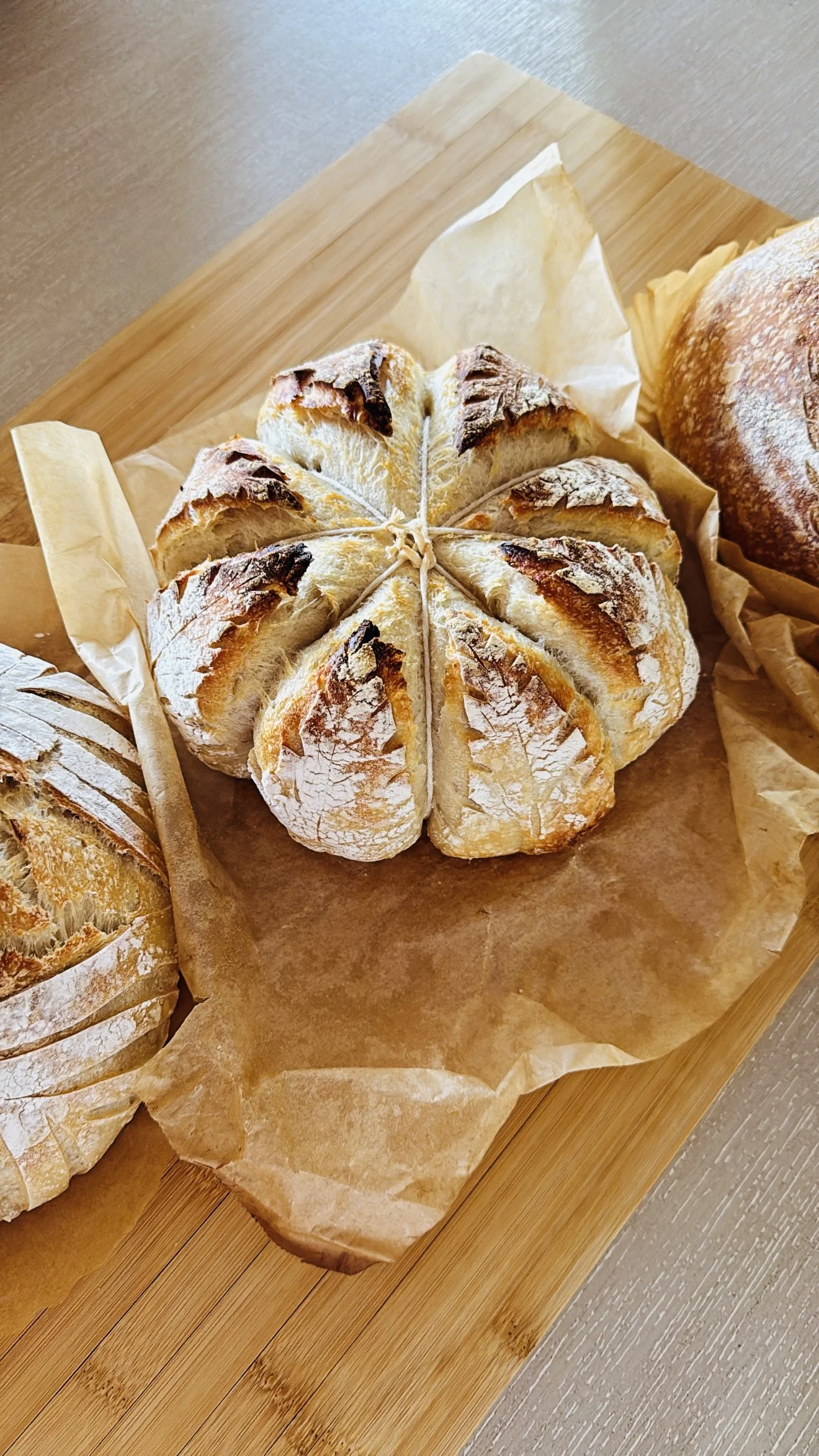
The Loaf That Broke Me Open
Some loaves are different.
They carry more than flour and water. They carry the weight of everything that brought you to the moment you finally make them.
This was one of those loaves.
I had seen other bakers creating these beautiful, segmented loaves around the holidays. I admired them quietly at first. I studied them. I watched video after video, trying to understand not just the technique, but the rhythm behind it. There is something about watching another baker work that invites you to believe, just for a moment, that maybe you can do it too.
Still, I hesitated.
This was not a simple loaf. It required precision, patience, and a level of confidence I was not sure I had yet. At the time, I didn’t even have my bread oven. I was still baking the old-fashioned way, using a Dutch oven and learning as I went.
But eventually, something shifted.
I gathered the courage and decided to try.
That morning felt like so many others in my kitchen. Quiet. Focused. A little uncertain. I worked through the process slowly, carefully shaping each section, tying it together, hoping it would hold. There is always a moment when you place the dough into the oven where everything is out of your hands.
And then comes the waiting.
When the time came, I stood there in front of the oven, just like I had so many times before, holding my breath as I lifted the lid.
Breathe.
Pray.
Trust.
When I saw what was inside, I didn’t move.
There it was.
Golden. Open. Alive.
Something I had made with flour, water, salt… and something more.
I sat down on the kitchen floor and cried.
At first, I didn’t even understand why.
It wasn’t just about the bread. It was about what that moment represented. Every quiet morning in the kitchen. Every failed loaf. Every tear that had fallen into a bowl of dough when no one was watching. Every step of healing that had felt invisible and slow.
In that moment, something inside of me caught up with itself.
All the grief.
All the rebuilding.
All the quiet work of becoming someone new.
It was as if, for the first time, I could see it.
Not perfectly. Not completely. But enough to know that something in me had been changing all along.
That loaf was proof.
Proof that something beautiful can come from simple things, given time and care.
Proof that healing doesn’t always announce itself. Sometimes it shows up quietly, in the form of a loaf of bread you never thought you could make.
I didn’t keep that loaf.
I gave it to a friend of mine who was walking through a brutal divorce. She couldn’t afford my bread, but that didn’t matter. Some things are not meant to be sold. They are meant to be shared.
Later, she sent me a message thanking me in the most beautiful way. She told me her two boys sat in the back seat of the car and ate the loaf before they even made it home.
I could picture it so clearly.
Small hands pulling apart warm bread.
Laughter.
A moment of comfort in the middle of something hard.
And I realized something then.
That loaf was never really mine to keep.
It was always meant to become part of someone else’s healing too.
I have seen some comments making fun of my journey. Making fun of the way I heal through baking bread. And I understand that not everyone will see what I see or feel what I feel in this process.
But for me, this is not just bread.
This is how I pray.
This is how I heal.
This is how I show up for others.
And if something as simple as flour, water, and time can bring even a small moment of comfort, connection, or peace into someone’s life, then I will keep baking.
I will keep learning.
And I will keep sharing what I have been given.
Warmly,
Kathy
Art of The Crumb
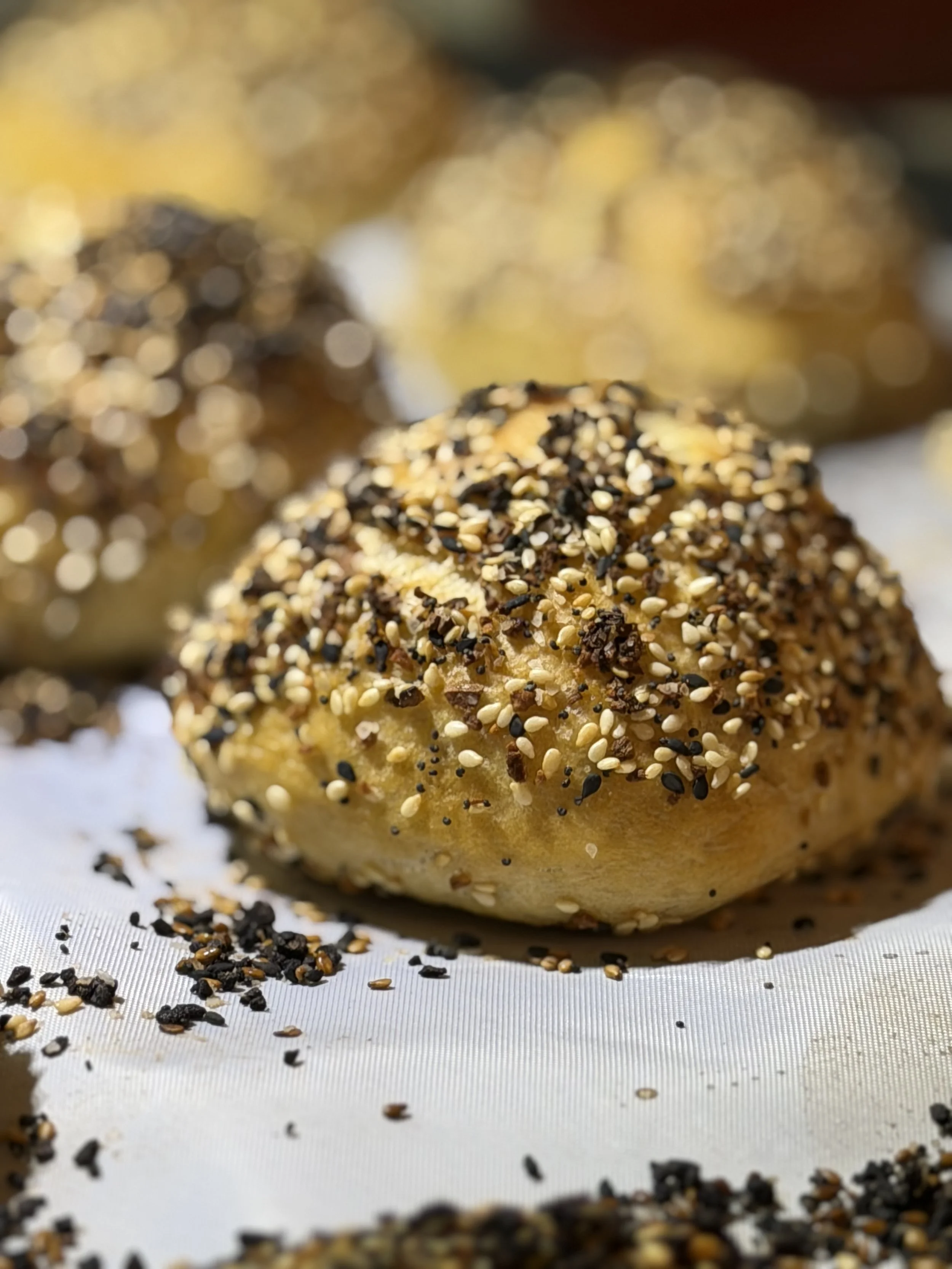
The Hole Lesson: What Sourdough Bagels Taught Me About Trust
When Faith Becomes Part of the Story
Over the past few weeks I have noticed something interesting.
Some people are deeply moved when I talk about faith in my writing. Others feel uncomfortable or even triggered by it. I understand that. Each of us walks our own path in life. Our beliefs, experiences, and understanding of God or a higher power are shaped by very different journeys.
For me, faith is simply part of the story. It is how I make sense of the twists and turns that have shaped my life. It is how I interpret the quiet moments of guidance that appear when I least expect them.
But I also understand that everyone’s path looks different, and that is perfectly okay. What matters most is that we treat each other with kindness and respect as we walk those paths.
Last week I experienced another small reminder of how faith and baking continue to intertwine in my life.
A customer asked if I could make sourdough bagels.
Now if I am being honest, bagels intimidate me.
They are still sourdough, but the process is completely different from baking a loaf of bread. A boule rests quietly in a banneton and then goes straight into the oven. Bagels demand more attention, more steps, and more precision.
When I first read the request, my immediate thought was that familiar voice of doubt.
Can I really do this?
But almost as quickly, another thought followed.
Maybe this is another nudge.
A quiet whisper that said, challenge yourself, Kathy. Trust the process. Trust Me.
So I said yes.
The process of making sourdough bagels begins much the same way as bread. Flour, water, salt, and starter come together to form the dough. After mixing, the dough ferments slowly, allowing the wild yeast to begin its work. Fermentation builds flavor and strength, the same way time builds depth in our own lives.
Once the dough has rested and developed structure, it is divided and shaped into rings. Each piece is rolled gently and carefully, forming the familiar circle that gives a bagel its character.
Then comes the cold proof.
The shaped bagels are placed in the refrigerator and left to rest overnight. This slow fermentation deepens the flavor and strengthens the dough. Patience is part of the process.
The next morning the bagels are brought back to room temperature. The yeast wakes up again, preparing the dough for the final stages.
Unlike bread, bagels are not baked immediately.
They are boiled.
Each ring of dough is gently lowered into simmering water for a short time. This step sets the crust and creates the chewy texture bagels are known for. Once they emerge from the water, they are rolled in toppings. Sesame seeds, poppy seeds, everything seasoning, or simply left plain.
Only then are they ready for the oven.
In many ways the process mirrors life itself. Some things require extra steps. Some challenges take more patience. Some lessons require us to slow down and trust what we cannot yet see.
As I worked through each stage of those bagels, I realized that the lesson was not really about mastering a new recipe.
It was about trust.
Trusting that I could learn something new. Trusting that the process would work if I followed it with care. Trusting that the quiet nudges I sometimes feel are guiding me toward growth.
That is what faith often looks like in my life.
Not certainty.
Just the willingness to say yes and take the next step.
And just like sourdough itself, the best things seem to rise when we give them time.
As I placed the bagels in the oven this morning, I realized something else. Baking has become more than a craft for me. It has become another way of understanding life itself. The dough teaches patience. Fermentation teaches trust. And the quiet rhythm of the kitchen often reveals lessons I might have missed if I were moving too fast.
Those lessons are part of the reason I write about this journey at all.
Why I Share
I have been thinking a lot about why I write the way I do.
Why I share pieces of my story. Why I speak openly about recovery, grief, faith, and the slow rebuilding of a life.
The truth is, it comes from my years in the rooms of sobriety.
If you have ever sat in those rooms, you know the rhythm. People sit in a circle and share their stories. Sometimes the stories are messy. Sometimes they are painful. Sometimes they are filled with quiet victories that might seem small to the outside world but feel enormous to the person speaking.
No one shares because their life is perfect.
They share because someone else in that room might need to hear it.
When I first began listening to others tell their stories of recovery, something shifted inside me. I realized that honesty has a strange kind of power. When one person speaks truthfully about their struggles, it gives another person permission to breathe a little easier. To believe that maybe they are not the only one carrying something heavy.
Over time I learned that sharing is not about drawing attention to yourself.
It is about extending a hand.
My journey has included sobriety, but it has also included learning how to live with grief, loss, and the rebuilding of a life I never expected to rebuild. Those experiences shaped me. They softened me. They taught me to listen more closely to other people’s pain.
So when I write about sourdough, faith, fear, or healing, I am not trying to present myself as someone who has everything figured out.
I am simply doing what I learned to do in those rooms.
Tell the truth about the journey.
Because somewhere out there, someone might read it and recognize a piece of their own story.
And sometimes that recognition is the first small step toward hope.
Warmly,
Kathy
Art of The Crumb
A Quiet Reminder from the Kitchen
Staying Present in the Rise
This week will be the biggest bake week I have experienced since beginning my sourdough journey.
And what a journey it has been.
When I look back over the past year, I can see how each step appeared at just the right time. Opportunities arrived that I never planned. Doors opened that I didn’t even know existed. I have come to believe that when something is placed directly in front of me, it is often God gently showing me the path forward.
Still, knowing that doesn’t mean the human part of me doesn’t feel overwhelmed.
May 9th sits on my calendar like a bright marker on the horizon. My first farmers market. The beginning of something new. If I am honest, the excitement walks right alongside anxiety.
Today I was preparing for the week ahead. Feeding starter. Setting menus. Writing out timelines. Trying to organize the rhythm of the days to come.
And then something familiar happened.
I started making small mistakes.
As I measured filtered water into a bowl for bagel dough, my mind wandered ahead. I began imagining the market, the setup, the customers, the unknowns. My thoughts were no longer in my kitchen. They were racing somewhere in the future.
Future tripping is an old habit of mine. It is a voice that sometimes shows up when something important is about to happen. It whispers questions and worries, trying to solve problems that do not yet exist.
As the water continued to pour, it flowed right over the edge of the bowl and onto the counter.
That snapped me back into the present.
I stopped what I was doing and stepped away from the counter. I closed my eyes and asked God to intervene.
And then, quietly, the words came.
Breathe.
Slow down.
Trust the process.
Trust Me.
Almost immediately a calm settled over me.
It reminded me of something sourdough teaches every single day. Nothing meaningful happens when we rush the process. Bread rises in its own time. The baker’s role is simply to tend it with patience and care.
Measure.
Mix.
Fold.
Wait.
Life is not so different.
When our minds race too far ahead, we lose the moment we are standing in. But when we return to the present, something steadier takes over.
Peace lives there.
So tonight I am reminding myself of something simple. And maybe someone reading this needs the reminder too.
Breathe.
Slow down.
Stay where your feet are.
Trust the process.
The same God who placed the path in front of you will walk it with you.
And in time, just like the dough resting quietly on the counter, everything will rise exactly as it is meant to.
Warmly,
Kathy
Art of The Crumb
Not Bread Jesus — Just the Bread Lady
When Criticism Comes: Returning to Purpose
I never intended for this space—this blog—to become a place where I justify myself.
From the beginning, I wanted it to be something else entirely. A quiet corner of the internet where I could reflect on faith, bread, healing, and the small lessons life continues to teach me. A place where stories about sourdough might open the door to conversations about recovery, grief, service, and grace.
But every once in a while something happens that makes me pause.
A comment.
A sentence.
A few words typed quickly and sent out into the world.
One cruel remark can linger longer than we would like to admit. Words have always carried power, but in this era of social media they travel farther and faster than ever before. Platforms that were meant to connect us sometimes become places where words are sharpened and thrown like stones.
And if I’m being honest, one harsh comment can still find its way into the quiet corners of the heart.
Over the years I’ve learned that criticism will come to anyone who shares their life publicly. Sometimes it arrives as thoughtful disagreement. Sometimes it comes as questions that push us to think more deeply. And sometimes it appears as something far less generous: words meant not to understand, but simply to wound.
For a long time, criticism had the power to shake me more than it should have. My mind would replay the comment again and again, trying to defend myself, trying to rewrite the conversation in my head until I somehow “won.”
Sobriety, faith, and a great deal of life experience have slowly taught me another way.
I’ve learned that not every comment deserves a battle. But occasionally a response can become an opportunity—not to argue, but to return to purpose.
Over time I’ve come to rely on a simple practice when criticism appears.
Acknowledge
The first step is simply acknowledging what was said without escalating it.
There is a quiet strength in recognizing a comment without immediately reaching for a sharper one in return. Acknowledging does not mean agreeing. It simply means refusing to let the moment turn into a shouting match.
Grace has a way of lowering the temperature in a room.
Clarify
The next step is to clarify intention.
Criticism often grows in the absence of understanding. When people do not know your heart, they fill in the blanks with their own assumptions. A calm explanation can gently return the conversation to the truth of what you are actually trying to do.
For me, the truth is simple.
I am not trying to elevate myself or pretend I have special authority over anything. I am a woman in her kitchen making bread and sharing the lessons that baking, faith, and recovery have taught me along the way.
Bread just happens to be the language I use to talk about healing, service, and community.
Return to Purpose
And then comes the most important step: returning to purpose.
When we stay focused on criticism, the critic controls the conversation. But when we return to our mission—why we started, who we are trying to serve, what matters most—the noise begins to lose its power.
My purpose has never been attention or status.
It has always been about service.
Bread is one of the oldest ways human beings care for one another. When we break bread together, we acknowledge something deeply human: that we all need nourishment and that we are better when we share it.
Choosing Grace
Responding with grace does not mean pretending harsh words do not sting. It means refusing to let them define the moment.
Over time I’ve learned that the way we respond to criticism says far more about us than the criticism itself. Often those words reveal something about the pain or frustration someone else may be carrying.
Meeting that pain with more hostility rarely improves the situation.
But responding with clarity, humility, and kindness sometimes shifts the conversation in a different direction.
And if it doesn’t?
At least you have remained aligned with the person you are trying to be.
Keep Showing Up
In the end, the answer is usually the same.
Keep showing up.
Keep doing the work.
Keep serving the people who find meaning in what you create.
For me, that work happens in my kitchen. It looks like flour on the counter, a jar of starter bubbling quietly on the shelf, and loaves of bread shared with neighbors, friends, and anyone who might need a little nourishment.
Not every voice will understand that.
But the right ones will.
And that is enough.
So I’ll keep tending the starter, baking the loaves, and letting kindness be louder than cruelty.
Warmly,
Kathy
Art of The Crumb
Trust The Rise: Preparing For My First Farmer’s Market
A Yes That Stirred Up the What-Ifs
When the email arrived from the Clarksville Downtown Market telling me I had been accepted as a vendor, two feelings showed up at the same time.
Excitement.
And fear.
For a moment I simply stared at the screen. Then the familiar chorus of what-ifs began to gather in my mind. My thoughts ran ahead of me, trying to plan every detail of something I had never done before.
Sobriety has taught me to recognize that voice.
It’s the same kind of future-tripping that used to dominate my days. The mind races forward, imagining problems before they exist, trying to control outcomes that haven’t even begun.
The questions came quickly.
How many loaves should I bake?
Should I offer different inclusions?
Do I add bagels, cookies, muffins?
When does the prep begin?
When do I actually start baking?
Before long, the excitement I had felt just minutes earlier had turned into something closer to panic.
The Practice That Grounds Me
In moments like this, I return to the practices recovery has given me.
I breathe.
I pause.
And I pray.
There is a kind of surrender that doesn’t come from giving up but from letting go of the idea that we must solve everything ourselves.
Once I stepped back from the noise in my head, something shifted. The answers didn’t arrive all at once. They came the way guidance often does now in my life—quietly, piece by piece.
I felt it again, that steady reassurance that God has His hand in my path. Over time that trust has become part of who I am. When fear begins writing stories in my mind, faith reminds me that I am not walking alone.
The market begins May 9.
The Right Help Appears
Almost as if on cue, another piece of the path appeared.
I received an email from one of the baking communities I joined when I first started baking with my Simply Bread Oven. What began as an online group has grown into something that feels more like family. In that space no question is dismissed and no baker is made to feel foolish for asking. People share knowledge freely and respond with kindness that is rare on the internet.
Today I’ll be joining a workshop called:
“The Micro-Baker’s Guide to Crushing Your First Farmer’s Market,” led by Alisha Fuller.
The focus is practical: how to plan what I can realistically produce, how to build a bake schedule that won’t leave me panicked the night before market, and what it actually feels like once the morning rush begins.
All the things my mind was trying to solve alone.
What Bread Keeps Teaching Me
Sourdough has a way of reminding me how life works.
A loaf does not rise because we worry about it. It rises because we tend to it faithfully and then allow time to do its work.
Measure.
Feed.
Fold.
Wait.
My life has begun to follow that same rhythm.
When fear starts whispering its what-ifs, I return to the practices that ground me—breath, prayer, community, and small action. Slowly the path becomes visible again.
Once again I’m reminded that sourdough has given me far more than bread. It has given me a daily way to practice faith.
Trust the process.
Let go of the old fears.
And rise.
Warmly,
Kathy
Art of The Crumb

The Mountain That Grounds Me
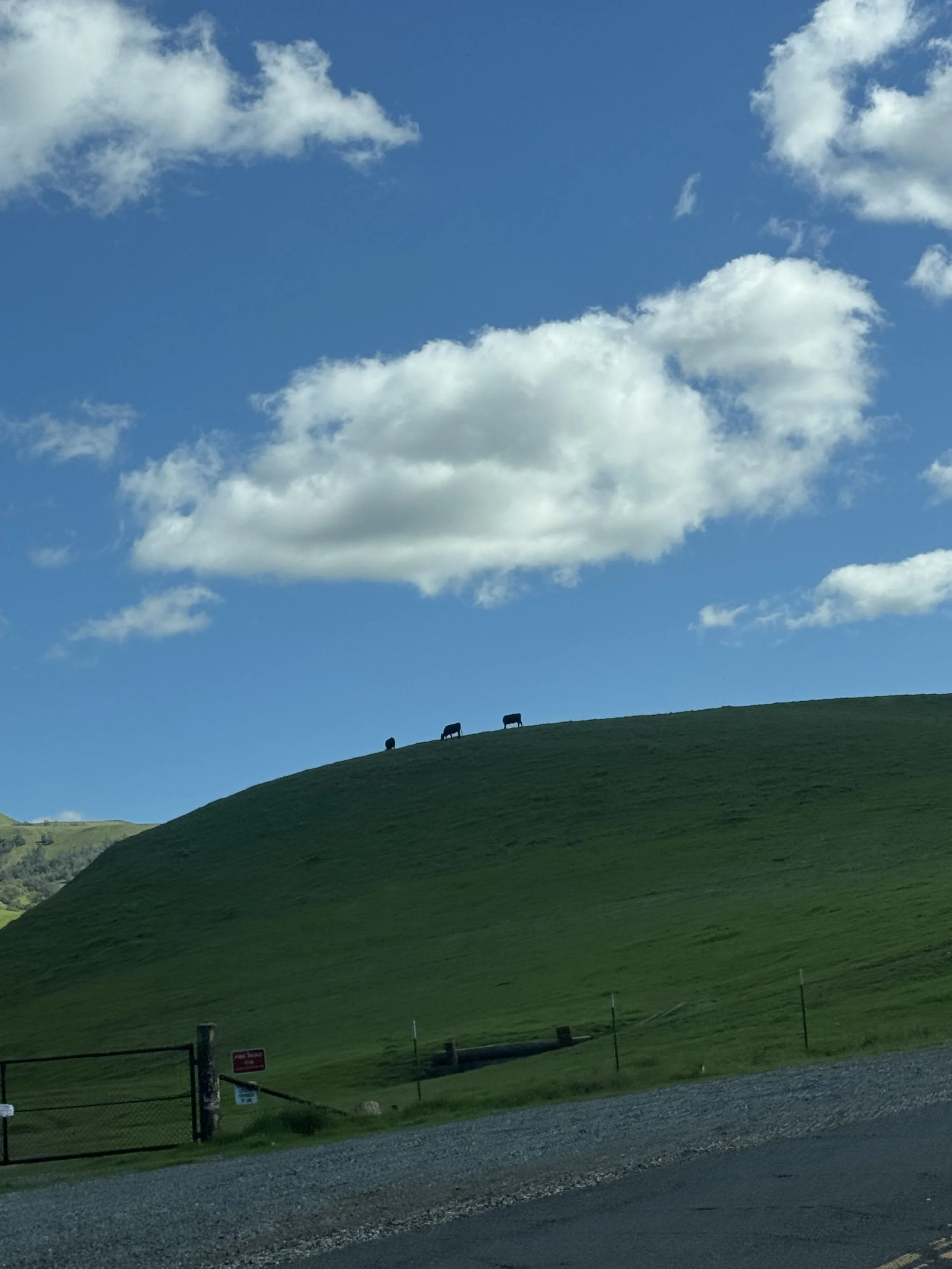
Every once in a while, I find myself back in California.
Home.
It is the place that grounds me in a way no other place quite can. The air feels familiar. The light feels softer. Even the quiet feels different here.
This trip has been filled with visits to people who have held me up through some of the hardest chapters of my life. Friends who have never stopped believing in me. Family who remind me where I came from and who I have always been.
And my cousin, who long ago became much more like a sister.
She is the one who picked me up off her kitchen floor during a moment when I truly believed I could not go on. I remember sitting there, feeling completely broken, and she looked at me and simply said, “Keep going. Don’t give up.”
And somehow, I believed her.
Sometimes the people who love us see strength in us long before we can see it ourselves.
Whenever I come back to California, there is one place I always go.
Mt. Diablo.
It was the mountain my dad shared with me when I was young. Long before life became complicated. Before marriage, before children, before divorce, before loss and grief found their way into my story.
Back then it was simply a place we went together. A place where the world felt wide and full of possibility.
Now, when I go there, it feels like something more.
Standing there, looking out across the hills and the valleys, I feel him. I feel the steadiness he carried and the quiet strength he gave to everyone around him. It is as if the mountain still holds pieces of him.
My dad was a high school football coach. People often said he was a maker of men. He believed in discipline, character, and showing up for others. He taught young men how to work hard and stand tall, but he also taught them how to care for the people beside them.
To me, he was simply my hero.
When I stand on that mountain now, I think of him and I think about how life continues to unfold in ways we never expect. The road has not been straight. There have been seasons that felt impossibly heavy.
But somehow, standing there, it feels like pulling into a gas station and filling the tank again.
The love.
The strength.
The encouragement to keep going.
I leave that mountain feeling refueled in a way that is hard to explain but easy to recognize. It is the same feeling my cousin gave me on her kitchen floor three years ago. The quiet reassurance that I am still moving forward and that the path I am on still matters.
And then I carry that feeling back with me into my life.
Back into my kitchen.
Back into my bread.
Back into the small, meaningful work of nourishing people.
Because sometimes all we need is a place that reminds us who we are.
For me, that place will always be Mt. Diablo.
Warmly,
Kathy
Art of The Crumb
Becoming “The Bread Lady”: Counting Blessings, Not Loaves
Are You the Bread Lady
It still surprises me how often the most important moments in my life happen in the most ordinary places.
This week, I pulled up to make a delivery and saw something I had never quite seen before. People were lined up, waiting to buy bread. My bread. I got out of the car with a crate in my arms, hair probably a little wild from the oven heat, and someone looked up and asked with a smile, “Are you the bread lady?”
I felt the words land in my chest.
Two women who were already there started talking about my loaves. They went on and on about the flavor, the texture, what they had made with them, how their families loved the bread. I stood there listening, cheeks warm, eyes welling up. Not because they were complimenting me, but because something I made in my quiet kitchen was truly touching their lives.
For so many years I did not know who I was anymore. I was a wife, then not. I was a full time mom, then an empty nester. I was a woman in recovery starting over in her sixties. I never imagined that one day I would be known, in the sweetest way, as “the bread lady.” It felt like God’s little wink, a gentle way of saying, “See, I can still write new names over you.”
The Bread Angel at Manna Café
On the days I bring loaves to Manna Café, I walk in with flour on my shirt and bags in my hands, and someone always calls out, “The bread angel is here.”
I am not an angel. I am a very human woman with a very human story. But every time I hear those words, I feel my eyes sting. Because I remember the day, sitting in traffic, when I cried out, “God, what do you want of me,” and glanced up to see the sign for Manna Café. I remember how lost I felt then, and how baking for them became a way to put my hands to work when my heart did not know what else to do.
To have them greet me this way is a reminder that small offerings matter. A few loaves on a pantry table. A basket at a community dinner. Simple bread, sliced and placed on plates, eaten by people who may not know my name but can feel the care in what they are being given.
I do not take a single “bread angel” comment for granted. I hear it as “God is using you, keep going.”
When the Neighborhood Starts Knocking
When I told my neighbors that I would be leaving town for a much needed trip to California, the messages started pouring in.
“Can I get a loaf before you go.”
“Do you have room for one more order.”
“I need to stock up while you are gone.”
My phone lit up with DMs and texts. People were not just buying bread. They were trying to make sure they did not have to go without it while I was away. I baked as much as I could before leaving, filling my porch, my car, and my heart.
There was a time not very long ago when I felt invisible. When I wondered if anyone would notice if I slipped quietly out of the room. Now my neighbors watch for my posts and listen for the sound of my car in the driveway, because it might mean a fresh loaf has arrived.
I am not saying this to brag. I am saying it because I am counting blessings.
Counting Blessings, Not Loaves
I think often about the girl I once was in California, learning to sew and bake through 4‑H, not knowing how those simple skills would one day carry me. I think about the woman I became in Connecticut, feeding a family of six at a long table, never imagining that table would one day change. I think about the version of me who arrived in Tennessee tender and tired, wondering if there was anything left for her to offer.
Now I see myself in Clarksville, standing beside crates of sourdough, being called “bread lady” and “bread angel,” and I feel nothing but gratitude.
For each person who lines up for a loaf.
For each neighbor who messages before I go out of town.
For each staff member at Manna Café who smiles when I walk in.
For each quiet kitchen where my bread is sliced and shared.
It is easy in this world to measure success by numbers, followers, or sales totals. I have done that at times. But the older I get, the more I realize the real success is connection. The real wealth is in being woven into the daily lives of people around you in a way that brings comfort and nourishment.
So I am counting blessings, not loaves.
Every time someone calls me the bread lady, I hear “You are needed here.”
Every time someone calls me the bread angel, I hear “You are being used for good.”
Every time an order comes in because someone heard from a friend, I hear “You are not invisible.”
This little bakery, born from grief and starter, has become a bridge between my heart and this town. For that, I am deeply, quietly thankful.
Warmly,
Kathy
Art of The Crumb
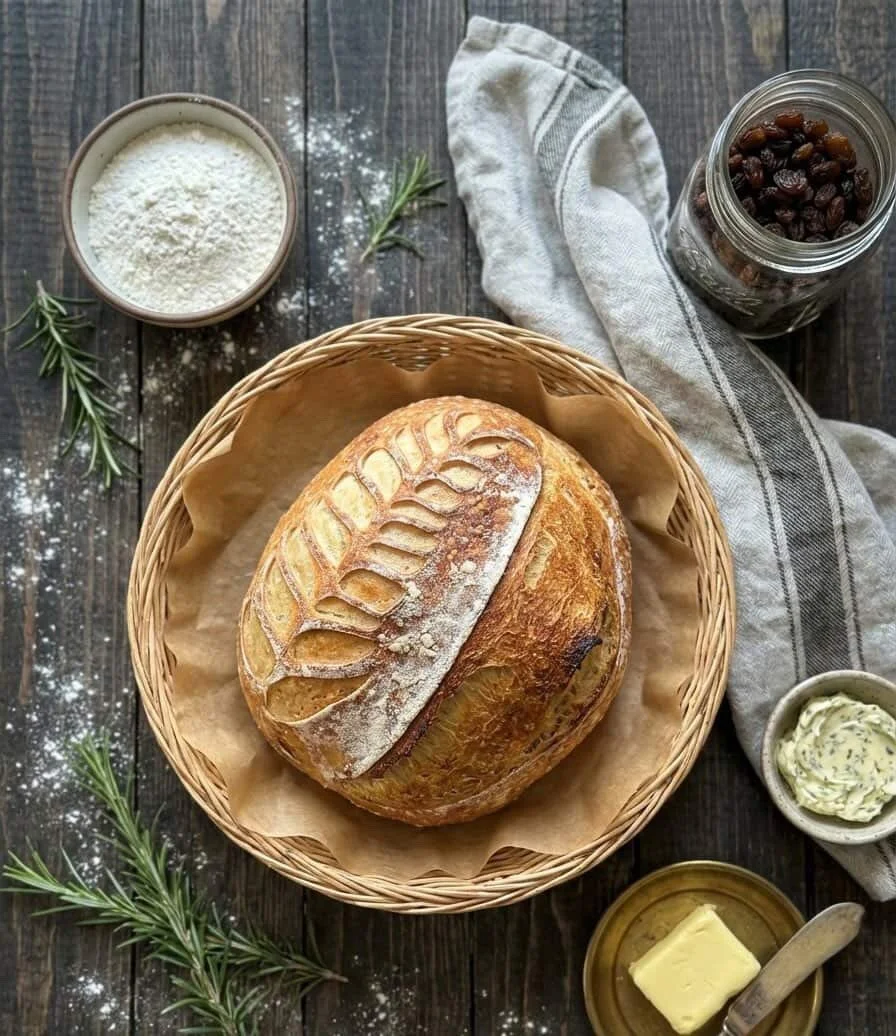
Sourdough, Inflammation, and Me: A Baker’s Look at Food as Medicine
A Baker, Not a Doctor
I want to begin with something important.
I am not a doctor.
I am not a registered dietitian or medical professional.
I am a woman in her sixties who found her way back to life and faith through flour, water, salt, and time. I am a home baker who listens closely to people’s stories and pays attention to how food makes us feel.
What I share here is not medical advice. It is simply my experience as a baker who is curious about the health benefits of long‑fermented sourdough and who has started reading what the science is beginning to say.
Please talk with your healthcare provider before making any decisions about your health, especially if you have medical conditions, allergies, or specific dietary needs.
What I Hear at the Table
Over the past year, I have lost count of how many times someone has said to me:
“I can’t eat most bread, but your sourdough feels different.”
“I usually bloat with bread, but this doesn’t bother me as much.”
“I thought I had to give up bread, and now I can enjoy it again.”
I have noticed some of the same things in my own life. Long‑fermented sourdough seems gentler on my body than many store‑bought loaves. That does not mean sourdough is safe or right for everyone. It does not erase gluten sensitivities or celiac disease. But it has made me curious.
So I started reading.
What the Research Is Starting to Say
Recently, I came across a scientific review article available through the National Institutes of Health (NIH) database. It was published in 2025 in the Journal of Inflammation Research and explored how sourdough fermentation may relate to inflammation and gut health.
You can read it here if you like digging into the details:
https://pmc.ncbi.nlm.nih.gov/articles/PMC11978714/
The authors looked at existing studies and suggested that long fermentation and specific lactic acid bacteria in sourdough can change certain compounds in wheat. These changes may affect how our bodies respond, including in ways that could be relevant to inflammation and the gut. They are careful to say that more research is needed. It is not a magic fix. But it is interesting.
Around the same time, I started following the work of Dr. William Li, a physician who writes and speaks about “food as medicine.” In one of his overviews, he talks about how certain foods and food preparations can support the body’s natural defense systems: immunity, blood vessels, the microbiome, and more.
You can read his overview here:
https://drwilliamli.com/an-overview-of-food-as-medicine-to-fight-disease/
He does not focus only on sourdough, but his work supports an idea that resonates with me deeply. The way we prepare food matters. Slow, traditional methods, whole ingredients, and fermentation are not just “old‑fashioned.” They may, in some cases, be kinder to our bodies.
Again, I am not qualified to interpret his work as a professional. I am just a baker who finds it encouraging that thoughtful people in medicine are paying attention to what many of us notice day to day in our kitchens.
What I Notice in My Own Kitchen
Science is important. So is lived experience.
In my kitchen, I work with long fermentation. That means the dough rests for many hours, giving the wild yeast and lactic acid bacteria time to do their work. During that time, they change the structure of the dough in ways we can taste and feel:
The flavor deepens.
The texture becomes more complex.
The bread often keeps longer without added preservatives.
Some researchers are suggesting that this fermentation may also affect things like gluten structure, FODMAP content, and bioavailability of certain nutrients. The 2025 review article hints at these possibilities. Dr. Li’s work on food as medicine supports the idea that food can play a real role in how we feel and how our bodies function.
In my life and in the lives of some of my customers, long‑fermented sourdough seems to be easier to live with than many fast‑made breads. That does not mean it is a cure. It does not mean it will help everyone. But it is enough to keep my curiosity awake and my commitment to slow methods strong.
Why This Matters to Me as a Baker
I care about this for a simple reason. I do not just want to make bread that looks pretty on a shelf. I want to bake bread that honors the bodies and lives of the people who eat it.
Knowing that there is early research suggesting possible benefits of sourdough fermentation encourages me in what I am already doing:
Using long, natural fermentation
Choosing high‑quality flours and ingredients
Avoiding unnecessary additives
Listening to how people feel after they eat my bread
I will always leave diagnosis and treatment to professionals. But inside my little circle of responsibility, I can choose to bake in a way that aligns with what we are slowly learning about food and health.
A Gentle Invitation
If you are interested in this topic, I encourage you to:
Read the Journal of Inflammation Research article for yourself
Explore some of Dr. William Li’s writing and talks
Pay attention to how different breads and foods make you feel
Speak with your doctor or nutrition professional if you have questions about what is right for your body
I am not here to make health claims. I am here as a baker who believes that food can be one part of a gentler, more intentional way of living in our bodies. Sourdough has been that for me. It has been a tool for healing, not just emotionally and spiritually, but physically as well.
I will keep reading. I will keep baking. I will keep listening to your stories and my own. And I will keep doing my best to make bread that nourishes more than just hunger.
Warmly,
Kathy
Art of The Crumb
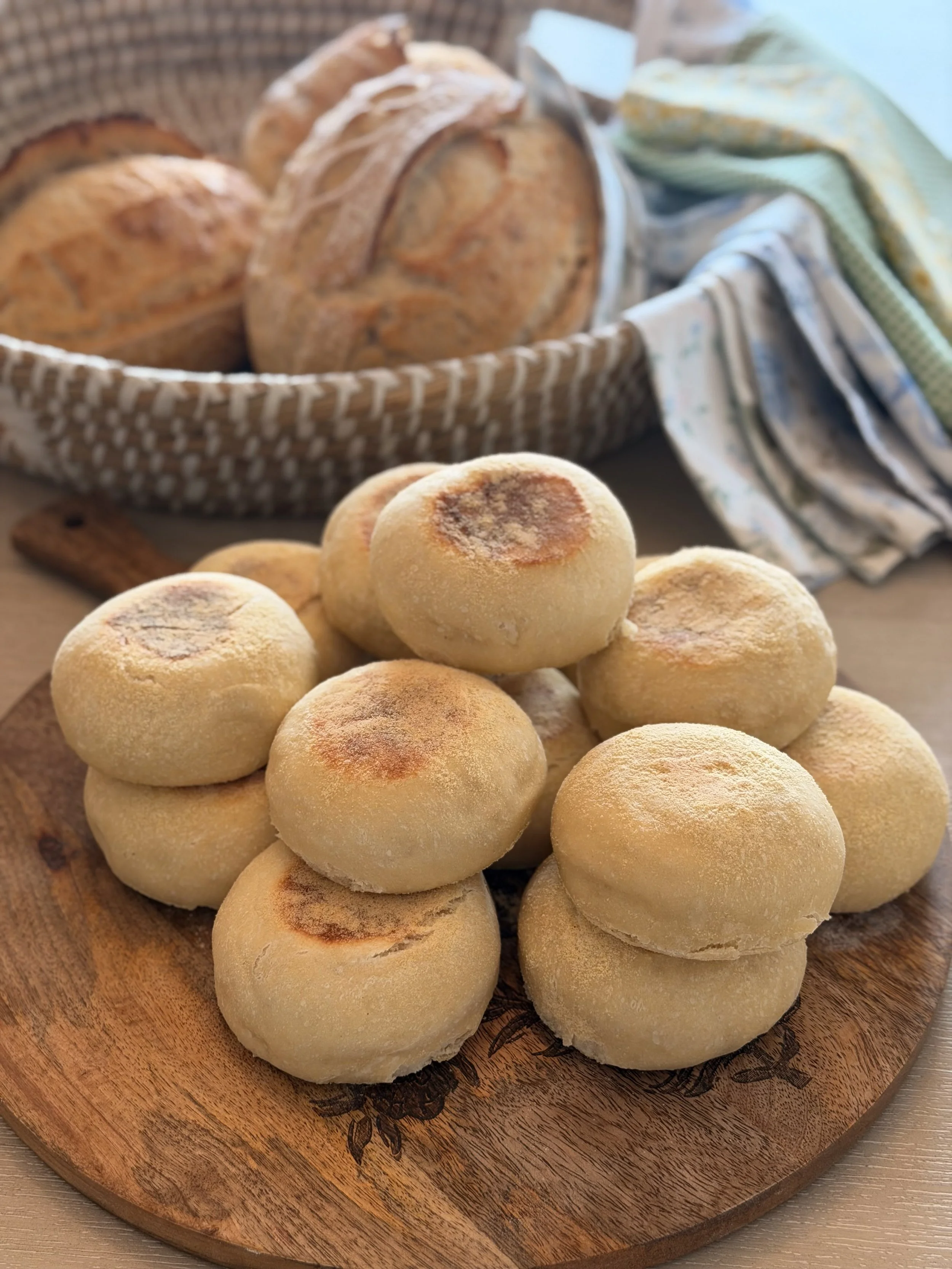
Borrowed Recipes, Shared Tables: What Sourdough English Muffins Taught Me About Community
Learning From Other Hands
Most of the recipes I bake now were born in my own kitchen. They came from years of trial and error, stained notebooks, and more than a few loaves that ended up as croutons. But not everything began with me. Some of my favorite bakes started in someone else’s bowl, in someone else’s hands.
Our sourdough English muffins are one of those.
The recipe that has quickly become my most requested item did not fall from the sky onto my counter. It came from another baker. Her name is Bim, and she shares her knowledge and her recipes with a generosity that feels rare and beautiful in a world that often clings tightly to its secrets.
I printed her recipe, read through her notes, and walked right back into the role of beginner.
The Humility of Starting With Someone Else’s Recipe
As bakers, it is easy to feel we must invent everything ourselves. That “real” artistry comes only from original creations. But that is not how bread, or tradition, actually works.
Almost everything we bake comes from somewhere. A grandmother’s card file. A neighbor’s scribbled note. A recipe shared across a counter after church. A blog post from a stranger who took the time to write it all down.
When I started working with Bim’s English muffin recipe, I burned a few. I underbaked a few. I overproofed some and squeezed others into pans that were a little too crowded. I took notes on what worked in my oven, in my climate, with my starter. I asked, “What if I adjust the fermentation here?” and “What happens if I change the heat just a bit?”
Slowly, that borrowed recipe began to feel at home in my kitchen. It carried Bim’s wisdom and structure, but it also started to hold my own rhythms and preferences. It became something shared, not stolen. A conversation between two bakers who may never knead dough in the same room, yet are still working together.
The Generosity of Bakers Who Share
I am deeply grateful for bakers like Bim who open their notebooks and say, “Here, try this.” They are not afraid that someone else’s success will diminish their own. Instead, they understand that good bread is meant to travel. It is meant to grow.
Their sharing allows more people to taste something wonderful. It allows more homes to fill with the smell of warm dough. It invites more tables to hold something that was made with care.
In my own journey, this kind of generosity has been a lifeline. When sourdough first found me in a season of grief and rebuilding, I learned from strangers on the internet as much as from my own experiments. People I had never met were willing to explain, to troubleshoot, to offer recipes and methods that had taken them years to refine.
They gave it away so that someone like me could begin again.
Making It My Own, Without Making It Mine Alone
Over time, I have adjusted Bim’s recipe so it works in my space. I have played with timing, handling, and little touches that suit my starter and schedule. Customers have tasted them and asked for more. Many have said, “These are the best English muffins I’ve ever had.”
That humbles me. It also reminds me to say, out loud and clearly, that I did not create this from nothing. I am standing on another baker’s shoulders.
I believe there is a way to honor both parts. I can be proud of the care I take in mixing, fermenting, shaping, and cooking each muffin. I can also be honest about where the bones of the recipe began, and give thanks for the one who first did the hard work of writing and testing it.
Good things grow when we refuse to hoard them.
The Table Is Big Enough for All of Us
Bread has always been a communal food. It is shared, broken, passed from hand to hand. It is rarely eaten alone. The same can be true of the craft of baking itself.
When we share recipes, methods, stories, and even mistakes, we widen the table. We make room for more people to learn, to bake, to feed the people they love. We move from competition to community.
These sourdough English muffins are a small symbol of that. They began in another baker’s kitchen. They traveled through her generosity into mine. From here, they travel again, to your tables and your toasters and your quiet mornings with coffee.
My hope is that you feel that lineage in every bite. That you sense the invisible community of hands behind them, all saying the same thing in their own way:
Here. Take this. Make it your own. Then share it on.
Warmly,
Kathy
Art of The Crumb
Bim’s Sourdough English Muffins Recipe
1,200 g. Bread flour
760 g. Milk
300 g. Sourdough starter or Discard one week old
80 g. Honey or sugar
22 g. Salt
3 eggs
Mix everything in a large bowl followed with 4 sets of stretch and fold every 30 minutes (2 hours)
Proof another 2 hours or until it rises 70% at 75º degrees.
Option one same day bake- cut the dough into 110 g. Or your preference size and bake.
Option two retard over night, cold retard gives the bread nice flavor.
In the morning cut the dough into size of your preference and mine are 110 g. (24 English muffins) making ball I use a lot of flour to handle them, rest dough on the countertop to proof another 2 hours or until double in size.
Oven Bake 400º
Before baking, cover each ball with individual cup (one cup size) find some heavy pot to put on top and bake for 20 minutes
Traditional bake.
Heat up the pan on medium low, put muffins in and covered the lid for 4-6 minutes each side or cook until golden brown, then transfer the English muffins into the baking tray and bake in the oven or air flyer another 4 minutes at 375º This way you avoid uncooked centers.
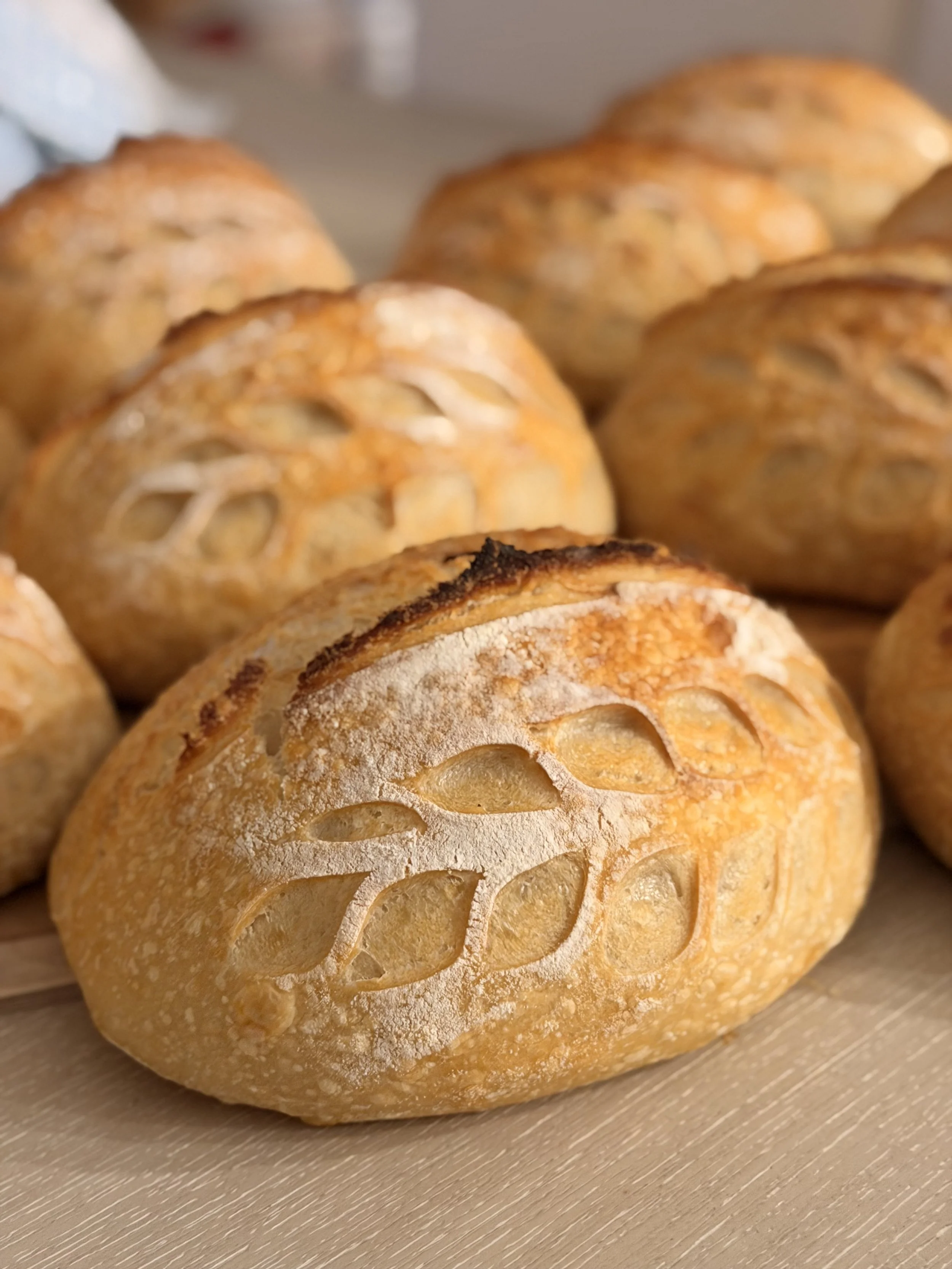
Loaves, Limits, and Letting Go: What Sourdough Is Teaching Me About Expectations
When Expectations Crowd the Counter
There are days when my biggest obstacle isn’t the dough in front of me—it’s the voice in my head.
It sounds like this:
You should be baking more.
You should be posting more.
You should be at that level by now.
Look at what they are doing.
Expectations pile up the way flour does: lightly, then all at once. What starts as a simple hope, “I’d love to grow this little bakery,” subtly turns into pressure: “If I don’t hit this number, this event, this look, I’m behind.” Before I realize it, my joy has been quietly swapped for anxiety. The craft I love becomes something I’m trying to “keep up” with, instead of something I’m receiving as a gift.
I’ve learned this the hard way: when I let expectations run the show, my baking, and my spirit, both suffer.
The Trap of Measuring Myself Against Other Bakers
Social media is a blessing and a snare. I can watch an incredible baker across the country shape perfect bâtards, score like an artist, fill tables with pastries I’ve never even attempted. I can learn so much: and I do. But if I’m not careful, admiration turns into comparison, and comparison turns into shame.
Suddenly my mind is full of “not enough”:
My crust isn’t as dark.
My scoring isn’t as intricate.
My menu isn’t as big.
My business isn’t as polished.
And yet, the people who come to my porch, a community table, or the New York Butcher Shoppe aren’t asking for perfection. They’re asking for bread that is honest, nourishing, and made with care. They’re not scrolling my mental list of failures; they’re slicing into a loaf that came from this kitchen, these hands, this life story.
When I compare my path to another baker’s, I’m measuring something God never asked me to measure. He didn’t call me to be the best baker on the internet. He called me to be faithful with what’s right in front of me.
Expectations as a Kind of Future-Tripping
In sobriety, I learned about “future tripping”…racing ahead in my mind to every possible disaster and then living as if it’s all already true. Expectations can be a cousin to that. Instead of catastrophes, they fill my head with invisible scorecards:
By now, you should be here.
Real bakers do this.
Real businesses look like that.
When I’m lost in expectation, I’m not in the room with the dough. I’m not with the starter, the scale, the gentle folds. I’m somewhere else entirely; living in an imaginary future where I’ve already been judged and found lacking.
But sourdough only lives in the present. It doesn’t care about where I “should” be. It responds to temperature, time, and touch right now. If my mind is ten steps ahead, I miss the quiet cues of the dough and, more importantly, the quiet presence of God in the moment.
What the Dough Knows: Returning to the Work in Front of Me
Bread has a way of humbling expectations.
You can follow the same formula and get a different result. One day the loaf springs high with a singing crust; the next it spreads a little, stubborn and low. Each bake reminds me: I am not fully in control. My job is to show up, pay attention, and do the next right thing, feed, mix, fold, bake.
When I feel overwhelmed by expectations or comparison, I’ve started asking myself three questions:
What is actually in front of me right now?
Not the imaginary audience, not the other baker’s feed. Just the dough, the oven, the person I’m baking for today.What is mine to do, and what belongs to God?
My part: honesty, effort, craftsmanship, care.
God’s part: outcomes, timing, who sees, who is moved.Does this expectation help me love people better, or just prove something?
If it helps me serve more gently, listen more deeply, give more freely,that’s worth holding. If it’s just about appearing impressive, it needs to go.
Loaves, Not Ladders
Expectations often feel like ladders: always another rung, always higher to climb. But my life has not been a climb; it’s been more like a series of loaves: one at a time, shaped by seasons, faith, and a lot of starting over.
I think about:
Six years of continuous sobriety.
A life rebuilt in my sixties.
A small home kitchen now baking for neighbors, a farmers market, a local butcher, and Manna Café.
None of that came from perfectly managed expectations. It came from a thousand small choices to keep going when I felt unsure, to show up when I felt behind, and to trust that my worth is not tied to anyone else’s pace or production.
God has never asked me for bigger numbers. He has asked me for a willing heart.
If You’re Suffocating Under Expectations
If you find yourself weighed down by all the “shoulds,” as a baker, as a parent, in your work, in your faith, here are a few gentle practices that help me:
Name the expectation honestly.
Write it down: “I think I should be ___ by now.” Seeing it on paper softens its power; you can question where it came from and whether it’s true.Shrink the circle.
Instead of comparing yourself to “everyone,” think of the one person you’re serving today. What do they actually need? It’s rarely perfection.Return to a simple, physical task.
Feed the starter. Shape one loaf. Stir a batter. Walk outside. Doing something small and embodied pulls you back from the fog of comparison.Let God hold the scoreboard.
Pray something like: “You know my heart. Help me be faithful, not frantic. Show me what’s mine to carry, and what I can lay down.”
Each time I release an expectation that isn’t mine, I make a little more room for joy, for creativity, for genuine connection. The bread gets better when the pressure lightens: not because the technique is suddenly perfect, but because my heart is present again.
I am still learning this. Some days I get lost in the scroll and forget who I am. But then I come back to the dough, to the quiet work, to the God who has carried me this far, and I remember:
I wasn’t called to impress the world.
I was called to feed the people in front of me, as honestly as I can.
One loaf. One table. One small, faithful step at a time.
Warmly,
Kathy
Art of The Crum
Face Everything And Rise: What Sourdough Taught Me About Fear
There was a time when fear felt like a houseguest who never left—one that rearranged the furniture, turned down the lights, and whispered catastrophes until I believed them. In the rooms we call that future tripping: my mind racing far ahead to every worst‑case scenario, rehearsing pain that hasn’t happened and, many times, will never happen. Fear became not just an emotion but a map I followed, and its directions were always toward smallness, isolation, and paralysis.
Early in my sobriety, I found myself sharing in meetings about the "what ifs,” about how they consumed me. I’d sit in a circle and tell the story of futures that hadn’t happened yet but had already stolen my peace. Six years of sobriety and counting, I don’t do that anymore. Acceptance is the answer. That real change didn’t come from pretending fear didn’t exist; it came from learning to notice it, name it, and move through it.
In AA we use a simple, stubborn piece of language: FEAR: Face Everything And Rise. It’s not platitude. It’s a practice. To face everything doesn’t mean to be fearless; it means to notice the fear, call it by name, and take another step anyway. Rising is the decision to keep showing up to life’s questions rather than pretending the answers are already written in disaster.
Sourdough taught me the rest. I didn’t set out to use bread as therapy, but the work of keeping a starter alive, of feeding it and waiting, of accepting imperfect loaves, mirrored the work I needed for recovery. When I’m creating loaves for a customer, my neighbors, or Manna Cafe, I find myself staying in the moment. Trusting the process. The routine, measure, feed, fold, wait, anchors me to the present and into a mindset of humility and patience.
There’s a useful comparison here. Fear, left unattended, behaves like an unfed starter: it grows wild and sour. But when tended with small, consistent practices it becomes manageable. Bread teaches this plainly. Some days the starter bubbles with enthusiasm; other days it’s sluggish. Sometimes a loaf sings in the oven; sometimes it collapses. Each outcome provides immediate feedback and the quiet lessons of cause and effect. The point isn’t perfection ; it’s showing up, learning, and rising again.
Grief and fear often sit side by side, indistinguishable at first: both heavy, both hungry. Grief wants to be named and felt; fear wants to be avoided or controlled. When they mingle, logic leaves the room. I’ve watched myself act irrationally, convinced by fear’s louder stories, when what was needed was breath, company, and a willingness to sit with not knowing.
If you’re being consumed, paralyzed by a future that hasn’t happened, try these steps I use when the what‑ifs start to crowd in:
Name it out loud. Say the fear or the “what if” in a meeting, to a friend, or into your phone. Naming moves the fear from imagined verdict to noticed feeling.
Take one tiny, concrete step. If your brain invents disaster scenarios about a meeting, make the call. If it invents failure, do a small action that contradicts the story. Tiny proof trumps the loudest what‑ifs.
Tend something that requires waiting. Make sourdough, water a plant, or keep a daily log. The discipline of tending grows tolerance for uncertainty.
Practice acceptance, not resignation. Acceptance doesn’t mean liking the situation; it means recognizing what is so you can act from there. In my experience, acceptance has been the difference between being hollowed out by fear and learning from it.
Each time I faced a fear, I collected a new kind of evidence: I survived, I learned, I rose. Each failed loaf reminded me that mistakes are information, not indictments. Each sober day taught me that the unknown is not an enemy but a landscape where possibility lives.
Fear won’t vanish overnight. It will visit. It may even move back in for a while. But fed with attention, met with small actions, and softened by acceptance, it loses its authority. You don’t have to outthink every what‑if. You only have to out‑act it one small step, again and again.
Face everything. Rise. And maybe…while you wait for the loaf to rise…you’ll learn how to keep rising too.
Warmly,
Kathy
Art of The Crumb
The Slow Loaf: What 72 Hours Gives Your Sourdough
Why It Takes Time: The True Pace of Sourdough
A Patient Practice
People often ask, “Why does it take so long to make a loaf?” The short answer: good sourdough is a slow conversation between flour, water, and microbes. Every loaf I make follows time-tested rhythms—feeding, fermenting, resting, shaping, proofing, and finally baking. Rushing any of those steps changes the flavor, texture, and structure. I refuse to compromise that process.
Why I Ask for 72 Hours’ Notice
When I say “please order 72 hours ahead,” I mean it. That window gives me the scheduling space to plan starter feedings, build the levain, and time bulk fermentation so your loaf finishes at peak maturity. It also allows for the inevitable adjustments—cooler kitchens, wetter flours, or busy baking days, so I can respond rather than force the dough. In practice, 72 hours lets me deliver the loaf you expect: the right oven spring, the right crumb, the right tang.
A Typical 72‑Hour Timeline
Day 0: Feed starter and prepare levain.
Day 1: Mix dough, first rise (bulk fermentation) with stretch-and-folds.
Day 2: Cold retard (slow proof overnight or longer in the fridge) to develop flavor and strength.
Day 3: Bench rest, final shaping, bake, cool, and package.
Some loaves need a slightly different timetable; the 72-hour window gives me that flexibility.
Care and Maintenance of the Starter
My starter is a living thing and the backbone of every loaf. It’s fed regularly with 100% hydration and kept on a schedule that matches my baking days. If I’m not baking daily, I adjust feedings or move it into the fridge to rest, but even refrigerated starters need reviving before they’re at baking strength. Consistent temperature, fresh flour, and attention (very small amounts of daily care) keep the starter vigorous and predictable. Skipping or shortcutting this care means weaker rise, poorer flavor, and uneven crumb, and I won’t sell loaves like that.
I Won’t Compromise the Process
I get asked to speed things up, no overnight ferments, bake tomorrow, rush it through. My answer is always the same: I won’t cut corners. The time is where the flavor and structure develop. If you want a quick bread, that’s a different thing entirely. I’ll happily recommend recipes. But my sourdough loaves are slow by design, and that’s part of what makes them worth waiting for.
Shipping: Why My Heart Sinks
I’ve tried shipping loaves. I’ve vacuum-sealed, packed, mailed—and each time I felt the loaf suffer. Vacuum sealing crushes the crust and quiets the aromas; the first bite loses what makes sourdough sing. Even carefully boxed, the loaf’s fragile balance of crust and crumb rarely survives long transit. For those reasons I don’t ship regularly. Quality matters more than convenience. I won’t compromise quality for a sale.
What I Offer Instead of Shipping
Local pickup or delivery in the Clarksville/Nashville areas so the loaf arrives whole and warm.
Whole loaves frozen for longer storage — slice at home from thawed bread for best texture.
Beeswax bag tips for short-term storage (keeps crust and crumb pleasant for days).
If you need a loaf mailed, ask and I’ll talk options—but expect compromises in crust and aroma.
How to Store Your Loaf Once It’s Home
Once your loaf arrives, treat it gently, sourdough dries out quickly if left exposed. My preferred method is an organic beeswax bread bag (the ones I make): cool the loaf completely, then tuck it in and fold the opening loosely so it can breathe. Other good options: a clean cotton bread bag or a kitchen towel wrapped loosely around the loaf for 1–2 days; a bread box that allows airflow but shields from drafts; or storing pre-sliced portions in an airtight container or bag in the fridge for short-term use (then toast or refresh in the oven). For anything beyond 3–4 days, slice and freeze: wrap slices in parchment or waxed paper, place in a labeled freezer bag, and toast straight from frozen. To refresh a slightly stale or softened crust, unwrap and heat the whole loaf at 350°F (175°C) for 8–12 minutes—this brings back some crunch and brightens the crumb.
A Promise to My Community
When you order from me, you’re not buying something rushed or mass-produced. You’re receiving loaves shaped by a living starter, kept on a careful schedule, and baked with the time and attention they deserve. I’m grateful for your questions and your patience—your 72-hour notice helps me keep this work honest and joyful.
Warmly,
Kathy
Art of The Crumb
Opening Day at the Market: What’s Coming to the Table
A New Saturday Rhythm Begins
May 9 is circled on my calendar, underlined, and quietly prayed over.
That’s Opening Day for the Clarksville Downtown Market, and for the first time, Art of The Crumb will have a tent there—right in the middle of the town that has helped me rebuild my life loaf by loaf.
I’ve baked for porches, pantry tables, neighbors, and friends. But this will be the first season I show up every Saturday, from 8:00 AM to 12:00 PM, with a table full of bread and treats, ready to meet you where you are: downtown, under an open sky, coffee in hand.
I wanted to start simple and honest. Nothing flashy. Just the basics done well, with care and intention. So here’s what you can expect to find on my table on Opening Day.
Market Day Breads
These are the heart of Art of The Crumb—slow-fermented, naturally leavened, baked fresh for the market.
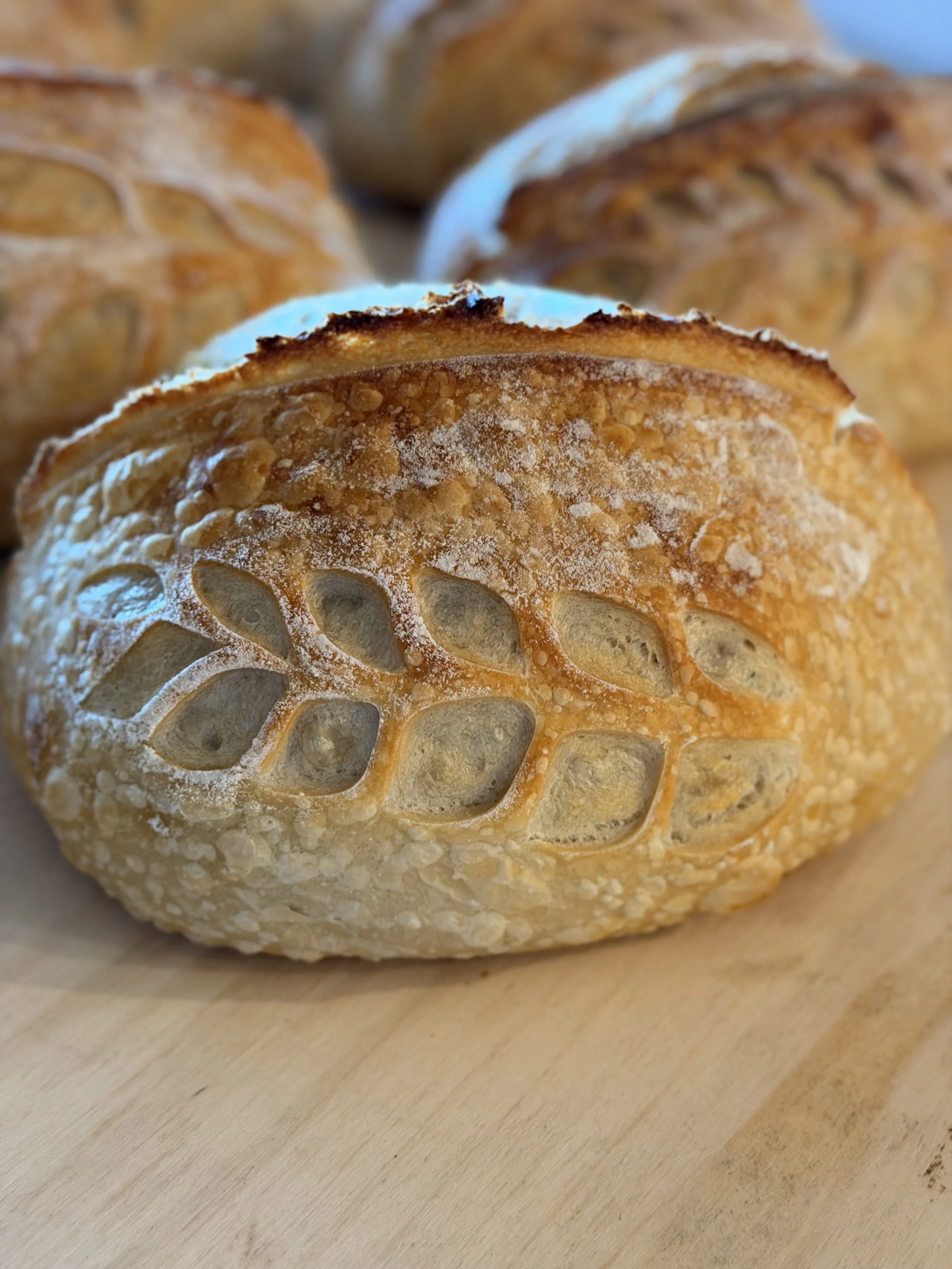
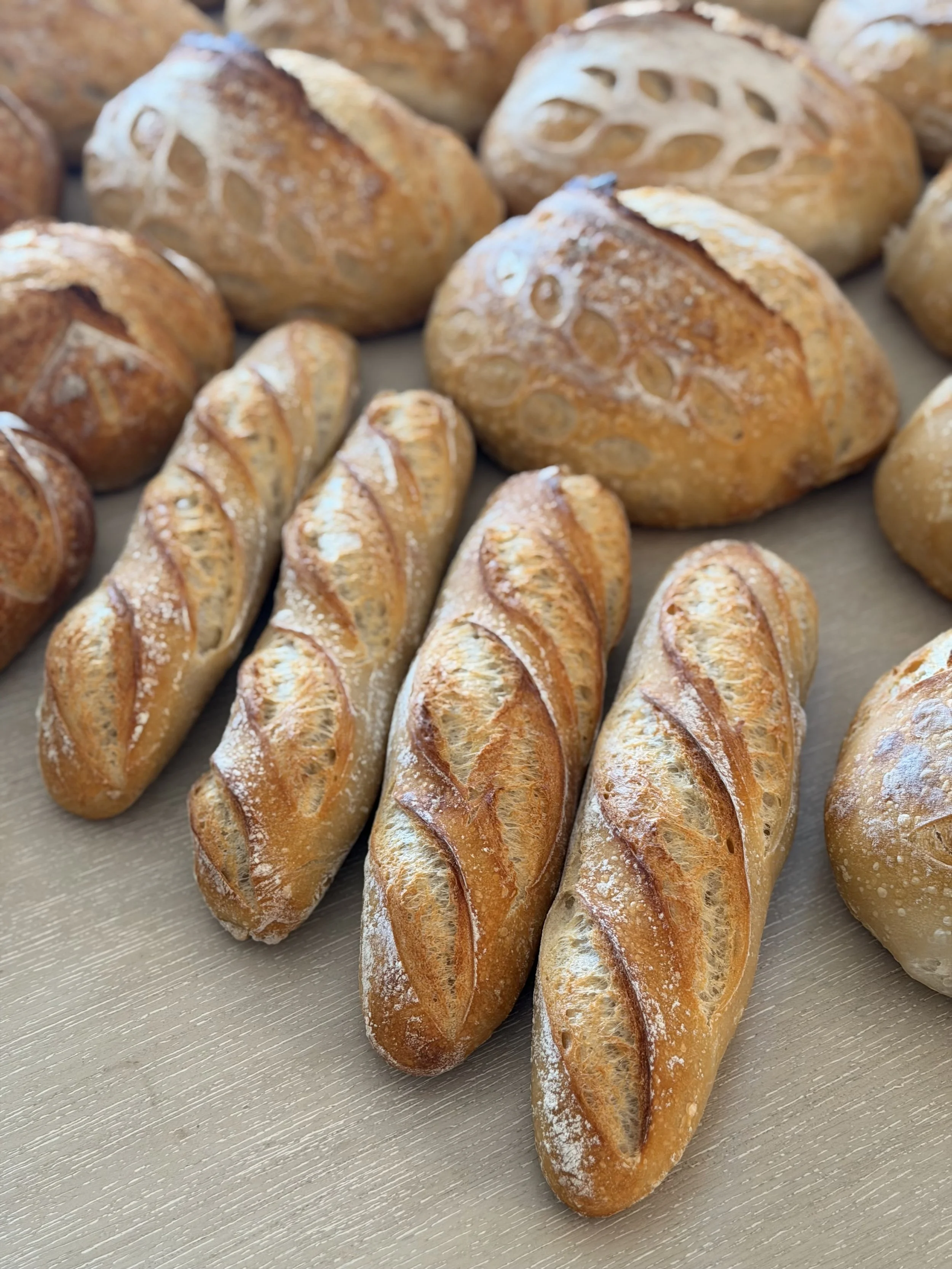
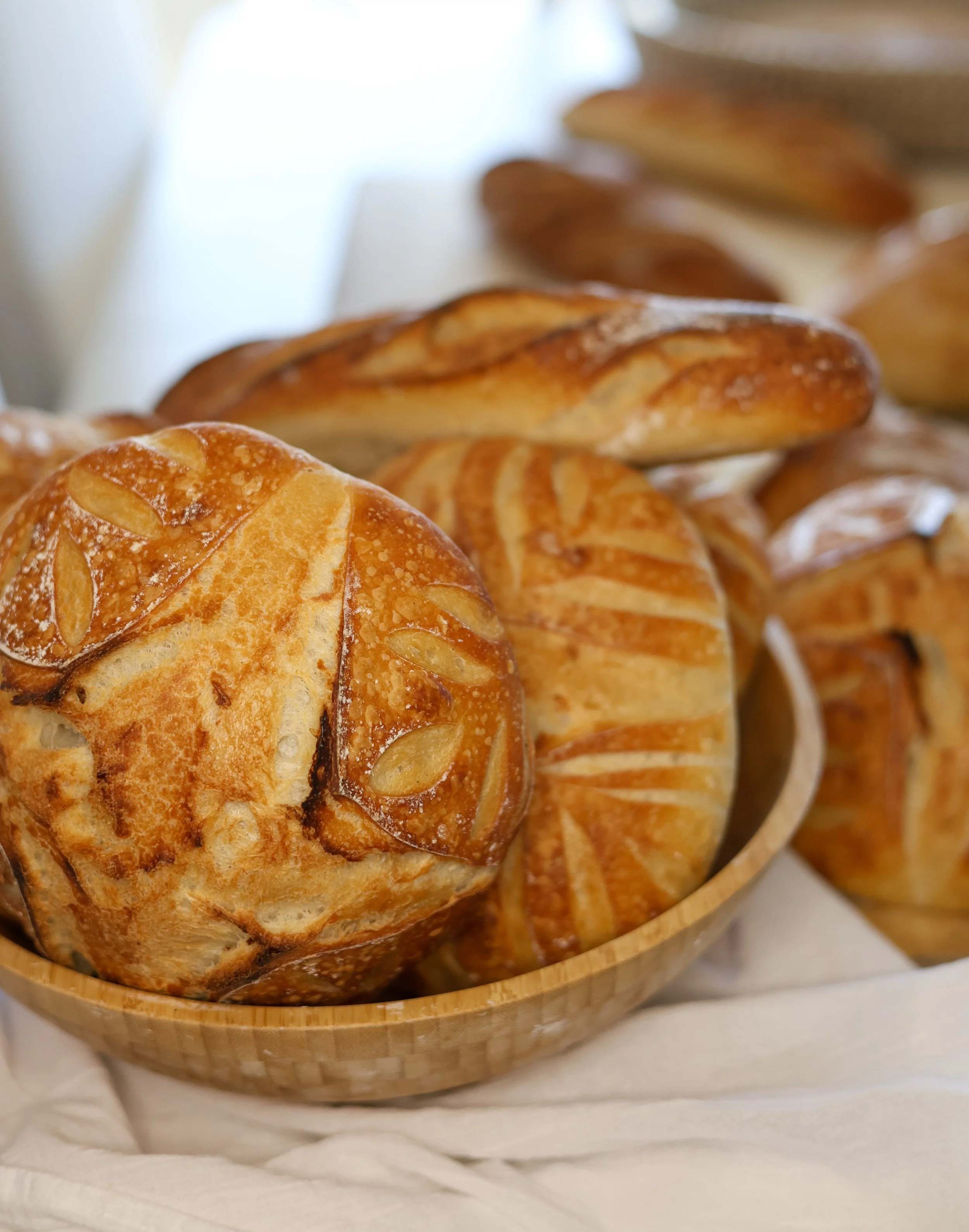
Classic Sourdough Oval Loaf
My signature loaf. Naturally leavened, long-fermented, with a crackling crust and tender crumb. Perfect for toast, sandwiches, or tearing apart at the table.
Sourdough Sandwich Loaf
All the goodness of sourdough in a softer, slice-friendly shape. Ideal for school lunches, grilled cheese, or anyone who prefers a traditional pan loaf.
Sourdough Baguettes
Small Baguette – A 15 oz beauty, just right for a meal or two.
Large Baguette – A generous 30 oz loaf, perfect for gatherings, charcuterie boards, or a big family dinner.
Crisp on the outside, chewy on the inside, just as a baguette should be.
Sourdough Bread Bowls
About 15 oz each, sturdy enough to hold hot soup or chili, soft enough to eat every last bit. These are one of my quiet favorites, food and vessel in one.
A Little Beyond the Bread
Even though sourdough is the anchor of what I do, I’ve always believed that love shows up in all kinds of bakes. So, for Opening Day, I’ll be bringing a few family favorites from my own kitchen.
Cowboy Cookies
These are more than 50 years in the making. The recipe first came to my mom, a high school counselor and girls’ athletic coach, from one of her players. I started baking them in my teens and have slowly made them my own, swapping Crisco for real butter (Danish Creamery), adding Madagascar Bourbon vanilla, and tweaking the leavening so they bake up soft and pillowy.
I’ll have them packaged in:
Half-dozen bags (6 cookies)
Dozen bags (12 cookies)
Sourdough Cinnamon Bread
A tender, lightly sweet loaf swirled with cinnamon and sugar, made with sourdough for flavor and keeping quality. Toasted with butter, it tastes like a warm hug. Sold as whole loaves.
Muffins
To keep things simple for Opening Day, I’ll start with one muffin flavor (I’ll announce the flavor as we get closer—likely something cozy and familiar).
They’ll be sold in:
2-packs, for freshness and ease.
They freeze beautifully if you want to save one for later.
A Table for More Than Transactions
While I’m grateful to be selling bread, my deepest hope is that my booth becomes more than a quick stop.
I want it to feel like:
A place to ask your sourdough questions without feeling embarrassed.
A place to swap simple recipes and discard ideas.
A place where faith, starting over, and everyday life can be talked about right alongside crust and crumb.
As always, part of what I bake will continue to flow outward, to Manna Café Ministries and to families in need, through occasional pay-what-you-can batches. The market doesn’t change that; it simply gives me a bigger table and a new way to show up for this community.
Come Say Hello
If you’ve been following along online, tasted a loaf, sent a kind message, or quietly cheered from the background, you are woven into this moment.
On May 9, and every Saturday through October 3, you’ll find me at the Clarksville Downtown Market, from 8:00 AM to 12:00 PM: flour on my apron, bread on the table, and a genuine desire to know your name.
Come by, say hello, tell me how you like to eat your sourdough, and let’s keep building this little community one loaf, one cookie, one conversation at a time.
Warmly,
Kathy
Art of The Crumb
From My Kitchen to Main Street: Joining the Clarksville Downtown Market
A Quiet Yes I Didn’t See Coming
Some moments in life feel big and loud. Others arrive quietly, almost on tiptoe, and yet they change everything.
Being accepted as a vendor at the Clarksville Downtown Market was one of those quiet, life‑shifting moments for me.
This year, more than 200 makers, growers, and small businesses applied to be part of the market. Twelve artisan vendors were chosen. Somehow, Art of The Crumb is one of them. When I read the email, I just sat there for a minute, hands over my mouth, letting it sink in.
I felt honored. Humbled. A little stunned.
For a woman who rebuilt her life loaf by loaf, this felt like one more gentle confirmation that the slow, faithful work of showing up matters.
The Heart of a Town, Under an Open Sky
If you’ve ever been downtown on a Saturday morning, you know the Clarksville Downtown Market is more than a row of tents. It’s the heartbeat of our town when the weather turns warm.
Families with strollers, kids with sticky fingers and fresh fruit, couples with coffee in hand, neighbors running into each other in front of a farmer’s booth—it’s community, in the simplest, truest sense. Fresh produce, flowers, handmade goods, local music, and conversations that start with “What are you making with that?” and end with, “Maybe I’ll try it, too.”
In 2025, the Clarksville Downtown Market was voted the #1 farmers market in all of Tennessee. That recognition didn’t come from fancy branding—it came from people. From the way this town shows up for local growers and makers, and the way local growers and makers show up for this town.
To be welcomed into that circle feels sacred to me.
Market Mornings: Where You’ll Find Me
Market season runs from May 9 through October 3, every Saturday from 8:00 AM to 12:00 PM.
I will be there every Saturday, hands a little flour‑dusted, heart wide open—with:
Small‑batch sourdough boules
Seeded and “community” loaves
Seasonal treats and pastries
And a few surprises from my counter at home
But I don’t want my booth to be just a place where you buy bread and walk away. My hope is that it becomes a little meeting point—a place to:
Swap simple sourdough tips
Share discard recipes you can actually make on a busy weeknight
Ask questions without feeling intimidated
Talk about faith, grief, starting over, or whatever is on your heart that morning
And as always, woven into the business side is the part that matters the most to me:
Continuing to donate loaves to Manna Café Ministries
Offering occasional pay‑what‑you‑can batches for families who need a little help
Keeping dignity and kindness at the center of every exchange
Bread is how I show up for people. The market is simply a bigger table.
A Life Rebuilt, One Loaf at a Time
If you’ve read my recent writings, you know this season of my life was not guaranteed.
Six years of continuous sobriety.
A heart stitched back together through faith.
Sourdough arriving in my life like a quiet form of grace.
I didn’t set out with a five‑year business plan or a clear roadmap. I set out with a jar of starter, a deep need for healing, and a desire to serve.
There were many moments I almost quit, both in life and in baking. Loaves that fell flat. Days when grief or fear felt heavier than any Dutch oven I could lift. But with each small “yes”, to God, to sobriety, to getting back up again, something in me kept rising.
So when I say I’m honored to stand under a tent downtown on Saturday mornings, I don’t mean that lightly. This isn’t just a new sales channel. For me, it is a visible sign of an invisible journey. A reminder that it is possible to start over in your sixties, to build something honest and good from the ground up, and to stand in the middle of your hometown offering what you have with open hands.
Thank You for Helping Me Get Here
If you have:
Bought a loaf from my porch or my kitchen
Sent an encouraging message when I shared a hard part of my story
Stopped by a pantry table and said “thank you”
Or simply followed along quietly, cheering from the sidelines
You are part of this.
You helped make it possible for a small, home‑based sourdough bakery to take its place at Tennessee’s #1 farmers market.
As opening day approaches, I’ll share more about weekly menus, special bakes, and a few fun “market‑only” offerings. But for now, I just want to say this:
Thank you.
Thank you for trusting me with your tables, your stories, and your Saturday mornings to come.
If you’re anywhere near Clarksville this season, I would love to meet you. Come find the Art of The Crumb tent at the Clarksville Downtown Market any Saturday from May 9 to October 3, between 8:00 AM and 12:00 PM.
Tell me your name. Tell me where you’re from. Tell me your favorite way to eat sourdough.
Let’s keep feeding each other—with bread, with dignity, with kindness, and with a little yeast of hope.
Warmly,
Kathy
Art of The Crumb

Starting Over at Sixty-Four: Why It’s Never Too Late to Rise
It’s Not Too Late to Begin Again
If you had told me years ago that in my sixties I would be starting a sourdough bakery, sharing my story online, and celebrating over six years of continuous sobriety, I’m not sure I would have believed you.
By the time we reach this season of life, the world often expects us to be winding down, settling in, and staying put. But my story has been the opposite. My sixties have been a season of starting over, again and again, with more honesty, courage, and faith than I ever had in my twenties or thirties.
This chapter wasn't easy, but it has been honest. And that has made all the difference.
When the Life You Longed For No Longer Fits
There was a time when I was living the life I thought I always wanted: married to a Wall Street partner, raising four children in picturesque Greenwich, CT, tending to a home and a family that I loved dearly. For many years, that life fit. It was real, and it mattered.
But life shifted. My 27-year marriage ended. My children grew up. The house got quieter. The identity I had wrapped around being a wife and a full-time mother began to unravel. I outgrew the life I once longed for.
That realization was painful and disorienting. But it was also the beginning of something new. Before I could say “yes” to the life I’m living now, I had to be willing to admit that the old one no longer fit, even if I didn’t yet know what would come next.
The Hardest Part Isn’t Starting
People often ask me: “How did you start over?” The truth is, the hardest part wasn’t starting. The hardest part was deciding I wasn’t going back, even when I felt wildly uncomfortable.
That has been true in my sobriety, in my faith, and in sourdough.
It didn’t work the first, second, or third time I tried to change my life. I failed… a lot. I stumbled, I doubted, and more than once I found myself standing in the middle of my own mess, wondering if it would just be easier to return to what was familiar, even if it was slowly breaking me.
I didn’t feel brave. I felt uncomfortable.
But discomfort, I’ve learned, is often the doorway to transformation. The most uncomfortable decisions I made in these past years, getting sober, telling the truth, sharing my story, starting a business in my sixties, have paid me the most, not in money, but in peace, purpose, and joy.
Sobriety: Clearing the Counter to Make Space
On November 1, 2025, I celebrated six years of continuous sobriety. Today, it’s six years and counting.
Sobriety was my way of clearing the counter of my life. I had to own my behavior. I had to make amends. I had to look honestly at the pain I’d caused and the pain I’d tried to numb. I had to surrender to my Higher Power, whom I call God, and trust that He could make something new from the broken pieces.
That daily practice of honesty and surrender became the foundation beneath everything else. Sobriety taught me to show up when it was hard, to live in the light instead of hiding in the shadows, and to believe that my story wasn’t over yet.
Without that foundation, I don’t believe sourdough—or Art of The Crumb—would have ever taken root.
Sourdough: Letting the New Life Rise
I often say I didn’t find sourdough; sourdough found me.
In a season of grief, transition, and quiet rebuilding, I started mixing flour and water. I fed a starter. I failed at more loaves than I can count. But in that simple, living process, something in me began to heal.
Sourdough baking asks for the same things recovery does: patience, presence, and faith in what you can’t fully see. You mix, you fold, you wait. You trust that transformation is happening in the quiet, invisible spaces.
Somewhere between the folds and the long, slow rises, I realized this wasn’t just about bread. Sourdough was a way of starting over—deliberately, gently, and with my whole heart engaged. It became a way to serve others, to nourish my community, and to pour all the lessons of my life into something I could share.
Faith: The Fermentation Beneath It All
My faith has always been a thread in my story, but in this season, it has become the whole fabric.
One day, sitting in traffic and crying out, “God, what do you want of me?” I looked up and saw a sign for Manna Café Ministries. It felt like a divine nudge, a reminder that bread, faith, and service have always been intertwined.
Since then, my baking and my belief have grown together. Every loaf I bake for my neighbors, my customers, or for Manna Café is an extension of that whispered prayer: Use me. Let my small offering matter to someone today.
Faith is the fermentation beneath it all; the unseen work that gives rise to everything else.
To The One Wondering If It’s Too Late
If you’re reading this and wondering if it’s too late for you, too late to change, too late to start, too late to begin again. I want you to hear this clearly:
It is not too late.
You are not stuck with the life you outgrew. You are allowed to clear the counter. You are allowed to tell the truth. You are allowed to begin again in your fifties, your sixties, your seventies, or beyond.
Starting over might not look flashy. It might look like getting honest with yourself. It might look like asking for help. It might look like making amends, learning something new, or standing in your kitchen with flour on your hands, trying again after another failed attempt.
This chapter of my life hasn't been easy, but it has been honest. And that honesty has led me to more freedom, more connection, and more joy than I ever expected to find at this age.
So if you’re asking, “How do I start over?” here’s my advice from this rookie in her sixties:
Start small. Tell the truth. Lean into your faith. Find the thing that invites you into presence and discomfort and quiet joy—your own version of sourdough. And then, one gentle step at a time, let your new life rise.
Warmly,
Kathy
Art of The Crumb
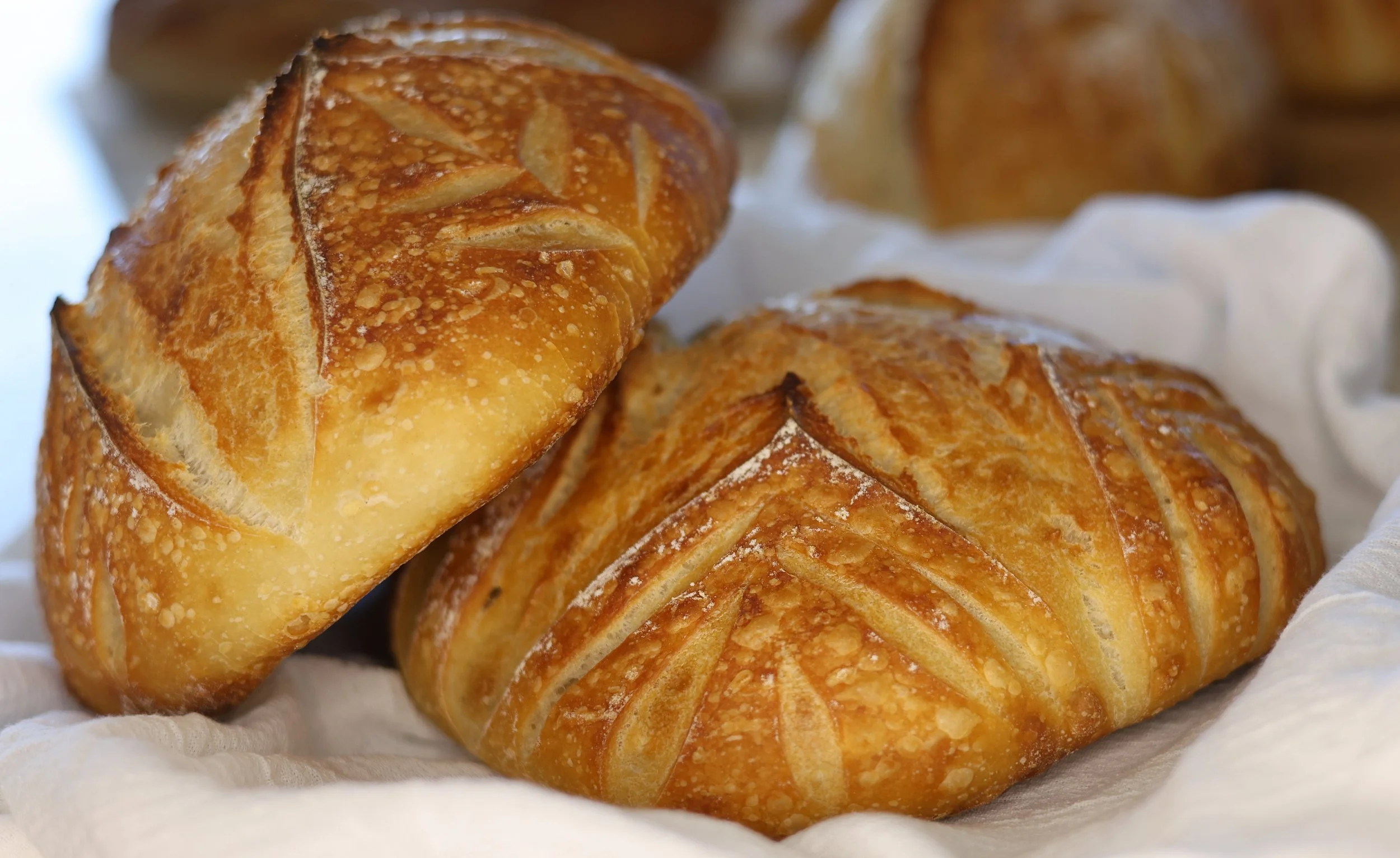
From Sobriety to Sourdough: Building a New Foundation
A Part of the Story Left Untold
If you’ve been following along, you’ve heard about the flour, the water, and the wild yeast. You’ve heard about the loaves that failed and the ones that fed my neighbors. But there is a vital ingredient in my story I haven’t shared here before. It isn’t about hydration levels or the perfect ear on a loaf of bread. But without it, Art of The Crumb likely wouldn’t exist.
On November 1, 2025, I celebrated six years of continuous sobriety.
When people ask me about my sourdough journey, I usually talk about the slow fermentation or the joy of feeding people. But the truth is, the discipline, the humility, and the clarity required to bake bread didn’t start in the kitchen. They started the day I decided to stop running and finally surrendered.
Clearing the Counter: Owning My Behavior
In baking, before you can shape anything beautiful, you have to clear the counter. You have to remove the clutter to make space for the work. Sobriety was my way of clearing the counter of my life.
It has been a little over six years since I made the decision to take a hard look at the mess I had made. Recovery asked me to own my behavior, to stop blaming circumstances, and to stand in the truth of who I had been. It was uncomfortable—painfully so. But just like a sourdough starter cannot thrive in a contaminated jar, my spirit could not grow until I got honest. I had to scrub the corners of my life clean so that something new could actually live there.
The Art of Amends and Folding
One of the most critical parts of sourdough is the "fold,” taking the dough, stretching it to its limit, and folding it back over itself to build strength.
Recovery taught me a similar motion: the art of making amends. I had to go back to the people I had hurt, stretch myself past my pride, and try to repair the tears in my relationships. It was a process of gentle, repeated strengthening. I learned that you don't fix everything at once. You show up, you own your part, and you fold. You do it again the next day.
Over time, just like the dough transforms from a shaggy mess into a smooth, strong ball, my life began to hold its shape again. I learned that repair is possible, but only if you are willing to do the work.
Surrender and The Higher Power
There comes a moment in baking where you have done all you can do. You have mixed, you have folded, you have shaped. And then... you have to let go. You have to trust the heat of the oven and the wild yeast to do the rest.
This is where my faith steps in. My sobriety is not built on willpower; it is built on a reliance on my Higher Power, whom I call God.
In my drinking days, I tried to control everything to manage my pain. Surrendering to God was terrifying because it meant admitting I wasn't the one in charge. But in that surrender, I found peace. I learned to hand over my grief, my fear, and my future to Him. Now, when I close the oven door, it is a small, daily act of faith: a reminder that the transformation happens not by my power, but by His grace.
Vulnerability is the Secret Ingredient
For a long time, I thought strength meant hiding my cracks. Sobriety taught me that strength is actually showing them.
When I was drinking, I was hiding. Now, I am fully here. Because I am sober, I can be vulnerable. I can admit when a loaf fails, and I can admit when I am struggling. This vulnerability allows me to pour genuine love into these loaves. Art of The Crumb is about connection, and I realized that I couldn’t truly connect with others until I had reconnected with myself and God.
To The One Who Needs to Hear This
I share this not for applause, but because I know I am not alone. Maybe you are in the thick of a struggle right now. Maybe you are staring at a mess and wondering if it can ever be made right.
I am living proof that it can. You can clear the counter. You can make amends. You can surrender to a God who loves you. And you might just find that the things you learn in the hardest, most barren seasons of your life become the ingredients for your most beautiful creations later on.
It is an honor to bake for you—with hands that are steady, a conscience that is clear, and a heart that is finally free.
Warmly,
Kathy
Art of The Crumb
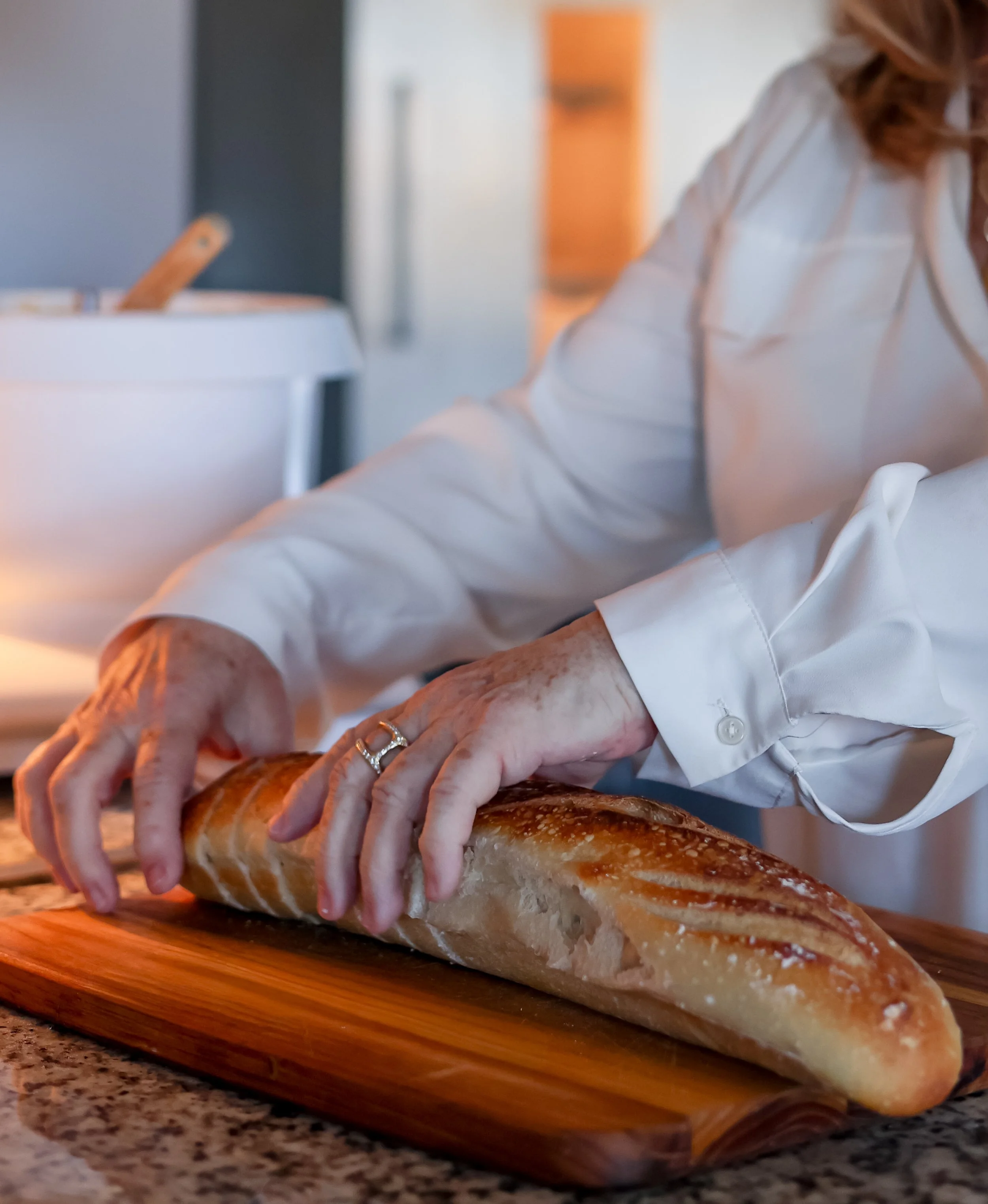
Advice From a Rookie (Who’s Been Here a Year)
It Starts With a Question
One of the most heartwarming things that has come from bringing Art of The Crumb into the world is the conversation it sparks. Friends, old and new, often reach out with questions that go beyond just flour and water: "How did you start making sourdough bread?" "Is it hard?" "Did you ever want to quit?" "I want to do that too, how do I start?"
These questions always make me smile, because while they sound like they’re about baking, I know they’re truly about something deeper. They’re about seeking transformation, about finding something steady and joyful in a world that can often feel anything but.
So, from one rookie to another—because in this beautiful journey, I’m always learning—here's some truth I’ve discovered.
The Uncomfortable Truth No One Talks About
When people see a beautiful loaf, or hear about a new venture, they often see the "after." They see the success, the joy, the loaves baked and shared. But no one talks about the moment you almost quit, right before everything changed.
I can tell you, I had those moments. More than once. It didn't work the first, second, or third time I tried. I failed... a lot. There were deflated loaves, gummy crumbs, and more than one starter that seemed utterly lifeless despite my best efforts. In those early days, standing over a stubbornly flat disc of dough, the thought of throwing in the towel was very real. It felt easier to just go back to what was comfortable, to close the chapter on this new, messy experiment.
Outgrowing, Not Just Growing
Looking back, I realize that the hardest part wasn't starting; it was deciding I wasn't going back, even if I got uncomfortable. And believe me, I got uncomfortable.
There was a profound shift in my life when I realized, quite suddenly, that I had outgrown the life I once longed for. The familiar patterns, the expectations, the comfortable routines, they no longer fit. That realization spurred me on, even when every fiber of my being wanted to retreat. The most uncomfortable decision I made last year also paid me the most, not in dollars, but in peace and purpose.
I didn't feel brave in those moments. I felt profoundly uncomfortable. But discomfort, I've learned, is often the fertile ground where true growth begins. It's the stretch, the pull, the necessary tension before a new shape emerges.
Sourdough Didn't Just Find Me, It Shaped Me
As I shared in my first post, I didn't find sourdough, sourdough found me. It came into my life at a time when I needed something tangible to tend, something that asked for patience and presence.
But here’s the secret, the thing I think my friends are really seeing: the transformation isn't just in the bread. It’s in me. This journey, especially with Art of The Crumb, has been my process of leaning into my faith and God, and actively pursuing something that brings me immense joy. It’s a joy that overflows, a comfort that can be shared.
This chapter wasn't easy, but it was honest. It was about embracing the messiness of learning, the vulnerability of sharing, and the profound satisfaction of tending to something alive—whether it’s a bubbling starter or a calling in your heart.
So, if you’re asking "how do I start?", my advice from this rookie is this: Find your sourdough. Find the thing that pulls you into discomfort, that demands your presence, that makes you feel both challenged and deeply alive. Maybe it’s not baking. Maybe it's a new skill, a new path, a new way of connecting. Whatever it is, lean into it. Trust that the process, the journey itself, is where your true transformation lies. And know that you don’t have to feel brave to start; you just have to be willing to get a little uncomfortable.
Warmly,
Kathy
Art of The Crumb
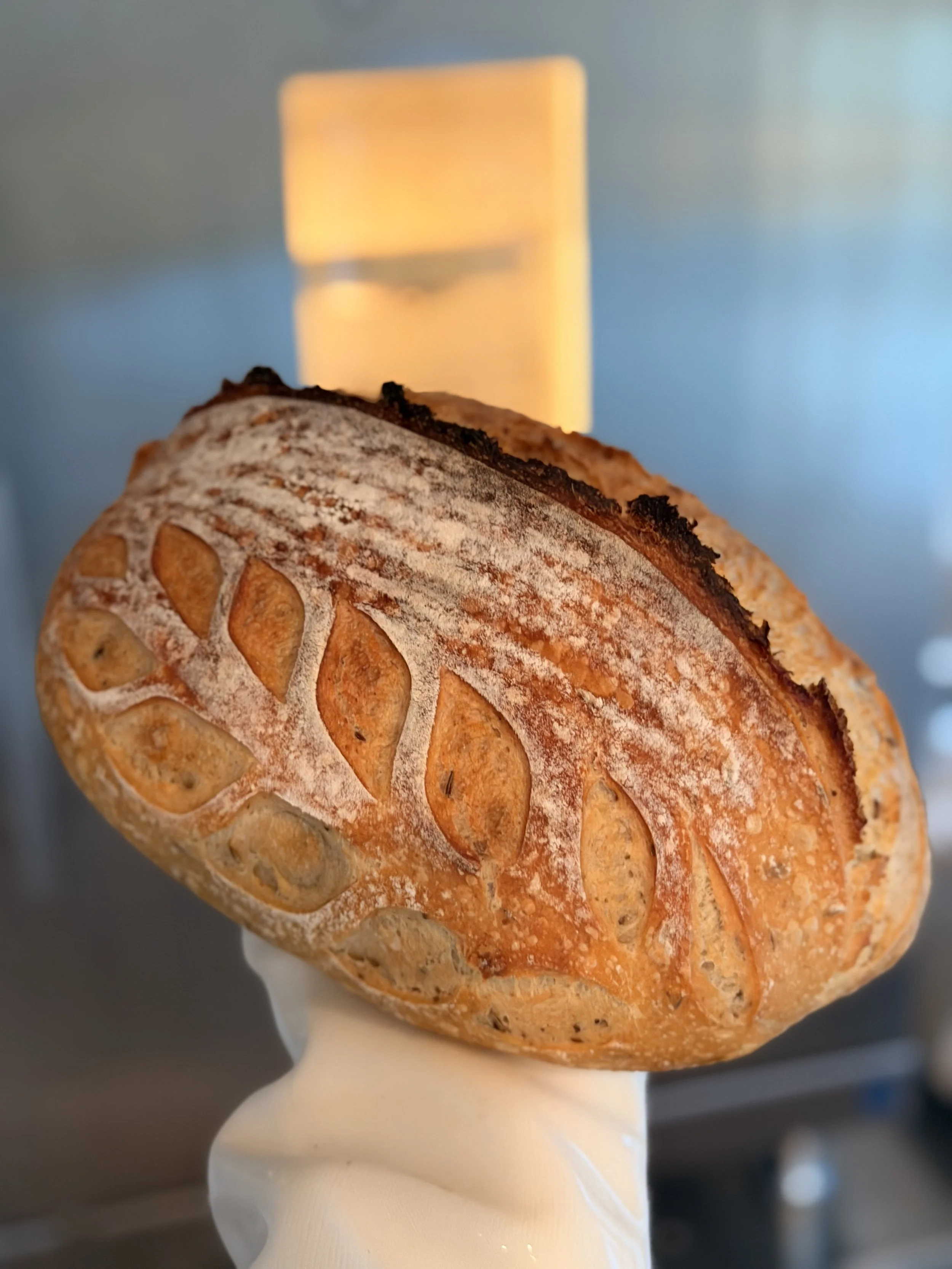
Fermented Faith:How Sourdough Brought Me Back to God
The Significance of Bread
Bread is often referred to as the staff of life, a staple that transcends cultures and generations. It carries profound significance throughout scripture, representing sustenance, community, and divine provision. In the Bible, bread is woven into the fabric of faith, from the manna God provided to the Israelites in the wilderness to Jesus identifying Himself as the "Bread of Life," symbolizing unwavering nourishment for the soul. Each loaf tells a story, connecting us to tradition, memory, and the essence of shared humanity.
My journey into sourdough and the rekindling of my faith began during a moment of deep desperation. One day, while stopped in traffic, I cried out to God, asking for guidance. "What do you want of me?" I pleaded, feeling lost and uncertain. Just then, I glanced up and noticed a sign that read, "Manna Cafe Ministries." This community outreach serves those in need by providing a food pantry, healthcare services, and community dinners.
This moment felt like a divine nudge, reaffirming the connection between bread, faith, and service. I realized that my budding passion for sourdough could be a vehicle for compassion and community engagement. Inspired by that sign, I began to share my loaves with Manna Cafe, offering nourishment not only in the form of bread but also as a gesture of love and connection. As I baked, I found purpose in helping others, and my sourdough journey became intertwined with the mission to support my community.
A Journey of Healing
For me, the act of making sourdough bread has become a deeply personal journey of healing and transformation. I found solace in the rhythm of mixing, kneading, and waiting—each step mirroring my own process of grappling with grief and seeking grace. Just as ancient grains come together to create something beautiful and sustaining, I discovered that my trials and tribulations could also be woven into a tapestry of healing.
Navigating Grief
Grief can arrive without warning, infiltrating the corners of our hearts and transforming our everyday lives into a series of heavy moments. At times, it has felt like a tidal wave crashing over me, making it difficult to navigate the waters of life. In those moments, I have often found myself by my kitchen counter, the soft glow of the light illuminating my baking supplies, surrendering my heartache to God. I cried over the bowl of dough, blending my tears with the flour and water, creating a mixture infused with raw vulnerability and emotion.
One day, while packing for a move, I stumbled upon a hidden box filled with cards and letters from loved ones, reminding me of the connections I once cherished. Each message proclaimed love and gratitude, reaffirming my role in nurturing relationships. The memories flooded over me with bittersweet feelings, leading me to question my past. But rather than letting that pain consume me, I turned to the sacred act of bread-making for clarity.
Embracing the Rhythm of Baking
As the days turned into weeks, I embraced the rhythm of baking, which transcended mere tradition. Nurturing my sourdough starter became a meditation, drawing me closer to the essence of creation, the transformation of simple ingredients into something beautiful and nourishing. It mirrored my longing for personal transformation.
One morning, as I mixed the ingredients, I felt a wave of gratitude wash over me. I remembered the verses from scripture that spoke of God as the Bread of Life; a nourishing presence in times of need. I whispered thanks for the journey I was on, the lessons I was learning, and the faith that was beginning to blossom within me.
A Spiritual Awakening
The process of fermentation became a metaphor for my spiritual awakening. Just as the wild yeast and bacteria danced together in my jar, forming a living culture, I realized my faith was also alive and evolving, gradually bubbling to the surface as I worked through my fears and doubts. Much like the dough needing time to rise, I too needed time to become who I was meant to be. In this nurturing, I felt God’s presence guiding me, reminding me that faith is not always about certainty; it’s about trusting the process.
Recognizing God's Presence
Throughout my sourdough journey, I began to recognize how God reveals Himself in the simplest of moments. As I shared my bread and exchanged stories with friends and neighbors, I felt the genuine warmth of fellowship. It became clear to me that community is a divine gift; when we share bread, we multiply love.
This realization was further validated when my neighbor underwent knee surgery and could no longer cook for her family. I frequently brought them hot meals, and one day, I included a loaf of my sourdough. Later, she texted me: "Did you know I have a gluten sensitivity? I can only eat sourdough bread, and store-bought options bother my stomach. I didn’t experience that with your bread. Thank you!" In that moment, I felt certain that God was guiding my path and orchestrating these meaningful connections.
Embracing Imperfections
One powerful lesson I learned was about imperfections. I once baked a loaf that didn’t rise as expected; it was dense and heavy. I almost tossed it aside in disappointment, but then remembered how much care and love I had put into that loaf. It dawned on me that my faith, much like that bread, doesn’t have to be perfect to be valuable. God doesn’t require flawless faith; He seeks our hearts just as they are, with all their lumps and shortcomings.
Connection Through Creation
As I stood before the oven, watching the crust brown and the steam escape, I felt a profound connection to the Creator and to my community. Each loaf became a prayer: a tangible expression of my hopes, dreams, and love. When I shared my bread with friends and neighbors, I was offering a piece of my soul, inviting them into the journey I was experiencing.
Baking sourdough has not only nurtured my spirit but also fostered a sense of belonging and connection within my community. Whether it was a warm loaf for a neighbor in need or a gathering where we broke bread together, I discovered the beauty of sharing—not just food, but also stories and moments that bind us. In those exchanges, I felt the power of compassion and support, reinforcing the idea that in sharing our creations, we uplift each other in ways that nourish both body and soul.
Warmly,
Kathy
Art of The Crumb